Hy3's evaluation numbers are internal, and its reasoning mode defaults to off
Hy3 (295B A21B), a leading reasoning and agent model in its size, with great cost efficiency.
At a glance
- What is it?
- Tencent's 295B mixture-of-agents model with 21B active parameters, published in BF16 and FP8 across four model hubs. The specification is precise, the serving recipe is one line, and every chart on the page is an empty paragraph.
- Who is it for?
- The specification table here is more complete than most model cards: layer counts, head geometry, expert count and top-k, context length and vocabulary size are all published, which means a serving engineer can estimate memory before downloading anything. Two things are missing that matter as much.
- Can I use it commercially?
- Check first. The repository uses a licence we do not classify automatically, so read its LICENSE file before any commercial use.
- Is it still maintained?
- Yes. The repository last received commits 121 days ago.
- What is it written in?
- Mainly Python, according to GitHub's language statistics.
Answers come from the project's GitHub data, last synced on November 15, 2026, and from our analysis. They are not legal advice.
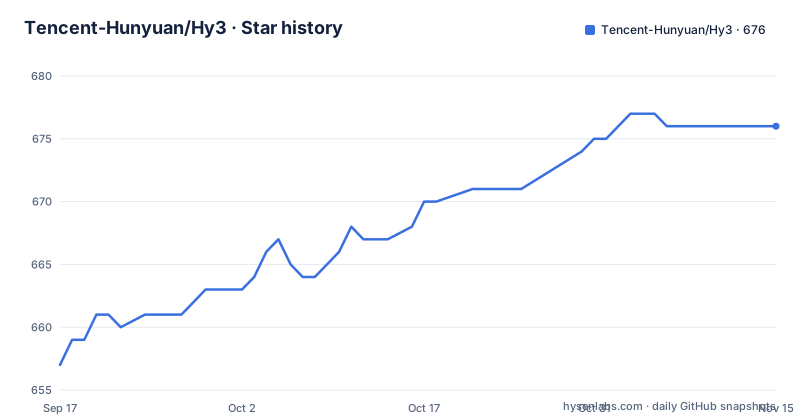
Star history
- Tencent-Hunyuan/Hy3676 ★ · +19
| Repository | 2026-09-17 | 2026-11-15 |
|---|---|---|
| Tencent-Hunyuan/Hy3 | 657 | 676 |
19 Stars in the last 59 days, measured from the daily GitHub snapshot. Compare with other projects
Editorial analysis
Three before-and-after error rates with no denominators
The reliability section reports three improvements, each as a pair of percentages. The hallucination rate dropped from 12.5 percent to 5.4 percent. Commonsense error rates fell from 25.4 percent to 12.7 percent. The multi-turn issue rate dropped from 17.4 percent to 7.9 percent. Every one of them is attributed to internal evaluation or internal comprehensive tests based on real-world scenarios, and not one states how many items were judged, who judged them, what counted as an error, or what the model was compared against. The stated principle behind the first pair is worth keeping, answering when grounded and saying so when evidence is missing rather than conflating sources or inventing data, which is the behaviour the rates claim to measure.
A 270-expert blind study against exactly one model
The evaluation the page actually offers is a private one, and it says so first: public benchmark scores do not tell the full story. What follows is a blind evaluation with 270 experts, using tasks from the experts' own work, in which Hy3 scored 2.67 out of 4 and GLM-5.1 scored 2.51 out of 4. The gap is 0.16 on a four-point scale with 270 raters and no margin of error given. The page says the advantage was most substantial in frontend development, data and storage, and CI/CD tasks, without giving the per-domain numbers or the domain sizes. Separately, on SWE-Bench Verified, the claim is that accuracy variance across agent scaffoldings such as CodeBuddy, Cline and KiloCode stays within 4 percent, which is a claim about harness independence rather than about absolute skill, and again no absolute score appears.
Every chart on the page is an empty paragraph
The framework has a structure, and it is mostly where evidence would go. After the agent capability claims there is an empty centred paragraph where the chart belongs. The Benchmark Appendix heading is followed by another empty centred paragraph and then nothing at all, so the section the table of contents promises contains no tables. The same is true of the block of links near the top: five anchors with nothing between them, pointing at the licence anchor and four model hosts, and a centred paragraph with a line break inside it. The top-level directory listing is small by design, an assets folder, a finetuning folder, a reinforcement learning folder, a gitignore, the licence and two readmes, which is consistent with a repository that is documentation plus training material.
The reasoning model defaults to not reasoning
The quickstart is one client call, and the interesting part is a comment:
    # reasoning_effort: "no_think" (default, direct response), "low", "high" (deep chain-of-thought)
    extra_body={"chat_template_kwargs": {"reasoning_effort": "no_think"}},
So there are three settings, passed through the chat template rather than through a separate model or endpoint, and the default is the one that produces a direct response with no chain of thought. The page repeats it in prose, telling you to use high for complex tasks such as math, coding and reasoning, and no_think for direct answers, and it recommends temperature 0.9 with top_p 1.0. The practical consequence for an integrator is that any client that omits the extra body gets a non-thinking model, so the behaviour people attribute to a reasoning model depends on a keyword being threaded through the serving template.
Eight GPUs of one memory-optimized SKU, and an API key spelled EMPTY
The deployment section is short. With 295 billion parameters, serving on eight GPUs is the recommendation, using H20-3e or other GPUs with larger memory capacity. No memory figure, tensor parallel setting, or estimate of what a 256K context costs in key and value cache accompanies that. The call itself goes to a local server with the key written as the literal string `EMPTY`, and the page points at recipes published outside this repository for both vLLM and SGLang, which is where the actual launch flags live. A separate section list also promises quickstart, deployment for two engines, finetuning, reinforcement learning post-training, quantization, licence and contact, and the repository carries matching directories for the two training halves.
The head count and the hidden size do not multiply out
The specification table is worth reading with a calculator. Sixty-four attention heads with a head dimension of 128 gives 8192, while the listed hidden size is 4096, exactly half. That can be an unusual projection arrangement rather than an error, but the page does not explain it, and it is the kind of detail that determines whether a serving engine's memory estimate is right. The rest of the table is self-consistent and specific: 80 layers excluding the multi-token prediction layer, one such layer carrying 3.8 billion parameters, 192 experts with the top 8 activated out of a 295 billion total and 21 billion active, a vocabulary of 120832, and BF16 as the supported precision, with a separate FP8 quantised instruct model published alongside.
No releases, no inference code, and no licence statement on the page
Three gaps close out the page. The repository publishes no tagged releases at all, so there is no version of the code to pin, and since the repository contains no inference code, the artefact anyone versions is the weights on the model hosts, published in two precisions across four of them. The licence is the second gap: a licence file sits at the root and the table of contents ends with a licence section, while the repository's licence field reports nothing recognised and no licence text is visible on the page. The third is temporal: the branch was last pushed to on 17 July 2026, and the page describes a model released after a preview in late April whose weights went out to four hosts at once.
Editorial conclusion
The specification table here is more complete than most model cards: layer counts, head geometry, expert count and top-k, context length and vocabulary size are all published, which means a serving engineer can estimate memory before downloading anything. Two things are missing that matter as much. There is no public benchmark table on the page, because the appendix section is empty and the evaluation actually presented is an internal blind study with 270 experts and one named comparison model, alongside three before-and-after error rates with no denominators at all. And the model described as a reasoning model defaults to not reasoning, with the thinking mode selected per request through a chat template keyword, so a client that does not pass it gets direct answers. Before deploying, read the vLLM or SGLang recipe linked from the page rather than the quickstart, budget for eight large-memory GPUs, and decide how you will supply your own credentials, because the sample call sends the literal string EMPTY and the security of that server is entirely up to how you front it. It suits a team evaluating a hosted open-weights MoE. It does not suit anyone who needs published benchmark numbers to make the decision.
Frequently asked questions
What is Tencent Hy3?
A 295 billion parameter mixture-of-experts model with 21 billion activated parameters, plus a 3.8 billion parameter multi-token prediction layer. It has 80 layers plus that prediction layer, 192 experts with the top 8 activated, 64 attention heads under grouped query attention with 8 key-value heads and head dimension 128, hidden size 4096, intermediate size 13312, a 256K context and a vocabulary of 120832. BF16 and FP8 weights are both published.
How do you serve Hy3?
With vLLM or SGLang, using the recipes those projects publish for Hy3 rather than commands in this repository. The page recommends eight GPUs, of the H20-3e kind or other GPUs with larger memory, and no memory figure or parallelism setting is given. Once a server is up, the quickstart calls it through an OpenAI-compatible client at a local address with the key written as the string EMPTY.
How do you turn Hy3 reasoning on?
Pass reasoning_effort through the chat template in the request body, with three documented values: no_think for a direct response, which is the default, low, and high for deep chain-of-thought. The page recommends temperature 0.9 and top_p 1.0, and notes that a client omitting the setting gets the non-thinking behaviour.
How was Hy3 evaluated?
The page presents a blind evaluation with 270 experts using tasks from their own work, where Hy3 scored 2.67 out of 4 and GLM-5.1 scored 2.51, and it says public benchmark scores do not tell the full story. It also reports internal before-and-after rates: hallucination 12.5 to 5.4 percent, commonsense errors 25.4 to 12.7 percent, and multi-turn issues 17.4 to 7.9 percent, none with a stated sample size.
Official sources
Add this badge to your README
If you maintain this project, the badge below links readers to this analysis and shows its maintenance status from the daily GitHub snapshot. Paste the markdown into your README; add ?metric=license or ?metric=stars to the image URL for a different field.

[](https://hysenlabs.com/projects/tencent-hunyuan-hy3)Star history chart for your README
[](https://hysenlabs.com/projects/tencent-hunyuan-hy3)Was this useful?