WeSmartFlow: five million credits for a star, and a miniprogram directory that is not there
Every question can open a new path. WeSmartFlow turns learning into conversation, exploration, stories, and hands-on discovery.
At a glance
- What is it?
- An agent-native adaptive learning framework from Tencent. ReAct tutoring with eight tools, a personal knowledge graph with spaced repetition, six interactive worlds, and a course generator that splits one topic across six agents. The developer surface is unusually well specified for a project this young, and the incentive on the front page is unusually large.
- Who is it for?
- WeSmartFlow is a serious engineering layout wrapped in a product that is still in a promotion phase, and those two facts sit awkwardly together. The layering, the three theme contracts and the honest note that passing the checks does not make a good lesson are all signs of a project run by people who have shipped before.
- Can I use it commercially?
- Check first. The repository uses a licence we do not classify automatically, so read its LICENSE file before any commercial use.
- Is it still maintained?
- Yes. The repository last received commits 19 days ago.
- What is it written in?
- Mainly Python, according to GitHub's language statistics.
Answers come from the project's GitHub data, last synced on November 15, 2026, and from our analysis. They are not legal advice.
Star history
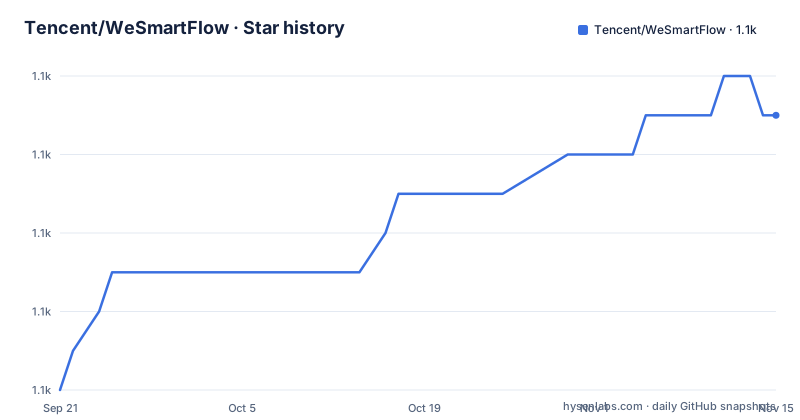
- Tencent/WeSmartFlow1,063 ★ · +7
| Repository | 2026-09-21 | 2026-11-15 |
|---|---|---|
| Tencent/WeSmartFlow | 1.1k | 1.1k |
7 Stars in the last 55 days, measured from the daily GitHub snapshot. Compare with other projects
Editorial analysis
Five million credits for a star, and five million more for verifying it
The updates log leads with a free trial plan, and the terms are specific.
Registering with a GitHub or email account grants five million credits. Starring the repository and completing verification with the same GitHub account grants another five million, for ten million in total, and each user account and each GitHub account may claim the star reward once. There is then a monthly top-up of up to one million credits, which continues only until the balance reaches five million, after which nothing is added.
That structure is worth reading carefully. The refill has a floor rather than an allowance, so an active user tops up to five million and then stops, and an inactive user's balance decays without replacement. The reward is the larger half of the grant, and it is tied to a public GitHub action plus an OAuth verification step.
The document also notes that usable time varies with the model chosen, learning frequency and the length of each piece of content, so the credit figure is not convertible into a fixed amount of study.
Three contracts, and a theme can be any stack at all
Exploration themes are the part of the system built for outside contributors, and the coupling is kept to three stable contracts. The content contract is the file examples/explore-catalog.json. The build contract is a command named build:wesmartflow plus agreed environment variables. The service contract is a same-origin static path with an optional relative /api path.
Everything else is free. A theme can be built with Vue, React, Svelte, Canvas, Three.js or plain HTML, and the framing is that a theme can be a full course, a small experiment, an interactive story or a new teaching mechanic.
Joining is four steps: create a standalone app under examples/, provide the build command, register the category, entry point and description in the catalog, and run the directory validation and the build check:
cd frontend
npm run validate:examples
npm run build:examples -- --only your-topic-id
The --only flag is what makes this workable for an author with one theme, since the alternative is building all of them.
Two of the six worlds need their own npm install
The examples directory holds six applications: Magic_English_Town, English_clip_mate, chemastry_lab, dive_into_math_garden, live_science and living_history, alongside the catalog file, a build script, a catalog script, a validation script and a README.
The dependency install step only covers two of them:
npm --prefix examples/Magic_English_Town install
npm --prefix examples/chemastry_lab install
The comment above those two lines says that two explore themes currently use Vite and each needs a one-time dependency install. So a person who cloned the repository, created a new theme, and followed the four documented steps can still hit a failure that the only remedy is a per-directory install nobody mentioned in the contract.
The directory name also carries a typo, chemastry rather than chemistry, which a contributor has to reproduce to find the right folder.
The six shipped worlds are described individually: an English town with a lost puppy and a moon festival for learners aged eight to sixteen, a maths garden with blocks and three-view drawings, a companion for TV drama with real dialogue, a chemistry lab where the agent judges the outcome, a place where you talk to scientists and repeat classic experiments, and a history world that can argue and be questioned.
Node 24, or Node 25 inside the Conda environment
The environment section gives one recommended path and one fallback, and they do not ask for the same versions.
The recommended path is the Conda environment shipped in the repository, which prepares Python, Node.js and the backend dependencies. Generating the immersive PDF courseware also needs XeLaTeX, latexmk and a specific Beamer theme.
Without Conda, the requirement is Python 3.10 or newer and Node.js 24 or newer, with a note that the Conda environment currently uses Node.js 25, and backend/requirements.txt has to be installed by hand.
The clone step needs Git LFS, because the repository tracks PNG and MP4 assets through a rules file, and git lfs pull fetches the real content after the clone.
The browser engine is a hard requirement too, not an extra. python -m playwright install chromium is needed both for the EduViz browser check and for the screenshots the WeChat assistant sends as images.
Three environment variables and any OpenAI-compatible endpoint
The model configuration is three keys in a file copied from a template:
cp backend/.env.example .envand then LLM_API_KEY, LLM_BASE_URL pointing at an endpoint ending in /v1, and LLM_MODEL. The documentation names OpenAI, DeepSeek and Qwen among the OpenAI-compatible interfaces that work.
Login is a separate requirement and needs at least one of three routes: GitHub OAuth, email over SMTP, or the WeChat mini program. Search, image generation and voice are described as optional capabilities that can be switched on as needed.
Two servers then run side by side. The backend is started with python main.py on port 8080, and the frontend with npm run dev on port 5173, in two terminals.
The reason the star-verification reward is bound to a GitHub account is visible here: OAuth is one of the three ways to sign in at all, so the promotion and the identity system are the same mechanism.
Passing the checks does not mean the lesson is good
There is a sentence in the visualisation section that is worth more than the features around it. Browser checks are used to find runtime problems and model review is used to verify core correctness, and then this: passing the checks does not mean the visual result or the teaching content has been fully verified.
The same restraint appears in the publishing process for new courses. A submission is reviewed for the build, the entry point, basic usability and the learning experience before it is listed, and the author keeps their own code structure, design language and control over later updates.
The knowledge graph section is equally concrete about what it stores: a mastery level per node, four relation types named prerequisite, related, extends and contrasts, spaced repetition scheduled with SM-2 parameters, one graph shared between free tutoring and immersive courses, and a user profile accumulated from long-term interaction.
What is missing is a statement about accuracy of the graph itself, which is the part a user would want measured.
A developer table that lists a directory the repository does not have
The layering table is the clearest description of the codebase: an agent core library with ReAct, DAG workflows, tools and MCP, skills, context assembly, session memory and run budgets; a backend service layer; a frontend application; the exploration examples; a WeChat entry point; and a public knowledge graph layer reached through a facade.
The last two rows are where the documentation and the tree part company. The WeChat row points at miniprogram/ and backend/channels/, and the top level of the repository contains .gitattributes, .gitignore, .pre-commit-config.yaml, LICENSE, both READMEs, assets/, backend/, environment.yml, examples/, frontend/ and knowledge/.
There is no miniprogram directory in that list. The row also names a specific implementation choice, one asynchronous long-polling coroutine per bot with httpx rather than a thread, scheduled by a channel manager, which is a level of detail that would be odd to invent for a directory that does not exist.
The licence situation has the same shape. The repository metadata carries no licence verdict, while a LICENSE file sits at the root and the README links it.
Editorial conclusion
WeSmartFlow is a serious engineering layout wrapped in a product that is still in a promotion phase, and those two facts sit awkwardly together. The layering, the three theme contracts and the honest note that passing the checks does not make a good lesson are all signs of a project run by people who have shipped before. What to weigh first is the credit model: a balance that is refilled to a floor and a five million point bonus for starring a repository is a growth mechanic, so judge the tool on whether it holds up once that runs out.
Frequently asked questions
What is WeSmartFlow?
An open-source, agent-native adaptive learning framework. It understands a learning goal, organises a path, practises with you through explanation, follow-up questions, cards, visualisations and quizzes, and records what changes in a long-term personal knowledge graph.
How do I run WeSmartFlow locally?
Install Git and Git LFS, clone the repository and run git lfs pull for the PNG and MP4 assets, create the Conda environment with conda env create -f environment.yml and activate it, install the frontend with dev dependencies, and run python -m playwright install chromium for the EduViz checks and the WeChat card screenshots. Then start the backend on port 8080 and the frontend on port 5173.
What does WeSmartFlow need to talk to a model?
Three variables in the root .env: LLM_API_KEY, LLM_BASE_URL for an OpenAI-compatible endpoint ending in /v1, and LLM_MODEL. Any OpenAI-compatible interface works, with OpenAI, DeepSeek and Qwen named. Signing in also needs at least one of GitHub OAuth, email SMTP, or the WeChat mini program.
How do I publish a new exploration world for WeSmartFlow?
Create a standalone app under examples/, provide a build:wesmartflow command, register the category, entry point and description in examples/explore-catalog.json, then run npm run validate:examples and npm run build:examples from the frontend directory. Three contracts must hold: the content contract, the build contract, and a same-origin static path with an optional relative /api path.
What are the WeSmartFlow credits for?
They pay for model usage. Registering with GitHub or email grants five million free credits, starring the repository and verifying with the same GitHub account grants five million more, once per account, and monthly top-ups continue only until the balance reaches five million. Usable time varies with the model chosen, learning frequency and content length.
Official sources
Add this badge to your README
If you maintain this project, the badge below links readers to this analysis and shows its maintenance status from the daily GitHub snapshot. Paste the markdown into your README; add ?metric=license or ?metric=stars to the image URL for a different field.

[](https://hysenlabs.com/projects/tencent-wesmartflow)Star history chart for your README
[](https://hysenlabs.com/projects/tencent-wesmartflow)Was this useful?