Tribler and the twenty year argument for self-run peer networks
Privacy enhanced BitTorrent client with P2P content discovery
At a glance
- What is it?
- Tribler pairs a BitTorrent client with its own overlay network so that seeding does not depend on a central index. Reading the release notes makes clear that anonymity here is an engineering project with a bug count, not a slogan.
- Who is it for?
- Tribler is a genuine research project that ships as a desktop application, and the 8.4 series shows what that costs: a demoted release, a serious disk-corruption bug, and an explicit knob for trading memory against speed. The overlay network is the part that makes it different from an ordinary torrent client, and the Python codebase with pyipv8 and libtorrent underneath is readable enough to learn from.
- Can I use it commercially?
- Yes, with conditions. GPL-3.0 is a copyleft licence: if you distribute software that includes it, you must release that software's source code under the same licence. Running it internally without distributing it does not trigger that obligation.
- Is it still maintained?
- Yes. The repository last received commits 7 days ago.
- What is it written in?
- Mainly Python, according to GitHub's language statistics.
Answers come from the project's GitHub data, last synced on October 20, 2026, and from our analysis. They are not legal advice.
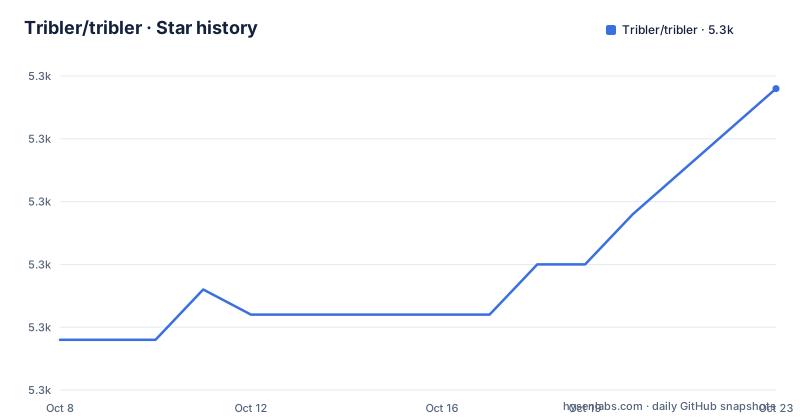
Star history
- Tribler/tribler5,327 ★ · +5
| Repository | 2026-10-08 | 2026-10-20 |
|---|---|---|
| Tribler/tribler | 5.3k | 5.3k |
5 Stars in the last 12 days, measured from the daily GitHub snapshot. Compare with other projects
Editorial analysis
What the overlay network is trying to solve
A conventional BitTorrent client cannot be anonymous, and the reason is structural rather than a matter of care. Peers find each other through trackers, trackers index what exists, and a tracker that knows which IP addresses are talking about which torrent is a log of your interests that nobody asked you to keep. Even magnet links do not fix this, because the first connection still has to be bootstrapped through something that can see both sides.
Tribler's answer is to run its own network rather than borrow Tor's. The README states the goal as giving anonymous access to content and describes an enhanced Tor-like network for anonymous torrent downloading, built on hidden-services-based seeding with end-to-end encryption. The mechanism is that nodes locate each other through the overlay instead of through a public tracker, so there is no single index to shut down or subpoena.
The project's own framing of that goal is worth quoting carefully, because it contains its own caveat. The README says it has worked since 2004 to ensure that the only way to take Tribler down is to take the internet down, and then immediately parenthesises that a single software bug could end everything. That is a more honest statement than the one usually attached to privacy projects. Resilience is a property of the protocol only while the implementation holds.
Why the overlay is a submodule and not a folder
The repository tree is small enough to read in one look, and one entry in it explains the architecture: `pyipv8` sits at the root as a submodule rather than as an ordinary directory. The `.gitmodules` file confirms it. Everything else is conventional: `src/` for the application, `build/` for build configuration, `doc/` for documentation, plus `requirements.txt`, `mypy.ini`, and a `.ruff.toml` for linting.
The name is the hint. IPv8 is the identity and addressing layer of Tribler's overlay, and pulling it out as its own repository means the routing stack can be developed, released, and audited on its own schedule. That is the right call for a component that has to survive hostile networks, and it is also the right call for anyone reading the code, because the part most worth understanding is not tangled into the user interface code.
The dependency list shows what else the client is standing on:
-r pyipv8/requirements.txt

aiohttp
ipv8-rust-tunnels
lz4
pillow
pony
pystray
pywin32;sys_platform=="win32"
sentencepiece
libtorrent==2.0.13
Two entries carry most of the weight. The first line pulls in the overlay's own requirements, confirming again that it is a separate component with its own dependencies. `libtorrent==2.0.13` is pinned exactly, which is the correct choice for a native extension that Tribler does not control, since an unpinned libtorrent upgrade can change torrent handling behaviour without any change on Tribler's side. `ipv8-rust-tunnels` tells you the tunnel layer is implemented in Rust and reached through Python bindings, presumably for performance reasons in the network path. The `pywin32` marker is scoped to Windows by an environment marker, and `pystray` is there for the system tray, which on pure GNOME desktops needs the extra setup the README links to.
The 8.4 release series, read as a maintenance history
The release notes are more informative than the README here, because they record what actually went wrong. Version 8.4.1, published in March 2026, was demoted to a pre-release due to reported Windows issues and an unsolved metadata issue. Version 8.4.2 in April opens by admitting that 8.4.1 did not actually fix the critical issue involving random files appearing on your disk, and that the demotion to pre-release was a consequence. The same release fixed a Windows installer problem that prevented use of the default installation path.
A project publishing that sequence is telling you something useful. The failure mode was data-adjacent, not cosmetic, and the response was to demote a published release rather than quietly patch forward. Version 8.4.3 in June is then an ordinary maintenance release: mostly making things faster and smaller, with a new setting in the General tab controlling memory consumption, letting users fetch torrent info into RAM when they have memory to spare.
That last change is the interesting product decision. A client whose whole premise is an overlay network has a real tension between keeping index data resident for fast discovery and leaving memory alone. Exposing it as a General tab setting rather than deciding for the user is the right call, and it is a small example of a project that understands its own resource profile well enough to hand the trade-off over.
Packaging, platform reality, and where the README runs out
Downloads come from GitHub releases, with Flathub as the alternative route and its own download badge in the README. The Flathub note is worth attention because it includes a specific warning: for Fedora 42 and what the README calls pure GNOME, there is a separate guide for enabling the tray icon. That is a real packaging wrinkle rather than boilerplate, since `pystray` in the dependency list depends on a system tray being available and some GNOME configurations do not provide one by default.
The Python version badge reads 3.12. Combined with `mypy.ini` and `.ruff.toml` in the tree, this is a project with typed and linted Python rather than a loose collection of scripts. Worth noting if you are contributing: the type checking configuration is a committed file, so contributions are expected to satisfy it.
On documentation, the boundary is clear. The README covers what Tribler is, where to get it, and how to reach the community, and it points outward for everything else. Development and build instructions live in the wiki, the protocol-level design lives in an anonymous downloading and streaming specification in the wiki, and user documentation is hosted on Read the Docs. The README itself is reStructuredText with substitution badges for download counts and issue counts, which is the visual language of a project that has been publishing the same page for two decades.
The downloads badges are also a historical artifact worth reading. They break total downloads into a pre-2006 bucket of 1.8 million, a SourceForge bucket of 200k, and a GitHub bucket. That is a project that predates GitHub releases as a distribution channel, and it has been migrating users across three hosting eras ever since.
Where the README and the repository disagree
There is one clear contradiction, and it is about age. The license section states that the file is part of Tribler, Copyright 2004-2024. The repository, however, has a most recent push dated September 2026 and shipped release 8.4.3 in June 2026. The copyright line has not kept pace with the release history, which means the header is maintained less often than the code. Nothing depends on it legally in a way that affects users, but it is a useful signal for judging how much of this project's documentation is actively tended and how much is a maintained historical artifact.
The same pattern shows up in the framing. The tagline about being anonymous and impossible to shut down has been in place since the SourceForge era, while the actual engineering story of the last two years is a series of difficult bug fixes in libtorrent integration, Windows installer behaviour, and memory management. The gap between those two things is not dishonesty. It is the difference between a project mission statement and a changelog, and for evaluating whether Tribler works, the changelog is the more informative document.
A second tension is inherent to the design rather than a documentation flaw. Running an overlay network means the network is only as private as its least trustworthy participant and only as available as its routing code. The README concedes the software bug point explicitly. Anonymity in a system like this is a property that has to be maintained release by release, not a feature that ships once.
Who this is for, and what to read first
Tribler is not the right tool if your requirement is a fast torrent client with a clean interface, because you are paying for an overlay network whether you need it or not. It is the right tool if you are interested in peer-to-peer content discovery that does not depend on a central index, or if you want to read a well-documented Python implementation of an anonymity network that has been running since 2004.
The most instructive entry point is the anonymous downloading and streaming specification in the wiki. It explains the protocol rather than the interface, and it is where the interesting engineering decisions are documented. The source tree supports this too: start with `pyipv8` as the component that stands alone, then move outward to the application code in `src/`.
The community channels are unusually direct for a project of this age. The README asks you to open an issue if nobody has filed the same bug or feature request yet, and to check the docs if you are lost in development. There is a Discord for users. That combination, an active issue tracker plus a chat, is a decent sign that the project still has people answering, which is the practical question for any software that depends on a decentralized network rather than a company.
One last practical note for anyone evaluating it on Linux. The Flathub route is likely the smoother install, and if you are on a pure GNOME setup you should read the tray icon guide before first launch rather than after, since a missing system tray is the kind of failure that looks like the application is broken.
Editorial conclusion
Tribler is a genuine research project that ships as a desktop application, and the 8.4 series shows what that costs: a demoted release, a serious disk-corruption bug, and an explicit knob for trading memory against speed. The overlay network is the part that makes it different from an ordinary torrent client, and the Python codebase with pyipv8 and libtorrent underneath is readable enough to learn from. Set your expectations from the docs rather than the tagline, because the project's own maintainers describe resilience as conditional on no single software bug.
Frequently asked questions
What is Tribler?
Tribler is a privacy enhanced BitTorrent client written in Python that aims to give anonymous access to content. It runs its own enhanced Tor-like network using hidden-services-based seeding and end to end encryption instead of relying on public trackers.
How does Tribler differ from an ordinary torrent client?
An ordinary client uses public trackers to find peers, which means a third party can log the connection between your IP address and the content you want. Tribler locates peers through its own overlay network, with pyipv8 shipped as a separate submodule handling the identity and routing layer.
Where can I download Tribler?
Builds are published on the project's GitHub releases, with Flathub offered as an alternative download route. The README notes that on Fedora 42 and pure GNOME setups you may need a separate guide for enabling the tray icon.
What version of Python does Tribler require?
The README carries a Python 3.12 badge, so 3.12 is the targeted version. The repository also ships mypy.ini and a .ruff.toml, so type checking and linting are part of the project configuration.
Is Tribler actively developed?
The repository was pushed to in September 2026, and release 8.4.3 followed in June 2026 after a 8.4.2 that fixed a critical issue involving stray files on disk. Earlier in the series, 8.4.1 was demoted to a pre-release because a metadata problem was not solved.
Official sources
Add this badge to your README
If you maintain this project, the badge below links readers to this analysis and shows its maintenance status from the daily GitHub snapshot. Paste the markdown into your README; add ?metric=license or ?metric=stars to the image URL for a different field.

[](https://hysenlabs.com/projects/tribler-tribler)Star history chart for your README
[](https://hysenlabs.com/projects/tribler-tribler)Was this useful?