Dusklight: a Twilight Princess reimplementation whose accuracy stops at GameCube
Dusklight brings a classic adventure to PC and mobile platforms with a variety of fixes and improvements.
At a glance
- What is it?
- A C++ reimplementation of Twilight Princess that you run against a disc you dump yourself, built on a decompilation that currently matches only the GameCube version. The readme is short and points installation at a separate website, while the repository carries several CMake files, a Nix flake and a patch file at its root.
- Who is it for?
- Dusklight is a serious piece of work with a clear boundary around what it is and is not: no game assets, and an explicit accuracy goal that comes with an explicit accuracy limit. Three things deserve checking before anyone builds a setup around it.
- Can I use it commercially?
- Yes. CC0-1.0 is a permissive licence: you can use, modify and sell software built on it, as long as you keep its copyright and licence notices.
- Is it still maintained?
- Yes. The repository last received commits 20 days ago.
- What is it written in?
- Mainly C++, according to GitHub's language statistics.
Answers come from the project's GitHub data, last synced on November 15, 2026, and from our analysis. They are not legal advice.
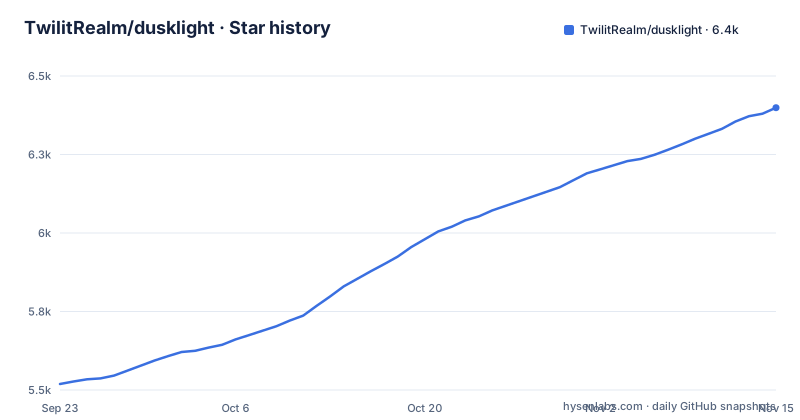
Star history
- TwilitRealm/dusklight6,399 ★ · +880
| Repository | 2026-09-23 | 2026-11-15 |
|---|---|---|
| TwilitRealm/dusklight | 5.5k | 6.4k |
880 Stars in the last 53 days, measured from the daily GitHub snapshot. Compare with other projects
Editorial analysis
A Wii disc still gets the GameCube HUD
Dusklight is built on the Twilight Princess decompilation, and that decompilation currently matches only for GameCube. The readme spells out what that means for a user: even when playing with a Wii disc, you are presented with the GameCube version's HUD and certain other specificities. So disc support and version fidelity are two separate axes, and Dusklight is only complete on one of them.
The disc coverage is broad in the other direction. All commercial discs are supported with one exception, the Korean release on Wii. Nothing in the repository says which of the GameCube specificities are cosmetic and which change behaviour, so the honest summary is that a Wii owner gets the game running with the wrong interface layer on top of it, and that Korean release gets nothing at all.
The first task is producing a disc dump with somebody else's tool
The project ships no game content and says so directly: Dusklight provides no copyrighted assets, and you must provide your own copy of the original game. Producing that copy is step one of setup, and the instructions for it are not in this repository. They live in an article on the Dolphin emulator wiki about ripping games.
Once you have a dump, the readme offers a space saving step rather than a conversion requirement. Dolphin or nodtool can turn a .iso into an .rvz. So the first real dependency a new user meets is not the framework but the dumping and compression toolchain, and the project treats both as pre-existing. That delegation is what keeps the repository clean of anything it does not own, and it also means the gap between installing Dusklight and running it is filled entirely by material the project does not publish.
D3D12, Vulkan 1.1 or Metal is the floor, and D3D11 is best effort
The stated minimum is a GPU with D3D12, Vulkan 1.1 or Metal support. Below that line, older devices get best effort support for D3D11 and for OpenGL ES on Android, and the readme is explicit about the cost: it will not achieve full accuracy or performance. It also warns that the experience may vary with specific hardware, operating systems and drivers.
That puts the accuracy goal and the compatibility fallback in direct tension. The project states its aim as being as accurate as possible to the original while adding options and tools, and then concedes that on older hardware it will not be accurate. No list of affected effects appears in the readme, so the honest reading is that two quite different fidelity levels ship under one name.
Setup is two headings and a link to another website
The whole setup section reads as a numbered skeleton:
1. Dump your game
2. Install Dusklight
Step one is covered above. Step two is a single line: visit the official installation guide at https://twilitrealm.dev/install/ for full instructions. Building from source is handled the same way, through docs/building.md, and the code conventions live in docs/code-conventions.md. Nothing else is printed in the repository, and no command line appears anywhere in the readme.
The readme also carries a warning that the official website is https://twilitrealm.dev/ and that any other site is not affiliated and may be promoting AI generated misinformation. That is an unusual thing to state, and it is worth taking at face value: anyone looking for installation steps will find mirrors and summaries, and the project has pre-emptively disowned all of them while pointing readers off the repository.
The code is CC0 while the content you run it on is not
The licence file at the repository root is CC0-1.0, which places the project's own work in the public domain. That covers the reimplementation and the tooling around it. It covers nothing about the game: the readme is emphatic that no copyrighted assets are provided and that the user supplies the original copy.
The split is clean and worth stating plainly, because it is the shape of the whole project. The engine side is permissively released, so a fork or a patch carries no licence negotiation with it. The content side is entirely the user's responsibility, which is why step one of setup is making a dump. Nobody can install Dusklight and immediately have Twilight Princess, and the licence choice makes clear that this is intended rather than merely unfinished.
Three patch releases in eleven days, with the last push on the newest tag
The release line is moving quickly. v2.0.1 landed on 2026-09-20, v2.0.2 on 2026-09-25 and v2.0.3 on 2026-09-30, three patch versions inside eleven days. The default branch is main, and the newest recorded push is 2026-10-26, nearly four weeks after v2.0.3.
Three fixes in under two weeks is the pace of a project absorbing reports, and the readme carries no stability or long term support statement to tell a reader which of those versions is the one to pin.
Four build entry points, a Nix flake, and a patch file at the root
The build story is broad rather than minimal. The root holds CMakeLists.txt, CMakePresets.json, a cmake directory, cmake-variants.yaml and files.cmake, which is one toolchain expressed four ways. Alongside them sit flake.nix with flake.lock for a Nix build and ios.toolchain.cmake for Apple platforms. Then there is fix-cmake-paths.patch, sitting at the top level with no explanation in the readme of what it corrects or when it should be applied.
The support files around those are just as mixed. .clang-format, .clangd and .gitattributes serve the C++ code, and .flake8 sits beside them, which is the Python linter's configuration file. extern/, libs/ and .gitmodules account for vendored dependencies, ci/ holds the continuous integration, and a .vscode directory is checked in. A contributor therefore has to work out which of those build paths is the real one, and a reader has to work out what a root level patch file is for.
mods/ and assets/ are tracked in the source tree, not installed later
Alongside src/, include/, res/, sdk/, platforms/, tools/, assets/ and mods/, the repository tracks modifications in version control as first class content. There is no separate mod loader directory and no download step in the readme for obtaining mods; the mods directory is simply part of the tree.
That matches the project's stated purpose, which is not only to reproduce the original accurately but to add new options, enhancements and tools for customising the experience. The credits point the same way: besides the decompilation team and the GameCube and Wii decompilation community, they name the Aurora developers and the Twilight Princess speedrunning community, and the repository carries the Aurora logo.
Editorial conclusion
Dusklight is a serious piece of work with a clear boundary around what it is and is not: no game assets, and an explicit accuracy goal that comes with an explicit accuracy limit. Three things deserve checking before anyone builds a setup around it. Know that the base only matches GameCube, so a Wii disc gives you GameCube specifics and the one disc it refuses outright is the Wii Korean release. Meet the hardware floor of D3D12, Vulkan 1.1 or Metal, and accept that D3D11 and Android get best effort. And follow twilitrealm.dev for installation rather than any other site, since the project publishes a CC0 licence over its own code while the content you supply stays yours, which makes the setup steps worth reading carefully before you trust them to someone else.
Frequently asked questions
What does dusklight do?
Dusklight is a reverse engineered reimplementation of Twilight Princess in C++, intended to be as accurate as possible to the original while adding options, enhancements and customization tools. It ships no copyrighted assets, so you run it against a copy of the original game that you supply yourself.
how to install dusklight
The repository prints no installation steps. It points to the official installation guide at https://twilitrealm.dev/install/, and warns that any website other than twilitrealm.dev is not affiliated. Before that you need your own dumped copy of the game, optionally converted from .iso to .rvz with Dolphin or nodtool.
If I use a Wii disc with Dusklight, do I get the Wii version?
No. Dusklight is based on the Twilight Princess decompilation, which currently matches only for GameCube, so a Wii disc still presents the GameCube version's HUD and certain other specifics. All commercial discs are supported except the Wii Korean release.
What hardware does Dusklight need to run?
At minimum a GPU with D3D12, Vulkan 1.1 or Metal support. Older devices get best effort support for D3D11 and for OpenGL ES on Android, which the readme says will not achieve full accuracy or performance.
Can I build Dusklight from source, and what licence applies?
Yes, and the repository points to docs/building.md for instructions and docs/code-conventions.md for conventions. The licence at the repository root is CC0-1.0 and covers the project's own code only, since no game assets are included.
Official sources
Where developers are discussing it
Posts on Hacker News, dev.to and Lobsters that link to this repository, found by our scan of those communities. 0 in the last 30 days; newest first.
- Dusklight 2.0.0Hacker News · Sep 19, 2026 · 2 points · 0 comments
Add this badge to your README
If you maintain this project, the badge below links readers to this analysis and shows its maintenance status from the daily GitHub snapshot. Paste the markdown into your README; add ?metric=license or ?metric=stars to the image URL for a different field.

[](https://hysenlabs.com/projects/twilitrealm-dusklight)Star history chart for your README
[](https://hysenlabs.com/projects/twilitrealm-dusklight)Was this useful?