Qix is personal study notes whose only release is a tag from 2014
Machine Learning, Deep Learning, PostgreSQL, Distributed System, Node.js, Golang.
At a glance
- What is it?
- Qix is a single-author collection of study notes covering machine learning, Go, PostgreSQL, distributed systems and databases, with one translated document alongside. It is not software: the repository holds Markdown files, a style guide and a licence, and the front page is a contact card followed by an index of links. The author states plainly that the material may contain incorrect information and invites corrections by email or pull request.
- Who is it for?
- Qix is worth reading if you want one person's compressed notes on a topic, and it is not worth citing. The author himself flags that the material may be inaccurate, there is no peer review and no versioning to tell you whether a note is current, and the index omits three of the files in the repository.
- Can I use it commercially?
- Check first. The repository uses a licence we do not classify automatically, so read its LICENSE file before any commercial use.
- Is it still maintained?
- Yes. The repository last received commits 70 days ago.
- What is it written in?
- GitHub does not report a main language for this repository.
Answers come from the project's GitHub data, last synced on November 15, 2026, and from our analysis. They are not legal advice.
Star history
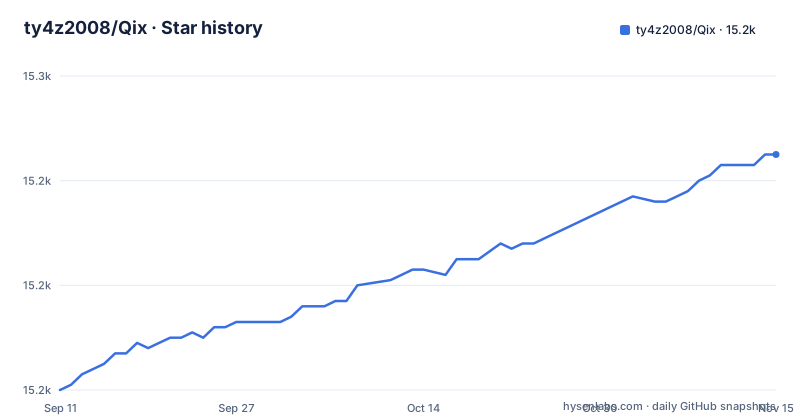
- ty4z2008/Qix15,245 ★ · +45
| Repository | 2026-09-11 | 2026-11-15 |
|---|---|---|
| ty4z2008/Qix | 15.2k | 15.2k |
45 Stars in the last 65 days, measured from the daily GitHub snapshot. Compare with other projects
Editorial analysis
The author disclaims the accuracy of his own notes
There is a note near the top of the front page, and it is not boilerplate.
It says there may be some incorrect information in the article, and that the author hopes to correct errors with readers, who can contact him by email or submit a pull request.
That is a disclaimer written by the person whose name is on everything, and it is more useful than the opposite would be. A reader knows immediately that these are working notes rather than reviewed material.
It also sets the bar for how to use the repository. If the author does not stand behind the accuracy, then a note that is wrong is not a bug to report but an acknowledged limitation, and the useful response is the one the note asks for, which is to say so.
The framing matters more here than it would for a technical project, because nothing in a Markdown note tells you how old it is or whether the tool it describes has since changed. The disclaimer is doing the work that version metadata does elsewhere.
There is one release, it is named after the project, and it is from 2014
The release history contains a single entry. It is tagged with the project's own name, and it is dated 2014.
Against a default branch that last took a push on 2026-09-06, that is a twelve-year gap.
So the tag is not a version of anything that still exists in a usable sense. It marks a moment when the author created a release, and nothing since has produced another. There is no minor line, no patch series, no release notes to read.
The practical consequence is that there is nothing to pin. If you are using this repository as a reference, you cannot say which state of the notes you read, because a commit hash is the only handle available and the branch has moved a great deal since that tag.
Compare that with a project that releases regularly, where the tag tells you what changed and when. Here the release feed carries no information at all, which makes it easy to mistake an actively maintained repository for an unversioned one.
Three files in the repository are missing from the front page index
Count the Markdown files in the repository against the links on the front page and they do not match.
The index links to a translated document, two machine learning and deep learning chapters, and one chapter each for Go, PostgreSQL, distributed systems and databases. That is seven linked files.
The repository also contains a chapter on algorithms, a curated list, and a Node style guide. None of the three appears anywhere in the index.
So a reader arriving from the front page misses roughly a quarter of what is there. The algorithm notes and the curated list in particular are the kind of thing a person browsing for study material would want, and they are only findable by opening the repository.
There is a second detail in the filenames worth knowing about. The style guide's filename contains spaces rather than dashes. That is legal in a repository and works fine locally, but it has to be encoded when it appears in a link, so a direct reference to it is more fragile than every other file in the tree.
Harmless individually. Together they are the signature of a personal repository indexed by hand rather than generated.
The description advertises Node.js and the only Node content is a translation
The project's one-line description names six areas: machine learning, deep learning, PostgreSQL, distributed systems, Node.js and Go.
Five of those have a section on the front page. Node.js does not.
The only Node.js material linked from the front page is a translation of the node-mysql driver's README, listed under a heading describing it as the author's translation, with a link to the official document alongside the translated one.
So one of the six advertised technologies is represented by somebody else's documentation in a second language, not by the author's own notes. Whether that counts as covering Node.js depends on what you were expecting, and someone who found the repository by searching for its description would reasonably expect a chapter and find a translation instead.
It is presented carefully, with the upstream link given so a reader can check the translation against the source.
That care is worth crediting, and it is the clearest signal of how the author thinks about attribution, which the front page returns to at the end.
Five of the six topics have exactly one chapter
Read the section headings and the shape of the repository is obvious. Go has one chapter. PostgreSQL has one chapter. Distributed systems have one chapter. Databases have one chapter. Machine learning and deep learning have two chapters between them.
That is a set of starting points rather than a curriculum.
There is a plausible reason for it, and the naming makes it explicit. Four of the sections say chapter one and nothing else, so what exists is the beginning of a sequence nobody finished, and the link stops at chapter one because there is no chapter two.
This is normal for a notes repository and it does not diminish it. A single dense chapter on distributed systems written by someone who understood it can be more useful in an afternoon than a structured course you abandon in week two.
But it does mean the repository cannot be used as a reference to return to. There is no index of topics within a topic, no progression, and nothing indicating whether a given chapter was finished, revised or abandoned. You either read it or you do not, and there is no way to check whether it is still current.
The attribution note is the most distinctive thing here
The last content section before the licence is not about technology at all. It asks readers to report a problem with authorship.
The author asks that if you find a resource whose authorship is incorrect, you submit feedback, and frames it as respecting the efforts of the people who wrote the material, closing with thanks.
That is a specific and unusual thing for a link collection to ask for. Most of these are built by aggregating other people's explanations, and the usual failure mode is a link presented as original work or an author's name dropped from a citation. The author here anticipates that failure and asks the readers to police it.
It also tells you something about the repository's shape. These are notes built from reading other people, so provenance is the fragile part, and the author is treating it as a shared responsibility rather than a private one.
For anyone reusing the material, that matters practically. A note that paraphrases a book or a lecture should be traced back to its source before you quote it, and this front page is unusually clear that the repository is a layer of commentary rather than an origin.
The project page is served over plain HTTP and the licence name is unusual
Two small details sit in the metadata rather than the prose, and both are worth a glance before you rely on this repository.
The first is the recorded project site, which is an address on the author's personal pages subdomain served over plain HTTP rather than HTTPS.
That is the author's own hosting choice for a personal pages site, and it is not a security problem with the notes themselves. But if you follow that link from anywhere sensitive, the connection is unencrypted, and the habit of linking it onward is the thing worth avoiding.
The second is the licence file, which is named differently from the conventional name and is linked from the front page under the MIT label, so the grant is stated. However, the licence recorded as metadata for the project carries no standard value, which means a tool that reads only the metadata will not identify it.
Together they are a reminder of what this repository is: a personal collection of notes, maintained in the way an individual maintains their own files, with the small inconsistencies that implies and none of the guarantees an institutional project would offer.
Editorial conclusion
Qix is worth reading if you want one person's compressed notes on a topic, and it is not worth citing. The author himself flags that the material may be inaccurate, there is no peer review and no versioning to tell you whether a note is current, and the index omits three of the files in the repository. Treat it as a pointer to other people's explanations rather than a source, and verify anything you take from it against the upstream project the note is about.
Frequently asked questions
What is the Qix repository?
Qix is a single-author collection of Markdown study notes covering machine learning, deep learning, Go, PostgreSQL, distributed systems and databases, with one translated third-party document and an algorithm chapter, a curated list and a Node style guide that the front page does not index. It contains no software, only notes, and is published under an MIT licence.
How current are the notes in Qix?
There is no reliable way to tell from the repository. It has a single release tagged with the project's name from 2014 and no releases since, while the default branch last took a push in September 2026. The author states on the front page that there may be incorrect information in the notes and asks readers to report corrections.
Can I use Qix as a reference for PostgreSQL or Go?
Read it as a pointer rather than a citation. Five of the six topics have exactly one chapter each, with no index within a topic and no indication of whether a chapter was finished or revised, and the author explicitly disclaims accuracy. Anything you take from it should be checked against the upstream project the note describes.
Official sources
Add this badge to your README
If you maintain this project, the badge below links readers to this analysis and shows its maintenance status from the daily GitHub snapshot. Paste the markdown into your README; add ?metric=license or ?metric=stars to the image URL for a different field.

[](https://hysenlabs.com/projects/ty4z2008-qix)Star history chart for your README
[](https://hysenlabs.com/projects/ty4z2008-qix)Was this useful?