Undertow: security bugs go to an email address, and two Final releases landed five minutes apart
High performance non-blocking webserver
At a glance
- What is it?
- Undertow is a Java web server built on non-blocking IO, shipped as three parts: a core HTTP server that also does blocking work, a Servlet implementation covering three specification generations, and a Jakarta WebSocket implementation. The file that describes it is short, and the things it does say point at Red Hat for bugs, Red Hat's tracker for issues, and Wildfly's Zulip for chat.
- Who is it for?
- Undertow fits a Java service that wants a servlet container with control over its IO model, particularly one that needs to serve both blocking and non-blocking work from the same server. Three things to settle before you plan around it.
- Can I use it commercially?
- Yes. Apache-2.0 is a permissive licence: you can use, modify and sell software built on it, as long as you keep its copyright and licence notices.
- Is it still maintained?
- Yes. The repository last received commits 26 days ago.
- What is it written in?
- Mainly Java, according to GitHub's language statistics.
Answers come from the project's GitHub data, last synced on November 15, 2026, and from our analysis. They are not legal advice.
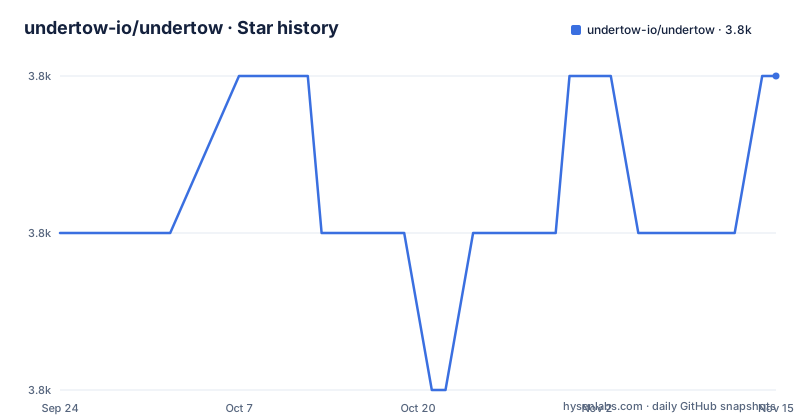
Star history
- undertow-io/undertow3,761 ★ · +1
| Repository | 2026-09-24 | 2026-11-15 |
|---|---|---|
| undertow-io/undertow | 3.8k | 3.8k |
1 Stars in the last 52 days, measured from the daily GitHub snapshot. Compare with other projects
Editorial analysis
Security bugs go to an email address, not the tracker
The file has a section on its own for this, and it is the longest section in the document. A bug with a security impact should be reported by email to a Red Hat security alert address, with a copy to the named project lead, whose Red Hat address is also given. The stated reason is that the bug will be properly handled without causing unnecessary negative impact on the user base, which is the language of an embargo rather than of an open tracker. A link to the vendor's security contacts and procedures page closes the section. So the ordinary channel for everything else, which is an issue tracker hosted on the vendor's project system, is explicitly not the channel for a vulnerability, and the repository also carries a security policy file for the cases this short file does not cover.
Three parts at three different compatibility levels
The server is described as based on non-blocking IO, and then broken into three parts whose compatibility ranges do not match each other. The core HTTP server supports both blocking and non-blocking IO, so the headline is a preference rather than a constraint. The servlet implementation covers specification versions 4.0, 5.0 and 6.0, three generations of the same specification. The WebSocket implementation is compliant with the older specification and with Jakarta 2.0, two generations. The repository layout matches that split with a core directory, a servlet directory and a directory named after the older WebSocket specification, so the three claims in the file are three build outputs rather than one server with optional parts.
The tracker is on one vendor, the chat on another's, and the mailing list is archived
Community infrastructure is spread across three systems and two organisations. Issues are filed on the vendor's issue tracking system under a project identifier, not on the GitHub repository the code lives in. Chat happens on a Zulip instance run under the Wildfly name, with a dedicated stream for this project. Questions go to a Google Group, and the file also points at an archived mailing list from the older JBoss-era setup, which means the project has migrated its list once and kept the old archive reachable. A project lead is named individually with a vendor email address, and the file is otherwise a set of contact details rather than a project description.
Two Final releases five minutes apart on the same day
The release history is unusual in two ways that a reader pinning a version should notice. The first is timing: a pre-release, 2.4.0.Beta1, published on 18 February 2026, was followed by 2.4.0.Final and then 2.4.1.Final on 20 May 2026, with the two finals five minutes apart. A patch release arriving minutes after its own minor release is the signature of a same-day fix rather than a scheduled train. The second is the tag form, which carries a dot after the leading letter while the artifact name does not, so the tag and the version string are not the same string. The naming also mixes conventions, with a capitalised pre-release suffix and a different one for the final. The last commit to the default branch is dated 2 October 2026.
A coverage report and an analysis exclusion list are committed
Two generated artefacts sit in the root listing rather than in a build output directory. One is a coverage report directory, which means a test coverage summary is part of the repository and can be read as a snapshot of some earlier run rather than of the current tree. The other is an exclusion file for a static analysis tool, which is the place where findings are declared to be acceptable, so its contents describe what the analysis deliberately does not report. Neither is explained anywhere in the short file. What is explained by the tree is the governance: an ownership file, a code of conduct, a contributing guide, a security policy and a developer certificate of origin text, which is a sign-off requirement rather than a contributor licence agreement.
A translation file and an OSGi module outlived the JBoss era
The root still carries a configuration file for a translation platform that predates most modern Java projects, which is a leftover from when this server shipped as part of a larger application server. Alongside it sits a module directory for OSGi packaging, an assembly directory for the distribution, a benchmarks directory, and an examples directory that has its own build file, its own source tree and a configuration directory. The examples directory also has a readme whose filename carries no extension, a small sign that the conventions in this repository predate the current tooling. The result is a tree where a new contributor has to work out which directories ship, which are for tests and which are for local experiments.
The project site is linked over plain HTTP
Small inconsistencies are worth noting because they are the kind of thing a reader copies. The project website is linked with an unencrypted address, while the issue tracker, the security procedures page, the chat and the mailing list are all linked over encrypted connections. The repository description calls this a high performance non-blocking web server, and the benchmarks directory is in the tree, but the file itself cites no measurement, no configuration and no comparison with any other server, even though searching for this server usually produces exactly that kind of comparison. What the file claims is modest and checkable: three parts, two IO modes, three servlet generations, two WebSocket generations, and a security reporting procedure.
Editorial conclusion
Undertow fits a Java service that wants a servlet container with control over its IO model, particularly one that needs to serve both blocking and non-blocking work from the same server. Three things to settle before you plan around it. The servlet, HTTP and WebSocket layers sit at different compatibility levels, so a deployment targeting one specification generation is not automatically covered by the other two. Security disclosure runs through a vendor email address with a copy to the named project lead, which is the process to follow rather than opening a public issue. And the repository carries a generated coverage report and a static analysis exclusion list in the tree, which are both worth knowing about before you read them as current state.
Frequently asked questions
What does undertow mean?
In this repository the name belongs to a Java web server based on non-blocking IO, made of a core HTTP server supporting both blocking and non-blocking IO, a Servlet 4.0, 5.0 and 6.0 implementation, and a WebSocket implementation compliant with the older specification and with Jakarta 2.0. The English meaning of the word is not what this file addresses.
how to use undertow in spring boot
This file does not cover that integration. What it states is the three parts of the server, the Servlet specification versions it implements, that issues go to a vendor-hosted tracker and chat to a Zulip stream, and that a security-impacting bug must be emailed to the vendor's security alert address with a copy to the project lead rather than filed publicly.
undertow vs tomcat
No comparison appears anywhere in this repository, and no measurement is cited for either server. The only performance-adjacent material is a benchmarks directory in the tree and a description calling this a high performance non-blocking web server, which is a claim without a figure attached.
Official sources
Add this badge to your README
If you maintain this project, the badge below links readers to this analysis and shows its maintenance status from the daily GitHub snapshot. Paste the markdown into your README; add ?metric=license or ?metric=stars to the image URL for a different field.

[](https://hysenlabs.com/projects/undertow-io-undertow)Star history chart for your README
[](https://hysenlabs.com/projects/undertow-io-undertow)Was this useful?