Unsplash Datasets: the Lite set is commercial, the Full set is not, and neither ships images
🎁 7,400,000+ Unsplash images made available for research and machine learning
At a glance
- What is it?
- Unsplash publishes two image datasets with identical fields and opposite permissions, a Lite set of about 25,000 photographs you may use commercially and a Full set of 7.4 million plus that arrives only after an access request. This repository holds no data at all, only the terms, the field documentation, a changelog and two loader guides.
- Who is it for?
- Use the Lite dataset when you want realistic photographs with real keyword and search metadata, you can live with 25,000 images, and your use is commercial or non-commercial, since the Lite fields match the Full schema and a project written against Lite can move to Full later. Use the Full set when the volume matters and your use is non-commercial, and plan for the access request and for roughly 20 GB compressed.
- Can I use it commercially?
- The repository metadata does not identify a licence. Check the project’s published terms and any component-specific licences before reuse.
- Is it still maintained?
- Yes. The repository last received commits 151 days ago.
- What is it written in?
- Mainly Jupyter Notebook, according to GitHub's language statistics.
Answers come from the project's GitHub data, last synced on November 24, 2026, and from our analysis. They are not legal advice.
Star history
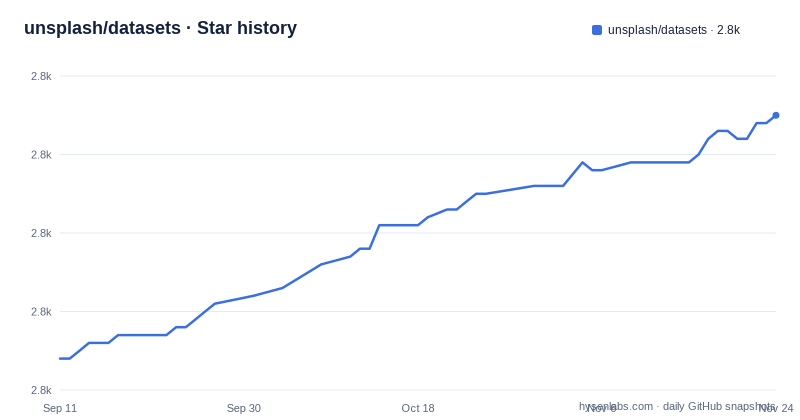
- unsplash/datasets2,815 ★ · +31
| Repository | 2026-09-11 | 2026-11-24 |
|---|---|---|
| unsplash/datasets | 2.8k | 2.8k |
31 Stars in the last 74 days, measured from the daily GitHub snapshot. Compare with other projects
Editorial analysis
Two datasets, one schema, opposite permissions
The same repository offers two downloads that differ in size and in what you are allowed to do with them. The Lite dataset is available for commercial and non-commercial usage and contains 25,000 Unsplash photographs, 30,000 keywords and one million searches. The Full dataset is available for non-commercial usage only and contains 7.4 million or more high-quality photographs, 1.6 million keywords and over 160 million searches. The useful detail is in the download section rather than the summary: the Lite dataset contains all of the same fields as the Full dataset, but is limited to about 25,000 photos. That parity is what makes Lite usable as a development stand-in, since a loader, a schema and a model written against the small set can be pointed at the large one without rework. It also means the field list you design against is not a subset you can discover later; it is the full set, available immediately at a size you can download.
The Full dataset is an access request, not a download link
The two datasets are reached in different ways. The Lite dataset is a direct download, described as roughly 700 MB compressed and about 1 GB raw, with the condition stated as provided you abide by the terms. The Full dataset has no download button at all: it is available for non-commercial usage, all uses must abide by the same terms, and to access it you are told to go to unsplash.com/data and request access. The volume explains why. The Full set weighs roughly 20 GB compressed, about 80 GB raw, which is a distribution decision rather than a technical obstacle, and the request is also where the non-commercial condition gets enforced. Both paths therefore end at the same two places, a terms document in this repository and a form on the company's own site, and anyone planning a pipeline should assume the Full set arrives as an approved request rather than a URL.
What the numbers say about the shape of the data
The stated scale comes from a stated contributor base: over 415,000 contributing photographers worldwide, with the data sourced from hundreds of millions of searches across a nearly unlimited number of uses and contexts. The two sets are not sampled the same way, and the ratios show it. Photos grow by roughly a factor of 300 from Lite to Full, keywords by a factor of about 50, and searches by a factor of 160. So the search and keyword tables are proportionally much smaller in the Full set than the photo table, which matters if your intent is to study search behaviour rather than images. The page also attributes the value of the dataset to that breadth of intent and semantics rather than to the images alone, and says the goal is to enable new opportunities for research and learning. Updates are promised as the library grows, with new fields and new images in each release.
The line that matters is redistribution, not commercial use
It is easy to read the Lite grant of commercial use as permission to ship the images, and the closing paragraph rules that out. It states the dataset is made available for research purposes, that it cannot be used to redistribute the images contained within, and that to use the Unsplash library in a product you should see the Unsplash API. So the permissions divide along two lines rather than one. Commercial versus non-commercial decides whether you may use the data commercially at all, which is what separates Lite from Full. Redistribution decides whether the photographs travel with your output, which neither grant permits. That leaves a narrow but real band for the Lite set, where a commercial project can use the keywords and the search records, and where the photographs are inputs to analysis rather than assets to distribute, with anything user-facing going through the API instead.
The citation the page tells you to use is one patch behind the newest release
The attribution guidance is specific: if you are using the dataset in a research paper, attribute it as `Unsplash Lite Dataset 1.4.0` or `Unsplash Full Dataset 1.4.0` and link to the permalink at unsplash.com/data. The release list disagrees by one patch. The newest tags are 1.4.1 on 2026-06-26, 1.4.0 on 2026-06-12 and 1.3.0 on 2025-04-16, so the string a paper would print is one release behind the newest data. That matters more than a version bump normally would, because the same page promises that each subsequent release is semantically versioned and that updates arrive with new fields and new images. A patch number on a dataset is therefore not a guarantee that the rows are identical to the previous patch, and neither the README nor the attribution line says which fields moved. The changelog in the root is where that question is answered, and anyone reproducing a published result should pin the exact version they downloaded rather than the one named in the citation example.
There is no license file, and the terms are a markdown document
The repository root contains a terms file and no license file, and the license recorded for the project is not an identifiable one. That combination is easy to misread, so it is worth being precise about what is actually there. Two documents govern use, and both grant sections point at them: the Lite download says provided you abide by the terms, and the Full section says all uses must abide by the terms, each linking to `TERMS.md` in the repository. The commercial and non-commercial distinction is stated in the README itself rather than deferred to that document, which means the README is where the first-order permission lives. What is not settled by either is the redistribution question in the closing paragraph, which is a restriction rather than a grant and is stated once, near the end, in the same place as the pointer to the API.
The repository holds no data, no code and no schema
What is in the tree is worth knowing before you clone anything. The root has a gitignore, a changelog, the field documentation, the README, the terms file and a directory of how-to guides. That is the whole list. There is no data, no loader library, no schema file and no notebook at the top level, and the project is not archived but has nothing to build. The how-to directory is the closest thing to code, holding guides for loading the dataset into a PostgreSQL database and into a Python environment, plus a page for submitting an example of your own, which is how the project collects new recipes. The field documentation is a separate document in the root holding the complete list of tables and fields, and the README defers to it rather than repeating any of it. Work that uses the dataset is invited by email to a data-specific address, whether it is a paper, a model, a blog post or a finding inside the data.
Editorial conclusion
Use the Lite dataset when you want realistic photographs with real keyword and search metadata, you can live with 25,000 images, and your use is commercial or non-commercial, since the Lite fields match the Full schema and a project written against Lite can move to Full later. Use the Full set when the volume matters and your use is non-commercial, and plan for the access request and for roughly 20 GB compressed. Before either, read TERMS.md rather than the download page, because the line that matters is redistribution: the photographs themselves cannot be redistributed under either grant, and anything shipped inside a product is meant to go through the Unsplash API instead. Note also that the citation string the page gives still names version 1.4.0 while the newest release is 1.4.1, so check the changelog for which fields changed before pinning a version. The default branch was last pushed on 2026-06-26 and the repository carries no license file.
Frequently asked questions
Can I use the Unsplash dataset for commercial purposes?
The Lite dataset is available for both commercial and non-commercial usage, while the Full dataset is available for non-commercial usage only. Both are limited by the terms, and neither permits redistributing the images, so for anything user-facing the page points to the Unsplash API instead.
How do I get the Unsplash Full dataset?
There is no direct link. The Full dataset is available for non-commercial usage and you are told to go to unsplash.com/data and request access, after which all uses must abide by the terms in the repository. It weighs about 20 GB compressed and around 80 GB raw.
How big is the Unsplash Lite dataset and can I develop against it?
About 25,000 photos, 30,000 keywords and one million searches, roughly 700 MB compressed and about 1 GB raw. It contains all of the same fields as the Full dataset, which is what lets you build and test a loader against Lite before requesting the larger set.
How should I cite the Unsplash dataset in a paper?
The page asks you to attribute it as Unsplash Lite Dataset 1.4.0 or Unsplash Full Dataset 1.4.0 and link to the permalink at unsplash.com/data. Note that the newest release is 1.4.1, published 2026-06-26, so the version named in that example is one patch behind.
Which fields and tables does the Unsplash dataset have?
The complete list lives in the field documentation in the repository root, and the page deliberately does not repeat it. The root also holds the changelog, the terms and a how-to directory with guides for loading the data into PostgreSQL and into a Python environment.
Official sources
Add this badge to your README
If you maintain this project, the badge below links readers to this analysis and shows its maintenance status from the daily GitHub snapshot. Paste the markdown into your README; add ?metric=license or ?metric=stars to the image URL for a different field.

[](https://hysenlabs.com/projects/unsplash-datasets)Star history chart for your README
[](https://hysenlabs.com/projects/unsplash-datasets)Was this useful?