DyRef: ECCV 2026 code for training image editors on many mixed reference images
[ECCV 2026 Oral] Official repository for Scaling Multi-Reference Image Generation with Dynamic Reward Optimization
At a glance
- What is it?
- Weistrass/DyRef is the official repository for an ECCV 2026 Oral paper on multi-reference image generation. It releases training and inference code, data, a benchmark and LoRA weights for Qwen-Image-Edit-2511, and it needs three separate Conda environments.
- Who is it for?
- DyRef is for researchers and practitioners who want to reproduce or extend the training of Qwen-Image-Edit-2511 or FLUX.2-klein-base on many mixed reference images, using the released data, benchmark and LoRA weights. It is not a ready application, it has no tagged releases, and it asks you to maintain three Conda environments and several large model downloads.
- Can I use it commercially?
- Yes. Apache-2.0 is a permissive licence: you can use, modify and sell software built on it, as long as you keep its copyright and licence notices.
- Is it still maintained?
- Yes. The repository last received commits 113 days ago.
- What is it written in?
- Mainly Python, according to GitHub's language statistics.
Answers come from the project's GitHub data, last synced on November 25, 2026, and from our analysis. They are not legal advice.
Star history
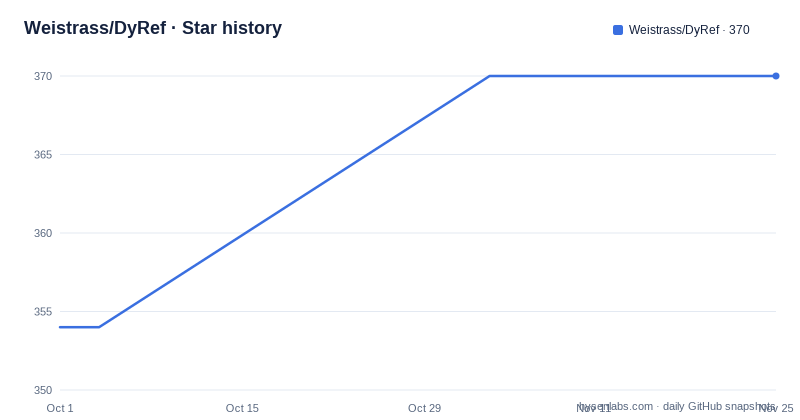
- Weistrass/DyRef370 ★ · +16
| Repository | 2026-10-01 | 2026-11-25 |
|---|---|---|
| Weistrass/DyRef | 354 | 370 |
16 Stars in the last 55 days, measured from the daily GitHub snapshot. Compare with other projects
Editorial analysis
A research release, not a product, with the code out since July 2026
DyRef is the official repository for the paper Scaling Multi-Reference Image Generation with Dynamic Reward Optimization. The news list records that the paper was accepted by ECCV 2026 on 2026-06-18, that the training and inference code, training data, benchmark and model weights were released on 2026-07-02, and that the paper was selected as an Oral Presentation on 2026-07-24. The authors come from Harbin Institute of Technology, Shenzhen, an independent researcher group and Shenzhen Loop Area Institute.
Despite the name, this is a code repository for a paper and has nothing to do with a company or a listed stock. Every item on its to-do list is ticked, including the arXiv paper, training code for two base models, the training data, the benchmark, the weights and a project page. The repository has no GitHub releases, and the last push was on 2026-08-05.
The problem is that open models degrade as references multiply
The motivation is stated plainly: the performance of mainstream open-source image generation models degrades substantially as the number of reference images increases and the diversity of reference types expands. That limits their use in professional applications that combine several kinds of references, such as people, objects and styles.
To measure this the authors introduce OmniRef-Bench, which evaluates complex multi-reference image generation across combinations of reference types and quantities. Their evaluation reports that current open-source models still struggle as complexity grows. They also built an automated data synthesis pipeline for this task. The central claim is that a Qwen-Image-Edit-2511 model trained with DyRef reaches performance comparable to a closed-source model, which is the authors' result and not an independent one.
A two-stage recipe: supervised fine-tuning, then reward-shaped reinforcement learning
DyRef is a two-stage training framework. Stage I uses supervised fine-tuning to give the model the basic ability to handle complex multi-reference generation. Stage II applies reinforcement learning with two additions. DRS enlarges the reward differences across samples so that training has a stronger signal, and DAR increases the model's focus on samples that contain many mixed-type reference images.
The practical meaning is that the second stage targets the hardest cases instead of averaging over all of them. The paper reports gains on multi-reference benchmarks, namely OmniRef-Bench, MultiBanana and OmniContext, and also on single-image editing, namely ImgEdit and DreamBench++, without compromising the foundation model's other abilities. It also reports consistent gains with datasets of about 5K, 7.5K and 14K samples and no clear sign of saturation.
Three Conda environments keep the dependencies apart
DyRef uses separate Conda environments for SFT, RL and benchmark evaluation, because each part has its own dependency requirements. Both training environments use Python 3.11. The SFT environment is created as follows:
conda create -n dyref_sft python=3.11 -y
conda activate dyref_sft
cd DyRef/sft
pip install -e .
The RL environment installs with the DeepSpeed extra:
conda create -n dyref_rl python=3.11 -y
conda activate dyref_rl
cd DyRef/rl
pip install -e .[deepspeed]
Because the two environments conflict, you must switch between them for each stage, and a command run in the wrong environment is a likely cause of confusing import errors. Plan for a separate environment for evaluation too.
Several base models must be downloaded before anything runs
The setup needs these models from Hugging Face: Qwen/Qwen-Image-Edit-2511, google/siglip2-base-patch16-384, facebook/dinov2-base, openai/clip-vit-large-patch14, and, if you need it, black-forest-labs/FLUX.2-klein-base-9B. The example download command uses the Hugging Face command line:
hf download Qwen/Qwen-Image-Edit-2511 --local-dir "your path to save this model"The vision encoders are used alongside the generator, which explains the extra downloads. The base image editing model is the largest requirement, so check disk space and your access to the Hugging Face hub before you start. FLUX.2-klein-base is only needed if you intend to reproduce that variant.
Inference uses the released LoRA weights on top of the base model
The released weights are LoRA weights, not a full model. To run inference you download the Qwen-Image-Edit-2511 base model and the pretrained LoRA weights published by the authors, activate the SFT environment, and run the inference script:
conda activate dyref_sft
python model_inference/Qwen-Image-Edit-2511.py
The script runs in the SFT environment, not the RL one. Because the weights are adapters, you always need the matching base model, so check that your base model version is Qwen-Image-Edit-2511 and not an earlier release. The dataset releases, OmniRef-Bench and OmniRef-training, are hosted on Hugging Face alongside the weights.
Training hands off between two codebases, and LoRA formats differ
Stage 1 SFT training runs from the SFT directory with a provided script:
conda activate dyref_sft
cd DyRef/sft
bash all_scripts/Qwen-Image-Edit-2511_lora.sh
Then comes a conversion step. The repositories used for SFT and RL store LoRA weights in different formats, so a conversion script must be run before RL so the SFT checkpoint loads correctly. It takes a mode, an input safetensors checkpoint, an output directory, a prefix of transformer, and a verify flag, and it lives in the SFT scripts as diffusers_peft_transfer.py.
Skipping the conversion would leave the RL stage unable to load your SFT result. Stage 2 then runs a script in the rl directory under the RL environment. The code is Apache-2.0 licensed, and the Acknowledgement and Citation sections point to the projects it builds on.
Editorial conclusion
DyRef is for researchers and practitioners who want to reproduce or extend the training of Qwen-Image-Edit-2511 or FLUX.2-klein-base on many mixed reference images, using the released data, benchmark and LoRA weights. It is not a ready application, it has no tagged releases, and it asks you to maintain three Conda environments and several large model downloads. Read the paper's claims as the authors' results, and run the benchmark yourself before depending on them.
Frequently asked questions
Is DTREF a legitimate company?
That question is about a stock. DyRef in this repository is a research project: the official code for an ECCV 2026 Oral paper on multi-reference image generation, released under Apache-2.0.
Which base models does DyRef support?
The repository releases training code for Qwen-Image-Edit-2511 and FLUX.2-klein-base. Pretrained LoRA weights are provided for Qwen-Image-Edit-2511.
Why does DyRef need separate Conda environments?
SFT, RL and benchmark evaluation each have their own dependency requirements, so the README uses separate environments, with Python 3.11 for the training ones.
Official sources
Add this badge to your README
If you maintain this project, the badge below links readers to this analysis and shows its maintenance status from the daily GitHub snapshot. Paste the markdown into your README; add ?metric=license or ?metric=stars to the image URL for a different field.

[](https://hysenlabs.com/projects/weistrass-dyref)Star history chart for your README
[](https://hysenlabs.com/projects/weistrass-dyref)Was this useful?