Local PDF Chat RAG names the six things you must add before using it for real
Transparent Python RAG reference with FAISS + BM25 hybrid retrieval, reranking, Gradio UI, and FastAPI.
At a glance
- What is it?
- Local PDF Chat RAG is a Python reference implementation of a hybrid retrieval pipeline, split into modules in the order a request is processed, with a Gradio interface and a three endpoint API. Its own front page lists what is missing before real use, and its index lives in process memory, which shapes almost everything else about it.
- Who is it for?
- Read this as a teaching artefact with unusually honest labelling, which is exactly what it says it is. The pipeline is legible end to end, the modules are named in request order, the placeholders in the environment file are detected rather than silently sent, and the front page enumerates the six things a real deployment needs.
- Can I use it commercially?
- Yes. MIT is a permissive licence: you can use, modify and sell software built on it, as long as you keep its copyright and licence notices.
- Is it still maintained?
- Yes. The repository last received commits 76 days ago.
- What is it written in?
- Mainly Python, according to GitHub's language statistics.
Answers come from the project's GitHub data, last synced on November 15, 2026, and from our analysis. They are not legal advice.
Star history
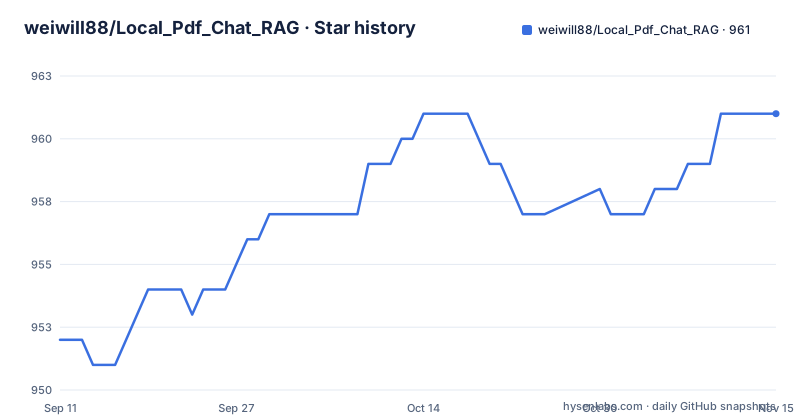
- weiwill88/Local_Pdf_Chat_RAG961 ★ · +9
| Repository | 2026-09-11 | 2026-11-15 |
|---|---|---|
| weiwill88/Local_Pdf_Chat_RAG | 952 | 961 |
9 Stars in the last 65 days, measured from the daily GitHub snapshot. Compare with other projects
Editorial analysis
The maintenance table dates itself two weeks early
The page carries a table of verifiable signals, and one row contradicts the repository. The table is headed as a repository state dated 2026-08-31, and the maintenance row says there were 5 commits in the last 90 days with the latest update to the default branch on 2026-08-16. The repository's own last push is dated 2026-08-31, fifteen days later. So the table is stamped after the event it fails to report, which is a small failure with an easy cause: the numbers were written once and the date field was refreshed later.
The rest of the table is more useful. Two published releases, currently a 2.1.0 whose title describes open-source readiness and bilingual documentation, with the previous one a 2.0.0 titled in Chinese as a modular refactor with bug fixes. Thirty-eight issues closed and none open. Nine pull requests merged and one under review. A latest CI run that passed, where CI compiles the sources and runs credential-free tests on every pull request.
The adoption row gives 951 stars and 179 forks, and a separate row gives 105 unique visitors and 78 unique cloners in the latest 14 day window. Those two rows do not agree about how much use a repository gets, and the page says so in the sentence under the table: the traffic and clone figures indicate interest, not verified installations. That caveat is the honest reading, and it is also why the visitor number is the more useful of the two.
Six missing pieces are listed on the front page
The warning above the usage section is the most valuable sentence in the repository. It says the project is intended for learning and experimentation, that it is not a production-ready knowledge-base service, and it names what to add before using it with real business data: authentication, tenant isolation, persistence, evaluation, security controls, and deployment governance.
Six items, written by the author, above the install instructions, before anyone can run it. Most projects in this category carry a shorter warning or none.
Three of the six are load bearing for how the rest of the code reads. With no authentication, the endpoints are open to anything that can reach the port. With no tenant isolation, two users share one index, which matters because the index is not persisted and not partitioned. With no persistence, a restart costs a full re-index, which is the fact the limitations section goes on to describe.
The other three are the parts a learning project legitimately does not attempt: an evaluation harness, security controls, and the operational work of deployment governance. Their absence is a scope decision, not an oversight, and the list makes it possible to tell the two apart.
Three endpoints, none of which deletes anything
The REST interface has three routes. A status route reports runtime and provider configuration status, an upload route processes a document, and an ask route answers a question against processed documents.
That is the whole surface. There is no route to remove a document, no route to list what has been ingested, and no route to clear the index. For a single-user local tool run by the person who uploaded the file, that is a defensible minimum. For anything shared, it is the shape that produces the support question nobody can reproduce: a document is in the interface, then it is not, and there is no operation that explains the difference.
The status route is the interesting one, because it reports provider configuration rather than health of the retrieval path. That matches the design: the failure mode this project can plausibly have is a misconfigured backend, and the placeholder detection described below exists to catch exactly that case before a request is made.
Combined with the missing authentication from the front page's list, the API is a good illustration of why that warning is there rather than decoration.
The index is in process memory, and the sentence stops there
The known limitations section states that the index is currently held in process memory, and the next sentence is not completed on the page. So the fact is disclosed and the consequence is left to the reader.
The consequence is not small. A vector store and a keyword index that live in RAM are rebuilt when the application starts, which means indexing cost is paid on every launch and scaling is bounded by memory rather than by disk. It also means the two entry points are independent of each other. The Gradio application is one process and the API is another, each with its own store, so a document uploaded through the API is not visible in the interface and vice versa. Nothing in the three endpoint list suggests otherwise.
The other two limitations that do finish are about input rather than storage. PDF extraction reads the text layer and provides no general-purpose OCR, so a scanned document yields nothing. Spreadsheet and presentation extraction focuses on text rather than visual layout, so a figure or a chart layout in a slide is not recovered.
Those three together define what this pipeline is for: born-digital text documents, re-indexed on demand, on a machine the person running it controls.
Two entry points, and one of them probes a port range
The web interface is a single command and it does not use the port the underlying library prefers. It tries a local address on one port first, and if that is unavailable it tries the next four in sequence before giving up. A range rather than a fixed port is a deliberate accommodation for a machine that already runs something on the usual port, which is the right choice for the audience.
The API is a separate command and a separate process. Combined with the in-memory index, that produces the behaviour worth knowing before anyone demos it: two processes, two stores, two sets of loaded documents. Switching from the interface to the API means uploading again.
The startup path for both is the same and is deliberately conventional. A virtual environment is created with a pinned interpreter version, the shell is activated, pip is upgraded, and the requirements file is installed. A separate requirements file exists for the development dependencies, so the runtime set is a real subset rather than everything.
The environment is created with a pinned interpreter version and installed from a requirements file:
python3.10 -m venv .venv
source .venv/bin/activate  # Windows: .venv\Scripts\activate
python -m pip install --upgrade pip
pip install -r requirements.txt
That interpreter is older than the newest, which is a sensible choice for a project whose dependencies are mostly open ranges, and it is the version the documentation is tested against.
Placeholder credentials are detected by their prefix
Configuration is one environment file copied from an example, and at least one of three backends must be filled in: a key for one hosted provider, a key plus an endpoint and model name for any OpenAI-compatible provider, or a locally running model server with the model named in the file.
The detail worth copying is the placeholder rule: values beginning with a specific prefix are treated as placeholders and are not valid credentials. Most example files rely on the user deleting them, and the usual failure is a real request going out with the literal example text as the key. Refusing those values in code turns a silent misconfiguration into an error at the point where the user looks for it.
Two other configuration entries shape behaviour. The reranking method is chosen between a cross-encoder and a language model, so the same pipeline can be run two ways with different latency profiles. The OpenAI-compatible endpoint accepts either a base URL or a full completions URL, which is the accommodation that lets the same three variables drive more than one provider.
One entry works against the local framing: an optional key for a commercial web-search service. Documents and the index stay on the machine, but a configured search key puts an outbound call in the request path, so local describes where the data lives rather than the whole journey.
The tests are credential-free by construction
The test command sets an environment variable that disables automatic loading of third-party test plugins before invoking the runner. That is a deliberate isolation: the suite uses the core runner and nothing a user happens to have installed, so a green local run means the same thing on a clean machine.
Four things are covered. Configuration and default backend selection. Loading behaviour for plain text and Markdown files and for unsupported file types. Merging of keyword and dense results into the hybrid set. And a clean, network-free failure when a credential is missing.
That last one is the interesting test, because it is the failure the placeholder rule is designed to produce. The suite verifies that the system refuses to proceed rather than sending an example value to a provider.
What the suite does not cover is as informative as what it does. There is no test that embeds a document and searches it, no test against a real model, and no test of the reranking path. So the retrieval quality of the pipeline is not something this repository can tell you about, and the label credential-free is accurate in the strict sense: the tests make no network calls and hold no secrets.
A sample document with a non-ASCII filename, and an undocumented tree
The repository root is not a clean library layout. Alongside the two entry points, the configuration module, the pipeline package, the tests and the requirements files, there is a sample PDF with a Chinese filename describing an excavator repair case, plus directories for features, a wiki, utilities and images, and a version module and a pytest configuration file.
The sample document is not a problem in itself; a reference implementation needs something to ask questions about. What is worth noting is that it is the project's own evidence for a pipeline decision. The requirements include a Chinese word segmenter alongside a general text splitter, and the README offers a Chinese translation, so Chinese text is a first-class input case rather than an afterthought, and the sample file matches.
The layout diagram on the page does not help with the rest. It shows the configuration module, the two entry points and eight files inside the pipeline package, then ends with a bare branch marker and no closing entries. So the features, wiki, utilities and image directories are never described on the page that lists them.
Two smaller notes from the maintenance section. The project adopted its open-source licence at some point rather than carrying it from the start, and it now documents a private security-reporting process, which is the right companion to the warning about missing authentication.
Editorial conclusion
Read this as a teaching artefact with unusually honest labelling, which is exactly what it says it is. The pipeline is legible end to end, the modules are named in request order, the placeholders in the environment file are detected rather than silently sent, and the front page enumerates the six things a real deployment needs. Three things to check before building on it. Decide whether an in-memory index is acceptable, because the store is rebuilt on every start and both entry points hold their own. Read the limitations before choosing your document types, since text-layer extraction with no OCR and text-only spreadsheet handling will decide what a scanned PDF costs you. And count the endpoints before exposing anything, because three routes with no delete and no authentication is the shape the page itself warns you about.
Frequently asked questions
What is Local_Pdf_Chat_RAG?
It is an educational Python implementation of a retrieval-augmented generation pipeline, split into modules that follow the order a request is processed: document loading, chunking, embeddings, a FAISS store, a BM25 index, hybrid retrieval, reranking, context building and generation. It ships both a Gradio interface and a FastAPI interface.
Does Local_Pdf_Chat_RAG need an API key?
At least one of three backends must be configured: a SiliconFlow credential, a credential plus endpoint and model for any OpenAI-compatible provider, or a locally running Ollama with the model named in the environment file. Values beginning with a placeholder prefix are treated as placeholders and rejected.
Is Local_Pdf_Chat_RAG production ready?
The page says it is not a production-ready knowledge-base service and lists what to add first: authentication, tenant isolation, persistence, evaluation, security controls and deployment governance. PDF extraction reads the text layer and provides no general-purpose OCR.
What document types can Local_Pdf_Chat_RAG load?
PDF, plain text, Markdown, DOCX, XLS and XLSX, and PPTX. Spreadsheet and presentation extraction focuses on text rather than visual layout, and the requirements carry two spreadsheet libraries because the older one only reads the legacy format.
Does the index survive a restart in Local_Pdf_Chat_RAG?
No. The known limitations state that the index is currently held in process memory, so the store is rebuilt when the application starts. The limitations list ends mid-sentence on that point, so the page describes no mitigation.
Official sources
Add this badge to your README
If you maintain this project, the badge below links readers to this analysis and shows its maintenance status from the daily GitHub snapshot. Paste the markdown into your README; add ?metric=license or ?metric=stars to the image URL for a different field.

[](https://hysenlabs.com/projects/weiwill88-local-pdf-chat-rag)Star history chart for your README
[](https://hysenlabs.com/projects/weiwill88-local-pdf-chat-rag)Was this useful?