Xaya Core: names, CHI Coins and game assets on Namecoin
XAYA Core
At a glance
- What is it?
- A decentralized information registration and transfer system built on Namecoin, aimed at blockchain gaming, and shipping the usual daemon, Qt client and command line binaries. The repository layout is close enough to Bitcoin's that the README tells you to build it with a Bitcoin guide, which tells you most of what you need to know.
- Who is it for?
- Xaya Core fits a developer building a game or a decentralised application that needs user accounts, an in-game currency or asset ownership recorded on chain rather than in a central database, and it is a reasonable base to read if you want to see Namecoin's design applied to a different vertical. Three things to check before you commit.
- Can I use it commercially?
- Yes. MIT is a permissive licence: you can use, modify and sell software built on it, as long as you keep its copyright and licence notices.
- Is it still maintained?
- Probably not. The repository last received commits 14 months ago, on August 19, 2025.
- What is it written in?
- Mainly C++, according to GitHub's language statistics.
Answers come from the project's GitHub data, last synced on October 22, 2026, and from our analysis. They are not legal advice.
Star history
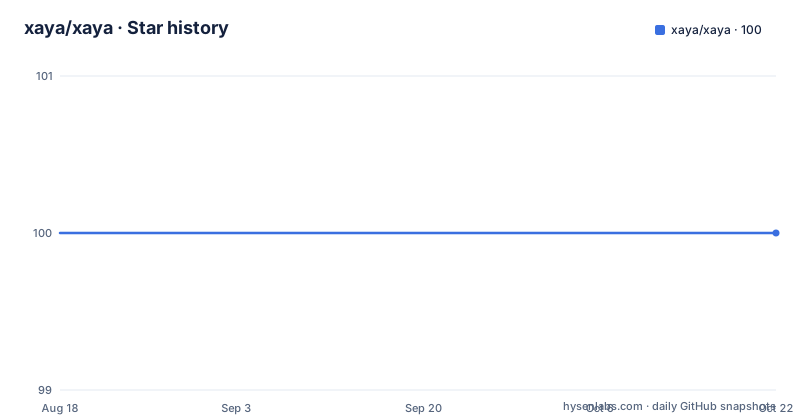
- xaya/xaya100 ★ · +0
| Repository | 2026-08-18 | 2026-10-22 |
|---|---|---|
| xaya/xaya | 100 | 100 |
0 Stars in the last 65 days, measured from the daily GitHub snapshot. Compare with other projects
Editorial analysis
A Namecoin chain built for games
Xaya Core is described as a decentralized open source information registration and transfer system based on the Namecoin cryptocurrency, and the reason it exists is vertical: it is primarily aimed at decentralized blockchain gaming. It is also positioned as the first layer of the Xaya Platform, which implies more layers exist above it, and the project was formerly called Chimaera. The name change is mentioned in one line under the title and nothing else, so anyone arriving from the older name has no migration notes here. The implementation language is C++, and the licence is MIT with the text in the COPYING file at the root. The project also keeps its own homepage at xaya.io and its own forum, which is where the build guidance and support requests are pointed.
Five capabilities, and the currency is CHI
The list of what it does is short. It securely records and transfers arbitrary names, described as keys. It transacts CHI Coins, the digital currency referred to as CHI. It stores data. It allows the creation of tokens. And then the README says and more, which is honest about the boundary and unhelpful if you need specifics. Two things are worth pulling out of that list. First, the naming layer is the primitive: everything else in the platform hangs off names that can be recorded and transferred. Second, the currency is native rather than borrowed, so a game that wants its own in-game currency does not need a second chain. What the repository does not state is anything about supply, issuance or transaction costs for CHI, so those details are not something this README will answer.
The use case list reads like a game developer's checklist
The applications section is written from the point of view of someone building a game or a complex decentralised application. Alongside some of Namecoin's own use cases, it lists the creation of game accounts, the creation of virtual game currencies, and asset storage, ownership and management with in-game items called out specifically. Then come identification and authentication systems, distributed applications, a payment gateway, and decentralised autonomous worlds. Read as a set, it is the standard argument for putting a name registry and a token on chain rather than in a central account system: the game does not own the identity, and the items keep an owner recorded outside the game server. What is missing is equally informative. There is no description of how any of these are done, no API documentation in the README, and no example application, so the list is a statement of intent rather than a specification.
The tree is Bitcoin's, which is why the build guide is Bitcoin's
The most useful signal in the repository is its file list. At the root there is libbitcoinkernel.pc.in, a pkg-config template named after Bitcoin's kernel library, alongside a depends/ directory, a contrib/ directory, CMakeLists.txt with a CMakePresets.json beside it, a vcpkg.json for dependency resolution, a COPYING file, a .cirrus.yml continuous integration configuration, and a .tx/ directory for translation. That set of names is what a Namecoin style chain inherits from Bitcoin, and the README leans on it openly: it says you can follow any Bitcoin build guide and just replace the repository with Xaya's, linking the Bitcoin documents for Windows, Unix and macOS. There is also a forum thread with a guide to building Xaya on Ubuntu for anyone who would rather have instructions written for the case at hand. So the practical build story is: take a Bitcoin build recipe, point it at this repository.
Three binaries, and a wallet for everyone else
Xaya Core ships the binaries you would expect from a chain at this stage of its life, described in the README as the base elements required for experienced users, miners and exchanges: xayad, which is the daemon, xaya-qt, the Qt client, and xaya-cli, the command line client, plus what the README calls the usual. That split tells you who the project considers its users. Miners and exchanges are named first, which is consistent with a chain whose value depends on its node distribution, and experienced users get the daemon directly. Everyone else is pointed elsewhere: standard users are told to use the XAYA Electron Wallet, which is a front end to xayad and lives in its own repository. That is a reasonable division, but it also means the wallet is not part of what you get here, so an evaluation of the platform has to look at two codebases.
Documentation lives in three places, none of them the README
The README is an overview rather than a manual, and it says where the rest lives. Specifications and additional information are in the doc/xaya directory inside the repository itself. Tutorials are in a separate wiki repository, xaya_tutorials, and the README links it directly. Build guidance for Ubuntu is a forum thread, topic 59 on the Xaya forum, and support questions are directed to either a GitHub issue or that same forum. There is an INSTALL.md at the root and a CONTRIBUTING.md, so the tree carries the two documents you would expect, and a SECURITY.md for disclosures. The split across four locations, repository, wiki, forum and issues, is normal for a chain project of this vintage and is worth knowing before you start, because there is no single entry point that answers everything.
The newest tag is over a year older than the newest commit
The version history and the commit history disagree, and that is the one thing about the project's state you should read before planning anything. The recent releases are Xaya Core 1.11.1 from 18 June 2024, 1.11 from 22 April 2024, and 1.10.1 from 2 April 2024. The last recorded push to the default branch is 19 August 2025, more than a year after the newest tag. So the code has moved since 1.11.1 without a release to mark it, and there is no way to tell from the tags alone which of the two you would be building. The repository is not archived, and the default branch is master rather than main. Anything you build from master is by definition ahead of every published version, which is a reasonable thing to do deliberately and a poor thing to do by accident.
Editorial conclusion
Xaya Core fits a developer building a game or a decentralised application that needs user accounts, an in-game currency or asset ownership recorded on chain rather than in a central database, and it is a reasonable base to read if you want to see Namecoin's design applied to a different vertical. Three things to check before you commit. The release history stops at 1.11.1 from June 2024 while the last commit on master is from August 2025, so the tags tell you nothing about how current the code is. The build path is inherited rather than documented, which is fine for anyone comfortable following a Bitcoin build guide and a poor experience for anyone who is not. And the project says so itself that it is the first layer of a wider platform, with a separate Electron wallet recommended for ordinary users. MIT licensed, C++, formerly known as Chimaera.
Frequently asked questions
What is Xaya?
Xaya Core is a decentralized open source information registration and transfer system based on the Namecoin cryptocurrency, primarily aimed at decentralized blockchain gaming. It is the first layer of the Xaya Platform, was formerly called Chimaera, and is written in C++ under the MIT licence.
What does Xaya Core actually do?
It securely records and transfers arbitrary names, described as keys, transacts CHI Coins, stores data, and allows the creation of tokens. The README ends that list with and more rather than enumerating the rest.
Which binaries does Xaya Core ship?
xayad, the daemon, xaya-qt, the Qt client, and xaya-cli, described as the base elements for experienced users, miners and exchanges. Standard users are pointed instead to the XAYA Electron Wallet, a front end to xayad that lives in a separate repository.
How do I build Xaya Core on Ubuntu or macOS?
The README points to a forum thread with a guide to building Xaya on Ubuntu, and also says you can follow any Bitcoin build guide for Windows, Unix or macOS and just replace the repository with Xaya's, linking the Bitcoin documents for each platform.
What is CHI in Xaya?
CHI Coins are the digital currency, abbreviated CHI, which Xaya Core transacts alongside name registration, data storage and token creation. The README does not state anything about CHI supply, issuance or transaction costs.
Official sources
Add this badge to your README
If you maintain this project, the badge below links readers to this analysis and shows its maintenance status from the daily GitHub snapshot. Paste the markdown into your README; add ?metric=license or ?metric=stars to the image URL for a different field.

[](https://hysenlabs.com/projects/xaya-xaya)Star history chart for your README
[](https://hysenlabs.com/projects/xaya-xaya)