New Grad Software Engineering Jobs 2027: reading the rows, not the heading
2027 entry-level software engineering jobs — SWE & full-time US roles from top tech companies & startups
At a glance
- What is it?
- This repository is a software engineering job list rendered as a README and a static page, where each row carries a company, role, location, posted age, a visa mark and a tracked apply link. The section heading filters nothing: experienced, manager, intern and sourcer roles all appear under it.
- Who is it for?
- This list suits a new graduate who wants breadth across a large set of US employers in one page and can filter by reading the role titles, since the section heading is a search scope rather than a qualification. It does not suit someone who needs the list already filtered to entry level, and the visa mark is a per-row claim that still needs confirming.
- Can I use it commercially?
- Check first. The repository uses a licence we do not classify automatically, so read its LICENSE file before any commercial use.
- Is it still maintained?
- Yes. The repository received new commits within the last day.
- What is it written in?
- Mainly HTML, according to GitHub's language statistics.
Answers come from the project's GitHub data, last synced on October 22, 2026, and from our analysis. They are not legal advice.
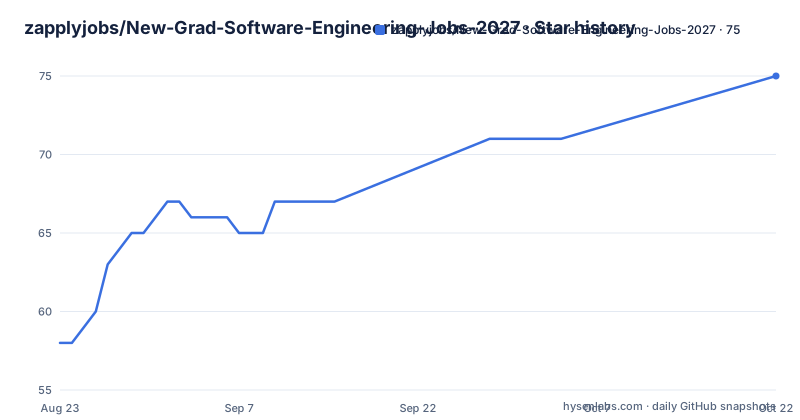
Star history
- zapplyjobs/New-Grad-Software-Engineering-Jobs-202775 ★ · +17
| Repository | 2026-08-23 | 2026-10-22 |
|---|---|---|
| zapplyjobs/New-Grad-Software-Engineering-Jobs-2027 | 58 | 75 |
17 Stars in the last 60 days, measured from the daily GitHub snapshot. Compare with other projects
Editorial analysis
Six columns and a filter that does not filter
The table has six columns and they are the whole interface: company, role, location, posted, visa and apply. The section is a collapsible block headed Software Engineering, inside a page titled for software engineering jobs in 2027, with a tagline claiming the list is updated every ten minutes. The repository itself is a single source of truth for the data rather than a data file: the top level holds a README, an index page, an images directory, a file for language model consumption, a licence, a code of conduct, a contributing guide and a contributors file, and GitHub reports HTML as the primary language. One inconsistency to note: a licence file is present at the top level while GitHub reports the licence as unasserted, so the terms have to be read from that file rather than from the repository metadata. There are no releases, so the rows on the main branch are the whole list.
The posted ages do not match the ten-minute claim
The posted column is where the freshness claim can be checked, and the values run from seventeen minutes to a full hour. The first visible row is seventeen minutes old, six rows are at eighteen minutes, two at nineteen, then one at thirty-four and one at forty-one, and everything after that sits at one hour. A ten-minute cadence would produce a spread between zero and ten minutes, so what the table actually shows is a pipeline whose recent tail runs to about an hour, whatever the stated interval. For a reader the practical consequence is small but real: the newest rows are worth opening immediately, and a row at one hour may already have been taken. The same structure appears in the other job lists this organisation publishes, so the behaviour looks like a property of the collection pipeline rather than of this page.
Three applicant tracking systems in the apply column
Every apply cell is a redirect rather than a link to the employer's page, and the path names the system the posting came from. Most rows carry a workday path with the company's careers slug and a requisition identifier, two Apple rows carry an apple path, and the OpenAI posting carries an ashby path. Each redirect also carries a source parameter naming this repository, so the destination can attribute the click. The requisition identifier is the durable part. A company's own careers page will surface the same posting after the redirect changes or after the row leaves this list, and the identifier is what to quote when a listing has moved. The trade is the usual one: every application route runs through one redirect service, so that service is a single point of failure for the list.
Experienced roles sit under the new grad heading
The list is titled for new graduates and the section is headed Software Engineering, and the titles inside it are not filtered that way. Boeing contributes a role explicitly open to experienced or senior candidates and another open to associate or experienced ones. USAA lists an intermediate-level contact centre applications role, RTX lists a software engineer level two, and Home Depot lists a remote software engineer manager role for cloud platform products covering agentic workloads. One OpenAI row is a technical sourcer for research software engineers, which is a recruiting role rather than an engineering one, and an Apple row is a people analytics full stack developer, which is a software title without an engineering one. Only one visible row signals entry level in the title itself, an early career data collection role at General Motors. The heading is a search scope, so the filter has to happen in your reading.
The visa column, and its three empty cells
Each row has a visa column, and most rows carry a mark indicating sponsorship. Three visible rows leave it empty: a machine learning software engineer role at Crowe, a summer intern role in software quality assurance at Allegion, and the remote manager role at Home Depot. The limitation is that the column describes the posting rather than a programme, and nothing in the repository explains how the mark is determined, whether it is read from the posting text or applied by hand, or when it was last checked against the employer's own documentation. Treat it as a shortlisting filter rather than a guarantee, and confirm with the recruiter, since eligibility tends to depend on the individual requisition and often on the candidate. It is also worth noticing that the two rows with the sparsest description, a machine learning role and a quality assurance internship, are two of the three with no mark at all.
Internships, sourcers and managers share one table
The seniority spread is the widest in this list, wider than a title-based filter would suggest. On the entry side there are two KLA software engineering internships, a quality assurance internship, and the early career General Motors role. In the middle sit first-level and associate titles, several full stack developer roles across a consultancy, a bank, a consultancy and an insurer, and a platform engineer role for OpenShift and model context protocol work. On the senior side there is an engineer level two at a defence contractor, an engineer manager role at a retailer, and a Boeing role that names senior candidates outright. The visible set also contains titles that are explicitly about machine learning and AI, including a C++ metrics frameworks role and a robotics simulation systems role, which is a reasonable signal about what these employers are hiring for but not a forecast.
The list is the top of a funnel
The first section of the page is not about jobs. It points at an onboarding page on the company's own site and promotes four things: a Chrome extension that autofills job applications in seconds, a dedicated job board with openings across various roles, user accounts carrying multiple profiles for different resume types and roles, and application tracking with streaks and commitment awards. A second section invites readers to a community of students and new graduates through a Discord server and a LinkedIn company page, and the onboarding link carries a referral parameter naming this repository, which is how the list and the service are joined. The published site is served from the same repository as the README, and the file for language model consumption sits at the top level with no explanation anywhere in the page of what it contains or who reads it.
Editorial conclusion
This list suits a new graduate who wants breadth across a large set of US employers in one page and can filter by reading the role titles, since the section heading is a search scope rather than a qualification. It does not suit someone who needs the list already filtered to entry level, and the visa mark is a per-row claim that still needs confirming. Before applying, read the full title, use the posted age to judge whether a row is still fresh, note that the redirect encodes both the applicant tracking system and the requisition identifier so you can find the same posting on the employer's own site, and remember the default branch was last pushed on 2026-09-28.
Frequently asked questions
When should I start applying for jobs if I graduate in May 2027?
The repository gives no application-timing advice. What it publishes is rows with a posted age measured in minutes, refreshed on a claimed ten-minute cycle, under a list titled 2027. The ages in the visible table run from seventeen minutes to a full hour, which is the useful signal for judging whether a row is still fresh.
Will software engineers be replaced by AI in 2026?
Nothing in the repository addresses that question. What its rows show is a set of current postings, several of which are explicitly AI-adjacent: a machine learning software engineer role, an ML and AI role for C++ metrics frameworks, a robotics simulation systems role, and a cloud platform manager role covering agentic workloads.
Which job boards feed the New Grad Software Engineering Jobs 2027 list?
Three families appear in the apply links: a workday path with the company's careers slug and a requisition identifier for most rows, an apple path for two Apple roles, and an ashby path for the OpenAI posting. Each redirect also carries a source parameter naming the repository, so the requisition identifier is what to use to find the same posting on the employer's own site.
Does this list only contain new graduate roles?
No. The visible rows include a Boeing role open to experienced or senior candidates, another open to associate or experienced candidates, an intermediate-level USAA role, a software engineer level two at RTX, a software engineer manager role at Home Depot, an OpenAI technical sourcer posting, an Apple people analytics developer role, and several internships. Only one row signals entry level in its title.
What does the visa column mean in this job list?
That the posting is marked as sponsorship available. Most rows carry the mark, and three visible rows leave the cell empty, including a machine learning role, a quality assurance internship and a remote manager role. The repository does not explain how the mark is determined or when it was verified, so confirm with the recruiter.
Official sources
Add this badge to your README
If you maintain this project, the badge below links readers to this analysis and shows its maintenance status from the daily GitHub snapshot. Paste the markdown into your README; add ?metric=license or ?metric=stars to the image URL for a different field.

[](https://hysenlabs.com/projects/zapplyjobs-new-grad-software-engineering-jobs-2027)Star history chart for your README
[](https://hysenlabs.com/projects/zapplyjobs-new-grad-software-engineering-jobs-2027)