MNN: Alibaba's On-Device Inference Engine for LLMs and Edge AI
MNN: A blazing-fast, lightweight inference engine battle-tested by Alibaba, powering high-performance on-device LLMs and Edge AI.
At a glance
- What is it?
- MNN is a C++ inference engine from Alibaba that runs deep learning models on mobile, embedded, and IoT devices, now with LLM and diffusion runtimes. This review covers its architecture, setup, limitations, and alternatives for engineers deciding whether to adopt it.
- Who is it for?
- Adopt MNN if you need on-device inference for LLMs or diffusion models on Android, iOS, or Qualcomm Hexagon DSPs, especially if you already target Alibaba's model zoo. Avoid it if you require a pure desktop GPU inference engine or if your team lacks C++ expertise for custom backend tuning.
- Can I use it commercially?
- Yes. Apache-2.0 is a permissive licence: you can use, modify and sell software built on it, as long as you keep its copyright and licence notices.
- Is it still maintained?
- Yes. The repository last received commits 1 day ago.
- What is it written in?
- Mainly C++, according to GitHub's language statistics.
Answers come from the project's GitHub data, last synced on November 13, 2026, and from our analysis. They are not legal advice.
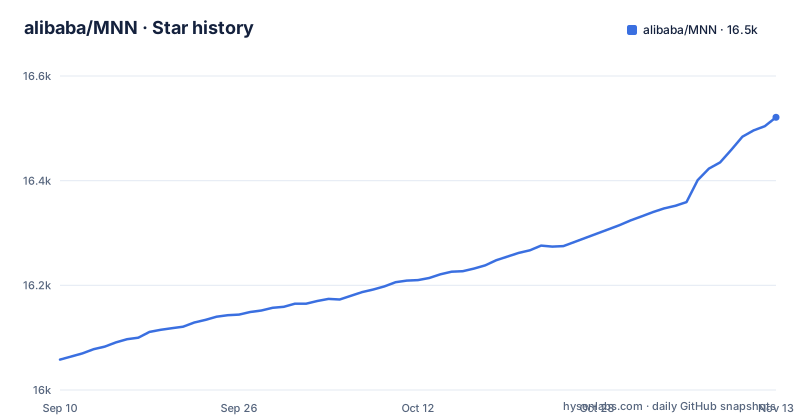
Star history
- alibaba/MNN16,521 ★ · +463
| Repository | 2026-09-10 | 2026-11-13 |
|---|---|---|
| alibaba/MNN | 16.1k | 16.5k |
463 Stars in the last 64 days, measured from the daily GitHub snapshot. Compare with other projects
Editorial analysis
What MNN Solves and Who Needs It
MNN is a deep learning inference engine written in C++, designed for devices with limited compute and memory. Alibaba reports integrating it into more than 30 of its apps, including Taobao and DingTalk, covering over 70 use cases from live broadcast to security risk control. The engine also targets embedded and IoT hardware. For engineers, the core problem is running models locally without a cloud round trip, which matters for latency, privacy, and offline operation. The project has expanded beyond classic convolutional networks. It now includes MNN-LLM, a runtime for large language models, and MNN-Diffusion for stable diffusion. These runtimes aim to put generative models on phones and PCs. The intended user is a developer building mobile or edge applications that need fast, local inference for both traditional vision models and modern transformer-based models.
Architecture: From Convolution to Transformers
The repository shows a layered design. The core engine handles operator execution across backends, while separate runtime modules sit on top for LLMs and diffusion. The base engine supports ARM, Vulkan, and other compute targets, with a Winograd algorithm for convolution acceleration. The LLM runtime, documented under transformers/README.md, supports popular models such as Qwen, Baichuan, Zhipu, and LLaMA. The diffusion runtime handles stable diffusion models. The recent addition of a Hexagon backend, announced in version 3.6.1, extends the engine to Qualcomm DSPs, which is a distinct path for offloading inference from the CPU or GPU.
Getting MNN Running: Build and Integration
The repository carries a top-level CMakeLists.txt, which points to a CMake-based C++ build. You would clone the repository, check out a release tag like 3.6.1, and build using CMake with options for your target backend. For Android, the project includes sample apps under apps/Android, such as MnnLlmChat. iOS apps are under apps/iOS. The documentation site at mnn-docs.readthedocs.io contains user guides for both the LLM and diffusion runtimes. For a quick start, you would likely convert a model using MNN's conversion tools, then load it with the MNN interpreter in your application. The release history shows a steady cadence: 3.6.0 in June, 3.6.1 in July and 3.6.2 in October 2026, which suggests active maintenance. You should consult the official documentation for the exact build flags.
The Hexagon Backend: A New DSP Path
Version 3.6.1 introduced a Hexagon backend, which is a significant addition for Qualcomm-based devices. The README states it enables accelerated model inference on Qualcomm Hexagon DSPs. This is not a minor feature. DSPs consume less power than GPUs and can free the CPU for other tasks. For always-on or battery-sensitive applications like voice assistants or sensor processing, a DSP backend can be the difference between a viable product and a thermal disaster. The main README links to the backend's own README under source/backend/hexagon for details. An engineer considering this path must read that file and test on actual hardware.
Performance Claims and the OSDI Paper
The README points to an OSDI'22 paper about the Walle system, which uses MNN as its compute container. The paper includes benchmark results against TensorFlow, TensorFlow Lite, PyTorch, PyTorch Mobile, and TVM. This is a credible source of performance data, but it is a research paper from 2022. MNN has evolved since then, adding LLM and diffusion support. The README says MNN has industry-leading performance for inference and training on-device. For engineers, the practical step is to run the scripts in the /benchmark directory against your own models and devices. The OSDI paper is useful for understanding the design principles, but it does not reflect the current state of the transformer runtimes. Do not assume that the 2022 benchmarks apply to today's LLM workloads.
Limitations and Wrong Tool Scenarios
MNN is not a general-purpose training framework. The README mentions training support, but the focus is clearly inference. For engineers who need to train custom models, other frameworks are more appropriate. The repository also shows a heavy tilt toward Alibaba's ecosystem. The news items emphasize Qwen models and Alibaba apps. If your production models are not in the supported list, you may need to convert them and deal with operator gaps. The README gives operator counts per converter format (178 Tensorflow, 52 Caffe, 163 Torchscripts, 158 ONNX), so verify your own model against them. Another limitation is the complexity of the build. A C++ engine with multiple backends requires cross-compilation skills. The sample apps help for Android and iOS, but for embedded Linux or custom hardware, you will need to configure the build yourself. The Hexagon backend is new and likely immature; expect bugs and limited documentation.
Alternatives: ONNX Runtime and TensorFlow Lite
The most direct alternative is ONNX Runtime, which supports a wide range of hardware backends including CPU, GPU, and NPUs, and has a mature Python API for model conversion. Its approach is different: ONNX Runtime uses a graph optimization pass and a pluggable execution provider architecture. TensorFlow Lite is another alternative, especially for mobile, with a focus on quantization and a large community. The key difference is that MNN is built specifically for Alibaba's production scenarios, which include extremely diverse Android devices and now LLMs, whereas TensorFlow Lite has broader industry adoption. For LLM deployment, MNN's dedicated runtime is a differentiator; ONNX Runtime has LLM support but is heavier. Your choice depends on whether you need the specialized LLM runtime or prefer a more general engine with broader ecosystem support.
Maintenance, Licensing, and Upgrade Costs
MNN is licensed under Apache-2.0, which is permissive for commercial use, but you should read the license text for any patent or notice clauses. The repository shows regular releases, with 3.6.0, 3.6.1 and 3.6.2 all released in 2026. This cadence means you will need to track upgrades to get bug fixes and new features, such as the Hexagon backend. Each new backend adds complexity to the codebase, and upgrading MNN may require re-testing your models across all target devices. The documentation is split between the README, the readthedocs site, and per-backend READMEs, which can make it hard to find current information. For a production deployment, you should pin a specific release and budget time for regression testing when you upgrade.
Editorial conclusion
Adopt MNN if you need on-device inference for LLMs or diffusion models on Android, iOS, or Qualcomm Hexagon DSPs, especially if you already target Alibaba's model zoo. Avoid it if you require a pure desktop GPU inference engine or if your team lacks C++ expertise for custom backend tuning. Before committing, verify model coverage for your specific architectures, test the Hexagon backend on your target DSP, and review the OSDI paper's benchmarks against your own workloads.
Frequently asked questions
What is Alibaba MNN and what is it used for?
MNN is a lightweight C++ deep learning framework for inference and training on device, and the README says it is integrated into more than 30 Alibaba apps including Taobao, Tmall, Youku, DingTalk and Xianyu. It also runs on embedded devices such as IoT hardware, and two runtimes, MNN-LLM and MNN-Diffusion, are built on top of it.
Which model formats can MNN convert?
The converter handles Tensorflow, Caffe, Torchscripts and ONNX. The README counts 178 Tensorflow OPs, 52 Caffe OPs, 163 Torchscripts OPs and 158 ONNX OPs, and describes MNN as supporting approximate full OPs for the AI model.
How large is the MNN library on iOS and Android?
On iOS the static library for the full option across armv7 and arm64 is about 12MB, adding about 2M to a linked executable. On Android the core shared object is about 800KB for armv7a against c++_shared. FP16 and Int8 quantize can reduce model size by 50%-70%.
What does the MNN_BUILD_MINI build option do in MNN?
It reduces package size by about 25%. The README attaches a limit to it: a fixed model input size, so models that need dynamic input dimensions are not candidates for a MINI build.
Does MNN support GPUs and other accelerators?
The README states that hybrid computing currently supports CPU and GPU, using Metal, OpenCL and Vulkan on mobile and CUDA and tensorcore for NVIDIA. Release 3.6.1 added a separate Hexagon backend for Qualcomm Hexagon DSPs, documented under source/backend/hexagon/.
Official sources
Add this badge to your README
If you maintain this project, the badge below links readers to this analysis and shows its maintenance status from the daily GitHub snapshot. Paste the markdown into your README; add ?metric=license or ?metric=stars to the image URL for a different field.

[](https://hysenlabs.com/projects/alibaba-mnn)Star history chart for your README
[](https://hysenlabs.com/projects/alibaba-mnn)Was this useful?