Apache NuttX: A POSIX-First RTOS for 8-Bit to 64-Bit Microcontrollers
Apache NuttX is a mature, real-time embedded operating system (RTOS).
At a glance
- What is it?
- Apache NuttX is a real-time operating system that prioritizes POSIX and ANSI compliance over proprietary APIs. This review covers its architecture, build process, limitations, and when it beats or loses to other RTOS options.
- Who is it for?
- NuttX is an RTOS worth evaluating when familiar POSIX-style APIs and configurable embedded features matter. Support and conformance vary by API, board and configuration, so check the documentation for your release and test the exact hardware, toolchain, memory budget and timing requirements.
- Can I use it commercially?
- Yes. Apache-2.0 is a permissive licence: you can use, modify and sell software built on it, as long as you keep its copyright and licence notices.
- Is it still maintained?
- Yes. The repository received new commits within the last day.
- What is it written in?
- Mainly C, according to GitHub's language statistics.
Answers come from the project's GitHub data, last synced on November 13, 2026, and from our analysis. They are not legal advice.
Star history
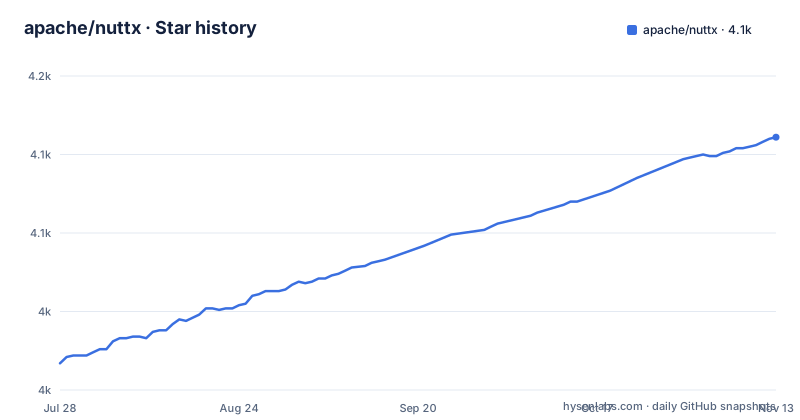
- apache/nuttx4,111 ★ · +144
| Repository | 2026-07-28 | 2026-11-13 |
|---|---|---|
| apache/nuttx | 4k | 4.1k |
144 Stars in the last 108 days, measured from the daily GitHub snapshot. Compare with other projects
Editorial analysis
What NuttX Solves and Who Needs It
NuttX targets engineers who want a real-time operating system without abandoning familiar POSIX and ANSI interfaces. Most RTOSes for microcontrollers, such as FreeRTOS or Zephyr, offer their own task, queue, and timer APIs. NuttX provides many POSIX-style interfaces, including pthreads and file descriptors, subject to configuration and implementation coverage; other RTOSes may also offer standards compatibility layers. That matters if you are porting code from a Unix-like system or if your team already knows POSIX programming. The project describes itself as scalable from 8-bit to 64-bit microcontroller environments, which is a wide net. It is not a general-purpose OS for desktop machines. It is for deeply embedded devices where memory is constrained but you still want standards-compliant interfaces. The README explicitly notes that some Unix APIs like fork() are not appropriate for such environments, so NuttX adopts alternatives where needed.
How the Architecture Honors POSIX Without Ignoring Embedded Realities
The core design choice is to make POSIX and ANSI standards the primary governing rules. That means the scheduler, inter-process communication, and file system interfaces follow those standards where possible. For functionality not covered by POSIX, NuttX borrows from Unix and other RTOSes like VxWorks. This hybrid approach is visible in the documentation's explanation: it adopts additional APIs only when a standard is missing or when the standard behavior is unsuitable for a small device. The result is an RTOS that can look familiar to a Linux developer but still includes real-time scheduling and synchronization facilities whose exact behavior depends on configuration; POSIX also defines scheduling and priority-inheritance interfaces. The repository layout, with separate directories for arch, drivers, and fs, suggests a modular kernel, but the README does not detail the internal scheduler. The emphasis is on the API surface, not on the kernel internals.
Getting Started: The Simulator Is the Fastest Path
The official quickstart covers prerequisites, source checkout and the simulator. NuttX uses Kconfig: choose a board configuration, optionally adjust it with menuconfig, then build using the documented toolchain. For example, the configuration guide uses `./tools/configure.sh -l sim:nsh` from the NuttX directory for a simulator configuration. Follow the complete version-specific quickstart, including its separate applications repository and host dependencies, before running the build.
Supported Boards and the Cost of Portability
The README claims support for a wide variety of platforms, with a full list on the Supported Platforms page. That breadth is both a strength and a burden. A wide board list means you can reuse your NuttX knowledge across different silicon vendors, which is rare among RTOSes. But it also means the project must maintain many board-specific drivers and configurations. The documentation warns that you should check the list before assuming your board is supported. If your board is not listed, look for compatible board support or community ports; a custom port may be needed and its effort depends on the hardware and available drivers. The project's size is a factor: the large selection of boards and features can make configuration discovery more involved, although a configured build need not compile every board's code. For a small project with a single custom board, this could be overkill.
Where NuttX Is the Wrong Tool
NuttX is not for every embedded project. If your device has a tiny flash budget, say a few kilobytes, and you only need a simple loop with interrupts, an RTOS may be unnecessary. A configured NuttX image may use more memory than a minimal bare-metal loop; measure flash and RAM for the actual configuration and alternatives. The README emphasizes small footprint, but that is relative to other full-featured RTOSes, not to bare metal. Also, if your team has no Unix background, the POSIX API can be a steep learning curve. You might be better off with a simpler RTOS that uses a task-creation function and a delay call. NuttX's adoption of VxWorks-style APIs for some features may also confuse developers who expect pure POSIX. The project's own caveat about fork() shows that it does not blindly follow standards, so you must read the docs for each API.
Alternative: Zephyr and Its Devicetree Approach
Zephyr and NuttX both offer configurable embedded systems and POSIX-related interfaces, though their API coverage and hardware support differ. Zephyr uses Devicetree and Kconfig; NuttX also uses Kconfig and provides board-specific configurations. Compare the exact board, drivers, required APIs, footprint, licensing and tooling using representative builds rather than assuming either configuration model is universally easier or more capable.
Licensing and Maintenance Considerations
The repository is under the Apache-2.0 license or a compatible license, as stated in the README. That is a permissive license, which is good for commercial products because Apache-2.0 permits use in proprietary products subject to its conditions, including applicable licence, notice and modification requirements. Review the licences and notices of all components included in your firmware. The project is an Apache Software Foundation project, which implies a certain level of governance and community oversight, but the README does not provide release cadence or maintenance metrics. Check the project's current releases, maintenance policy and security advisories before relying on a particular version for a long-term product. The documentation includes contributing guidelines, which suggests an active development process, but you must verify the current state yourself.
Editorial conclusion
NuttX is an RTOS worth evaluating when familiar POSIX-style APIs and configurable embedded features matter. Support and conformance vary by API, board and configuration, so check the documentation for your release and test the exact hardware, toolchain, memory budget and timing requirements. The simulator is useful for learning the build workflow, but it does not replace testing on the target device.
Frequently asked questions
what is nuttx
Apache NuttX is a mature real-time embedded operating system with an emphasis on standards compliance and small footprint. It scales from 8-bit to 64-bit microcontroller environments, and its primary governing standards are POSIX and ANSI.
what is nuttx rtos
NuttX is a real-time embedded operating system with configurable subsystems and POSIX-style interfaces. Its core OS is maintained in the nuttx repository, while applications and examples are also maintained in the separate nuttx-apps repository; the absence of a top-level apps directory in the core repository does not mean applications are unavailable.
is nuttx open source
Yes, under the Apache 2 licence. The repository states that the code is under either the Apache 2 license or a license compatible with the Apache 2 license, which covers vendor board support code, and the documentation site carries a license page with the detail.
Official sources
Add this badge to your README
If you maintain this project, the badge below links readers to this analysis and shows its maintenance status from the daily GitHub snapshot. Paste the markdown into your README; add ?metric=license or ?metric=stars to the image URL for a different field.

[](https://hysenlabs.com/projects/apache-nuttx)Star history chart for your README
[](https://hysenlabs.com/projects/apache-nuttx)Was this useful?