auto-sklearn: scikit-learn estimators that pick their own models, and what that costs
Automated Machine Learning with scikit-learn
At a glance
- What is it?
- A research-derived AutoML toolkit that fits model selection, preprocessing and hyperparameter tuning behind the scikit-learn estimator interface, pinned to a scikit-learn version from 2021.
- Who is it for?
- auto-sklearn is a legitimate choice for a research baseline or a tabular problem where you want a strong model fast and do not mind a long fit, and the four-line estimator interface makes it drop into a scikit-learn pipeline without ceremony. Two constraints decide whether it is usable for you, and both are visible in the repository rather than buried.
- Can I use it commercially?
- Yes. BSD-3-Clause is a permissive licence: you can use, modify and sell software built on it, as long as you keep its copyright and licence notices.
- Is it still maintained?
- Yes. The repository last received commits 4 days ago.
- What is it written in?
- Mainly Python, according to GitHub's language statistics.
Answers come from the project's GitHub data, last synced on November 26, 2026, and from our analysis. They are not legal advice.
Star history
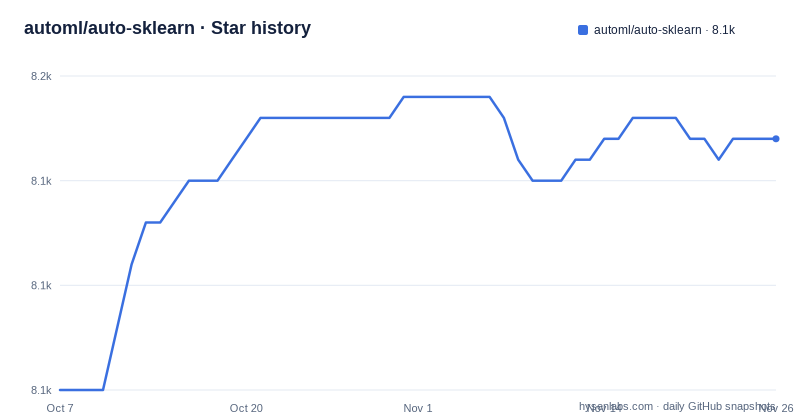
- automl/auto-sklearn8,147 ★ · +12
| Repository | 2026-10-07 | 2026-11-26 |
|---|---|---|
| automl/auto-sklearn | 8.1k | 8.1k |
12 Stars in the last 50 days, measured from the daily GitHub snapshot. Compare with other projects
Editorial analysis
The four-line interface and what sits behind it
The README's selling point is brevity. The whole estimator fits into four lines:
import autosklearn.classification
cls = autosklearn.classification.AutoSklearnClassifier()
cls.fit(X_train, y_train)
predictions = cls.predict(X_test)
`AutoSklearnClassifier` satisfies the scikit-learn estimator protocol, so it drops into `Pipeline`, `cross_val_score` and `GridSearchCV` wherever a classifier would go. The repository description calls it a drop-in replacement for a scikit-learn estimator, and the API reference links out to the hosted manual rather than duplicating it.
What runs inside that `fit` call is the actual research contribution. The dependencies name some of the pieces, such as `smac` for the optimizer and `ConfigSpace` for the configuration space, and the Auto-sklearn 2.0 paper the README cites is titled "Hands-free AutoML via Meta-Learning". The README's "auto-sklearn in one image" section gives the visual overview.
So the trade is explicit. You give up control of the pipeline in exchange for a good starting point, and you pay in compute time, because the search has to actually run rather than start from a guess.
The scikit-learn pin is the real constraint
The single most consequential line in this repository is not in the README. It is in `requirements.txt`, which pins the estimator library to a narrow window:
scikit-learn>=0.24.0,<0.25.0That range is scikit-learn 0.24, a generation released in 2021. It means a current scikit-learn installation will not satisfy this resolver, and installing auto-sklearn into an environment that already has a modern scikit-learn either fails or forces you to downgrade it. For research work in a dedicated virtual environment or a container that is fine. For a shared analytics environment or a service that also uses scikit-learn directly, it is a hard blocker rather than an inconvenience.
The rest of the dependency list tells you what the search engine is made of: `ConfigSpace>=0.4.21,<0.5` for the configuration space, `smac>=1.2,<1.3` for the optimizer, `pynisher>=0.6.3,<0.7` and `pyrfr>=0.8.1,<0.9`. `dask`, `distributed`, `pandas`, `liac-arff`, `threadpoolctl`, `tqdm` and `numpy`/`scipy` complete the set.
POSIX only, enforced at install time
The second constraint is in `setup.py`, which opens with a guard that raises a `ValueError` before any package metadata is built:
if os.name != "posix":
    raise ValueError(
        "Detected unsupported operating system: %s. Please check "
        "the compability information of auto-sklearn: https://automl.github.io"
        "/auto-sklearn/master/installation.html#windows-osx-compatibility"
        % sys.platform
    )
The error text points at a documentation anchor named windows-osx-compatibility, and it also misspells compatibility, which suggests the wording has not been revisited in a while. The practical effect is that installation fails outright on Windows, where `os.name` is not `posix`, so you need Linux, macOS, WSL or a container; macOS passes this guard, and its support is a matter for that compatibility page.
The repository ships a Dockerfile that handles this properly, and it is worth reading because it shows the project's assumptions in full. It starts from `ubuntu:20.04`, sets the locale to en_US.UTF-8 with a comment noting a workaround for issue 867, and installs `python3-dev`, `build-essential` and `swig`. The last of those is not incidental: `pyrfr` has a compiled component, so a C++ toolchain is a real prerequisite rather than a convenience.
It also has `RUN export` lines setting OpenBLAS, MKL, BLAS and OpenMP thread counts to one, under a comment about using only one core, which shows the project expects single-threaded numeric libraries.
What v0.15.0 added, and how long ago that was
The current release is v0.15.0, published on 2023-02-13, and the README links a Releases page in the documentation for its changes.
The date matters most. The most recent release is from February 2023, and the release before it, v0.14.7, was published in August 2022. The repository is not archived and the last push was on 2026-09-15, so there is current work on the `development` branch. But a project whose newest published version is more than three years old while its dependency floor is pinned to 2021 is telling you something about the maintenance posture, and the sensible reading is that this is a maintained-by-occasional-commits research codebase rather than an actively released product.
The examples directory tells you the intended audience
The `examples/` directory is organised into numbered tiers, and the numbering is the clearest statement of who this is for: `examples/20_basic/`, `examples/40_advanced/`, `examples/60_search/` and `examples/80_extending/`, with a `README.txt` alongside.
That progression is a curriculum. Basic examples get you a working classifier. Advanced covers the configuration options. Search examples get into the optimizer behaviour and time limits, which is where the practical decisions live. Extending is for people writing their own components, which tells you the toolkit is designed to be modified rather than only configured.
The repository layout around it supports that audience. There is a `test/` directory configured in `pyproject.toml` to run under pytest with `--forked` and a minimum pytest version of 3.7, with coverage configured for branch tracking. Formatting is pinned in the same file: black targeting Python 3.7 syntax, isort with a custom section ordering that puts typing and test libraries in their own groups, and pydocstyle on the numpy convention. There is a `Dockerfile`, a `Makefile`, a `.pre-commit-config.yaml`, a `CITATION.cff` and a `MANIFEST.in`.
The citation file is a signal worth reading plainly. This is research software with a paper trail, and the README asks for citation in scientific publications while linking two papers, the 2015 NeurIPS paper and the 2020 Auto-sklearn 2.0 arXiv preprint. If you are building something commercial on it, that framing still holds, but the feature priorities follow academic needs rather than production ones.
Where auto-sklearn loses to simpler and newer options
The honest comparison is against two very different alternatives, and auto-sklearn sits awkwardly between them.
Against a hand-written pipeline with scikit-learn's own tuning tools, auto-sklearn loses on cost and wins on starting quality. A `GridSearchCV` or `RandomizedSearchCV` over three estimators takes minutes and gives you a model you fully understand. auto-sklearn may give you a better model for a dataset it has seen something like, and you have no way to know in advance whether it will, because the meta-model's warm start is a probabilistic bet. If you already know your problem shape, the simpler option is usually correct.
Against a modern gradient boosting implementation, auto-sklearn loses on raw predictive strength. Its newest release is from February 2023 and it is pinned to scikit-learn 0.24, so its search space reflects the estimators of that generation. On a tabular problem today, a well-tuned gradient boosting model will usually beat whatever auto-sklearn returns for a fraction of the effort.
What auto-sklearn remains genuinely good at is being a baseline. Give it a dataset and a generous time budget and it will return a properly cross-validated model with preprocessing applied, which saves you the tedium of assembling and tuning a pipeline when the goal is a defensible starting number rather than a final system. That is a real job, and this does it in one call. The mistake is expecting the baseline to become the product.
Editorial conclusion
auto-sklearn is a legitimate choice for a research baseline or a tabular problem where you want a strong model fast and do not mind a long fit, and the four-line estimator interface makes it drop into a scikit-learn pipeline without ceremony. Two constraints decide whether it is usable for you, and both are visible in the repository rather than buried. The dependency file pins `scikit-learn>=0.24.0,<0.25.0`, so you are pinned to a scikit-learn generation from 2021 and cannot share an environment with a current installation, and `setup.py` raises on any system where `os.name` is not `posix`, which rules out Windows, while the Dockerfile builds on Ubuntu. Check those two against your environment before reading anything else. If both fit, start from `examples/20_basic/`.
Frequently asked questions
What is AutoML used for?
AutoML automates the parts of building a supervised model that are repetitive rather than creative: choosing an estimator, tuning its hyperparameters and assembling the preprocessing pipeline. auto-sklearn does this behind a scikit-learn estimator interface, so `AutoSklearnClassifier` can be dropped into a Pipeline or cross-validation loop like any other classifier, at the cost of a much longer fit.
What is sklearn and what is its purpose?
scikit-learn is a Python library of classical machine learning algorithms with a shared estimator API, the same `fit`, `predict` and `score` contract that auto-sklearn implements. Its purpose is to make algorithm comparison and pipeline assembly consistent. auto-sklearn extends that contract by automating the search for which estimator and settings to use.
Is scikit-learn still relevant in 2026?
It remains the standard Python library for classical machine learning, and its estimator API is still the integration point most tools target. The constraint auto-sklearn adds is version-specific rather than general: its requirements file pins scikit-learn to `>=0.24.0,<0.25.0`, so it cannot be installed alongside a current scikit-learn release in the same environment.
What is AutoML in Python and how does it work?
In auto-sklearn the search is warm-started by a meta-model fitted on many datasets in advance, then refined against your specific data by the SMAC optimizer over a configuration space. In the 2.0 design the fit call applies a series of transformations including preprocessing, which the README shows in its pipeline diagram. The result is one estimator object rather than a list of scores to compare yourself.
Official sources
Add this badge to your README
If you maintain this project, the badge below links readers to this analysis and shows its maintenance status from the daily GitHub snapshot. Paste the markdown into your README; add ?metric=license or ?metric=stars to the image URL for a different field.

[](https://hysenlabs.com/projects/automl-auto-sklearn)Star history chart for your README
[](https://hysenlabs.com/projects/automl-auto-sklearn)Was this useful?