Semiconductor Manufacturing Introduction: a free book on how chips are made
Introduction to Semiconductor Manufacturing
At a glance
- What is it?
- This repository holds an open book of 25 chapters that follows a single silicon wafer from sand, through the fab, test and packaging, until it becomes a chip. It skips the heavy physics and concentrates on process flow, terminology and the know-how that comes from the fab floor, in five languages.
- Who is it for?
- The book fits an engineer joining a semiconductor team, a hardware developer who needs to talk to process engineers without guessing, and a student who wants the vocabulary before the theory.
- Can I use it commercially?
- Check first. The repository uses a licence we do not classify automatically, so read its LICENSE file before any commercial use.
- Is it still maintained?
- Yes. The repository last received commits 8 days ago.
- What is it written in?
- Mainly Python, according to GitHub's language statistics.
Answers come from the project's GitHub data, last synced on November 6, 2026, and from our analysis. They are not legal advice.
Star history
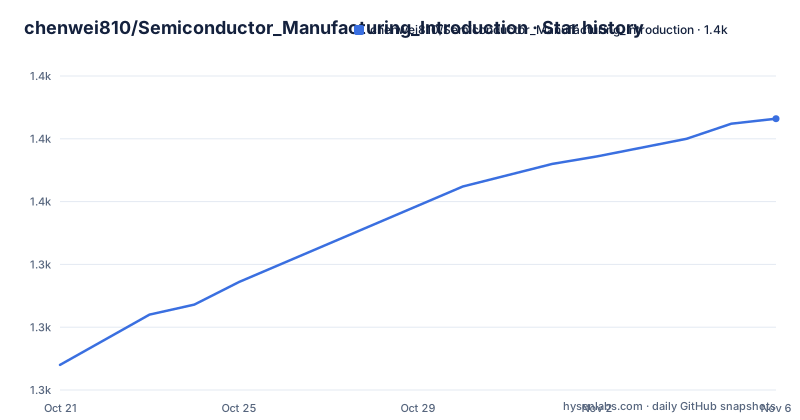
- chenwei810/Semiconductor_Manufacturing_Introduction1,383 ★ · +98
| Repository | 2026-10-21 | 2026-11-06 |
|---|---|---|
| chenwei810/Semiconductor_Manufacturing_Introduction | 1.3k | 1.4k |
98 Stars in the last 16 days, measured from the daily GitHub snapshot. Compare with other projects
Editorial analysis
One wafer, from sand to a packaged chip
The framing device is simple and effective. The book follows one silicon wafer on its whole journey, starting from sand, moving through the fab, through test and packaging, and ending as a chip. Along the way it focuses on three things: the flow of the process, the terminology, and the know-how that only comes from working on a fab floor. The heavy physics is skipped on purpose, and the README states that no background in semiconductor physics is needed. Two reading aids appear in every chapter, a term box for the vocabulary and a know-how box for the practical detail that textbooks leave out. The result is a book that a software or hardware engineer can read in a fortnight and come out able to hold a conversation with a process engineer, which is a more specific and more achievable goal than understanding the physics.
The first two parts: the fab and the fundamentals
The contents open with a part called Before You Start, which sets the scene with a chapter on the big picture and one on how a fab works, the sort of material that answers what actually happens in that building and who does what. The fundamentals part then adds the bridge from theory to material, with a chapter on going from physics to transistors and another on going from sand to wafer. That second chapter is the one that grounds the rest of the book, because every later module is a step applied to a wafer that has already been produced. The chapter numbering is deliberate and consistent, with two digit prefixes and a stable path per chapter, and the whole table is laid out with the same chapter in five languages side by side, which makes it easy to see that the structure is the shared spine of the project rather than an accident of one translation.
The process modules and the integration chapters
The middle of the book is the part a working engineer will use most, and it is organised as one chapter per process module. Lithography, thin films, etching, ion implantation with thermal processing, chemical mechanical planarisation, cleaning and contamination control, and metallization each get their own chapter. The naming of the directories follows the same order, from 04-lithography through to 10-metallization, which is a small but useful signal about how the author thinks about the flow. After the modules comes the part on process integration, where the pieces are put back together: a chapter walking a complete CMOS process flow end to end, one on advanced transistor structures, one on memory processes, and one that answers what a node name such as 3 nm actually means. That last chapter exists because the marketing number and the physical dimension have drifted apart, and the book treats the confusion as a topic worth a full section.
Quality, yield and failure analysis
The last visible part of the book covers quality and yield, and it opens with metrology and inspection, the measurement side of a fab, and continues into yield and failure analysis. These chapters matter for a reader who is thinking about manufacturing rather than about design, because a design that cannot be measured cannot be improved and a yield problem cannot be fixed without knowing where the defects came from. The safe conclusion for a reader is that the book is organised as a complete walk from raw material to finished part rather than as a set of essays.
Five languages and the translation workflow
The repository carries the book in English, Traditional Chinese, Simplified Chinese, Japanese and Korean, each in its own top level directory with the same numbered chapter folders inside. Making that work is a real engineering task, and the repository is organised around it. There is a TRANSLATIONS.md document, a STYLE_GUIDE.md that presumably fixes how terms are rendered in each language, a templates/ directory, a scripts/ directory written in Python for whatever mechanical work the translations need, a markdownlint configuration to keep the formatting consistent across dozens of files, and a CONTRIBUTING.md that the README links to. The layout also implies the maintenance rule that matters most for a translated book, that a change to a chapter has to be made in five places, which is exactly why a templates directory and a linting setup exist in the first place.
Who the book is written for
The audience is stated in the README, and it is narrower than the title suggests. This is a book for someone who needs to understand manufacturing rather than to become a process engineer. In practice that means a new joiner in a semiconductor company, a hardware designer who has to reason about what a fab can and cannot do, a developer who has been handed a wafer fabrication problem and has no vocabulary, and a student who wants the mental model before the equations. The two features that make it work for that audience are the term boxes and the know-how boxes, because the first removes the need to keep a glossary open and the second supplies the context that a diagram cannot. A reader who already knows the flow will find parts of it slow, and the README makes no attempt to pretend otherwise.
What the book leaves out on purpose
The omissions are as important as the content, and they are deliberate. There is no heavy physics, no derivation of the transistor from quantum mechanics, and no device simulation. There is no recipe level material either, nothing that tells a process engineer which parameters to set on a particular tool, and no vendor or equipment specific detail. The book is therefore not a substitute for an internal training package at a fabrication company, and it is not a reference to consult during a production issue. What it does offer is the framework that lets you read a process flow diagram, follow a conversation about yield, and understand why a step exists at all. Readers who need the physics can use it to find the right place to start, which is a defensible use of 25 chapters.
Licence, repository state and how to read it
The licence needs attention before anything else, because it constrains what a company can do with the material. The README badge states CC BY-NC-SA 4.0 and a LICENSE file is in the repository root, while GitHub does not surface a standard identifier for the project itself, so the file is the version to rely on. A Creative Commons attribution, non-commercial and share-alike licence is generous for study and for internal reading, and restrictive for anything commercial, because a paid course, a customer manual or a compiled textbook would fall outside the non-commercial condition and the share-alike condition would reach the derived work. The repository is actively worked on, with the last push on 2026-10-18, a contributions file linked from the README, and no tagged releases, so the master branch is the artefact to read and there is no versioned download to pin. The master branch also holds the chapter list, which is the fastest way to see whether the material covers what you need before you start.
Editorial conclusion
The book fits an engineer joining a semiconductor team, a hardware developer who needs to talk to process engineers without guessing, and a student who wants the vocabulary before the theory. It does not fit a process integration engineer who needs recipe level detail or a device physicist, because the physics is deliberately skipped, and the licence matters more than it looks, since the non-commercial and share-alike conditions rule out reusing the text or its illustrations in a commercial course or manual. Before adopting any of it, read the LICENSE file at the repository root, because the badge states a Creative Commons licence while GitHub itself does not surface a standard identifier for the repository.
Frequently asked questions
What is the Semiconductor Manufacturing Introduction book?
It is an open, beginner-friendly book of 25 chapters that follows one silicon wafer from sand, through the fab, test and packaging, until it becomes a chip, with term boxes and know-how boxes in every chapter.
Which languages is the book available in?
English, Traditional Chinese, Simplified Chinese, Japanese and Korean, each with its own directory at the repository root and the same numbered chapter folders inside.
Do I need a physics background to read it?
No. The README says no background in semiconductor physics is needed, because the book skips the heavy physics and concentrates on process flow, terminology and know-how from the fab floor.
Which process modules does the book cover?
Lithography, thin films, etching, ion implantation and thermal processing, chemical mechanical planarisation, cleaning and contamination control, and metallization, followed by integration chapters including a full CMOS process flow and a chapter on what a node name such as 3 nm means.
Which licence applies to the book?
The README badge states CC BY-NC-SA 4.0, with a LICENSE file in the repository root, so the text is attribution, non-commercial and share alike. GitHub does not show a standard identifier for the repository itself.
Is the book still being worked on?
The last push was on 2026-10-18 and the README links a contributions file, with contributions welcome. There are no tagged releases, so the default branch is the current version.
Official sources
Add this badge to your README
If you maintain this project, the badge below links readers to this analysis and shows its maintenance status from the daily GitHub snapshot. Paste the markdown into your README; add ?metric=license or ?metric=stars to the image URL for a different field.

[](https://hysenlabs.com/projects/chenwei810-semiconductor-manufacturing-introduction)Star history chart for your README
[](https://hysenlabs.com/projects/chenwei810-semiconductor-manufacturing-introduction)Was this useful?