DreamZero: NVIDIA's World Action Model for Zero-Shot Robot Policies
Code to pretrain, fine-tune, and evaluate DreamZero and run sim & real-world evals
At a glance
- What is it?
- DreamZero jointly predicts actions and video, ships pretrained DROID and AgiBot checkpoints, and serves inference over a distributed WebSocket server. Here is what the repository actually contains, what it costs to run, and where it stops being the right tool.
- Who is it for?
- Adopt DreamZero if you have multi-GPU hardware (the README names GB200 and H100, minimum two GPUs), need a pretrained DROID policy, or want to post-train on roughly 30 minutes of play data for a new embodiment. Do not adopt it if you have a single GPU, no CUDA 12.9+ environment, or need a documented support and deprecation policy.
- Can I use it commercially?
- Yes. Apache-2.0 is a permissive licence: you can use, modify and sell software built on it, as long as you keep its copyright and licence notices.
- Is it still maintained?
- Activity is slowing. The repository last received commits 7 months ago.
- What is it written in?
- Mainly Python, according to GitHub's language statistics.
Answers come from the project's GitHub data, last synced on November 23, 2026, and from our analysis. They are not legal advice.
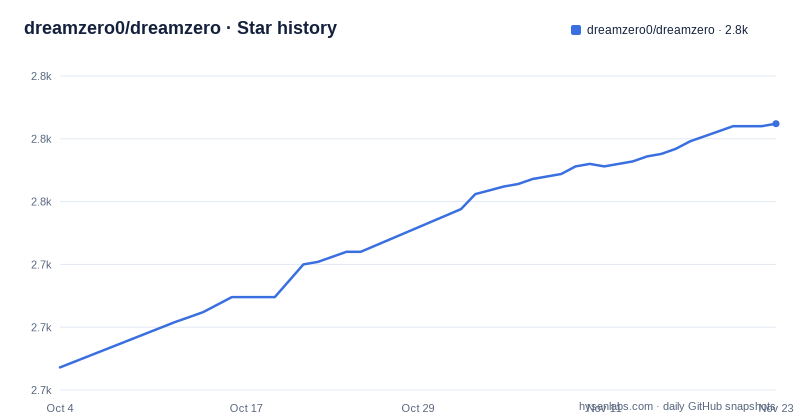
Star history
- dreamzero0/dreamzero2,781 ★ · +97
| Repository | 2026-10-04 | 2026-11-23 |
|---|---|---|
| dreamzero0/dreamzero | 2.7k | 2.8k |
97 Stars in the last 50 days, measured from the daily GitHub snapshot. Compare with other projects
Editorial analysis
What DreamZero solves, and who the repository is written for
Most robot policies are trained for one embodiment and one task distribution. DreamZero is a World Action Model: it predicts actions and video together, and the README claims strong zero-shot performance on unseen tasks. The release package is built around loading a pretrained model and running distributed inference behind a WebSocket server, not around a single-machine demo. The intended reader is a robotics or ML engineer with a multi-GPU node, a CUDA 12.9+ stack, and an interest in evaluating a checkpoint on DROID simulation or on real hardware through RoboArena. The README also states that DreamZero-DROID was trained from scratch on the DROID dataset only, with no pretraining on large-scale robot data, which is the project's central argument for video-model backbones as generalist policies. The repository is Apache-2.0 licensed and is classified as Development Status 3 - Alpha in pyproject.toml, so the packaging metadata itself sets the maturity expectation.
How the joint action and video prediction is served
The architecture visible in the repository is a checkpoint plus a serving process. socket_test_optimized_AR.py is the inference server; it uses PyTorch distributed utilities to shard the model across GPUs and exposes a socket interface on a chosen port. test_client_AR.py is the matching client. eval_utils/ holds the evaluation entry points, and groot/ plus docs/ hold training and embodiment material. The README describes DiT caching as the inference optimization, with the flag --enable-dit-cache, and gives approximate latencies of 0.6s on GB200 and 3s on H100 after warm-up. A separate TensorRT path exists for GB200 only, driven by the LOAD_TRT_ENGINE environment variable pointing at a .trt file inside the checkpoint and DYNAMIC_CACHE_SCHEDULE set to true. That split matters: the fast path is hardware-specific, and the README explicitly marks the Transformer Engine and TensorRT steps as GB200-only, to be skipped on H100. The server also supports video generation saved as MP4, which is the visible half of the joint prediction.
Installing DreamZero and running the inference server
The README pins Python 3.11 and CUDA 12.9+, and states a minimum of two GPUs for distributed inference. Start with a conda environment, then install the package in editable mode. The extra index URL is required because the PyTorch wheels come from the CUDA 12.9 channel.
conda create -n dreamzero python=3.11
conda activate dreamzero
pip install -e . --extra-index-url https://download.pytorch.org/whl/cu129
MAX_JOBS=8 pip install --no-build-isolation flash-attn
On GB200 only, the README adds Transformer Engine and TensorRT. Both steps are marked to be skipped on H100.
pip install --no-build-isolation transformer_engine[pytorch]
pip install tensorrt==10.13.2.6 tensorrt_cu13==10.13.2.6 tensorrt_cu13_libs==10.13.2.6 tensorrt_cu13_bindings==10.13.2.6 --no-deps
pip install transformer_engine==2.10.0 transformer_engine_cu12==2.10.0 transformer_engine_torch==2.10.0
Download the DROID checkpoint for inference, then launch the server across two GPUs. The first few inferences take a few minutes to warm up; after that the README gives roughly 0.6s on GB200 and 3s on H100.
hf download GEAR-Dreams/DreamZero-DROID --repo-type model --local-dir <path/to/checkpoint>
CUDA_VISIBLE_DEVICES=0,1 python -m torch.distributed.run --standalone --nproc_per_node=2 socket_test_optimized_AR.py --port 5000 --enable-dit-cache --model-path <path/to/checkpoint>
With the server running, the bundled client confirms it responds.
python test_client_AR.py --port 5000Evaluating a hosted DreamZero-DROID policy in simulation
There is a second path that does not require the checkpoint at all. The README provides an inference script that evaluates a hosted DreamZero-DROID policy on sim_evals, but access is gated: you must first request it through a Google form linked from the README. Once you have a host and port, the setup clones sim_evals with submodules, installs uv, syncs the environment, and downloads the DROID simulation assets from the owhan/DROID-sim-environments dataset. The asset download may need HF_TOKEN exported first. The evaluation script takes --host and --port and writes outputs into a runs directory.
git clone --recurse-submodules https://github.com/arhanjain/sim-evals.git
cd sim-evals
curl -LsSf https://astral.sh/uv/install.sh | sh
uv sync
source .venv/bin/activate
uvx hf download owhan/DROID-sim-environments --repo-type dataset --local-dir assets
cd ..
python eval_utils/run_sim_eval.py --host <API_HOST> --port <API_PORT>
Hardware, warm-up and the limits the README admits
The first few inferences take a few minutes to warm up. That is stated plainly, and it is the kind of detail that decides whether an evaluation loop is practical: a fixed warm-up cost is tolerable for batch evaluation and awkward for interactive control. The hardware floor is the bigger constraint. Two GPUs minimum, GB200 or H100 named as the tested configurations, and a GB200-only TensorRT path for the fastest generation. On a single-GPU workstation the distributed server as documented does not apply. The dependency list is also pinned aggressively: torch==2.8.0, transformers==4.51.3, peft==0.5.0, numpy==1.26.4, and multi-storage-client pinned at 0.33.0 with a comment explaining that the pin prevents breakage from new releases. That is a reasonable choice for reproducibility and a real cost if you need to co-install DreamZero with other libraries that want newer versions of the same packages. Two features are listed as coming soon, PolaRiS and Genie 3.0 simulation support, so neither should be planned around. The README does not document a rollback procedure, a supported upgrade path between checkpoints, or a deprecation policy.
Post-training on a new embodiment, and what it competes with
The DreamZero-AgiBot checkpoint exists specifically for fine-tuning. The README says post-training on roughly 30 minutes of play data lets a robot perform basic language following and pick-and-place, and points to the YAM experiments in the paper. The YAM and AgiBot training scripts default to pretrained_model_path=./checkpoints/DreamZero-AgiBot, and the new-embodiment guide is docs/DATASET_TO_GEAR_AND_TRAIN.md. LoRA and full fine-tuning scripts are both listed. The comparison the README draws is against VLAs that pretrain on large-scale robot data; DreamZero-DROID was trained from scratch on DROID alone, and the project cites first place on the MolmoSpaces and RoboArena leaderboards. Treat that as the project's own claim from its news section, not an independent measurement. If your alternative is a conventional VLA pipeline, the difference in approach is that DreamZero carries a video prediction objective alongside the action head, which is what the caching and MP4 output machinery is built to serve.
Licence, maintenance and upgrade cost
The repository is Apache-2.0, and pyproject.toml declares the classifier License :: OSI Approved :: Apache Software License. Apache-2.0 permits commercial use and modification and includes a patent grant; it also requires that you preserve notices and state changes. The dependency pins are the practical licence-adjacent concern, since some bundled components carry their own terms. This is not legal advice. On maintenance: the last push was on 2026-04-19, and the repository is not archived. That is roughly five months before today, so the codebase is not being pushed to continuously, and the README's own news entries are dated 02/20 and 02/27 with no release tags. Upgrading means re-downloading checkpoints from Hugging Face and re-pinning the environment, because the README documents no versioned release channel. Budget for that rather than assuming a smooth in-place upgrade.
Editorial conclusion
Adopt DreamZero if you have multi-GPU hardware (the README names GB200 and H100, minimum two GPUs), need a pretrained DROID policy, or want to post-train on roughly 30 minutes of play data for a new embodiment. Do not adopt it if you have a single GPU, no CUDA 12.9+ environment, or need a documented support and deprecation policy. Before committing, verify three things yourself: that your hardware matches the GB200/H100 split in the install steps, that the DreamZero-AgiBot checkpoint downloads at its stated ~45GB, and that the API form at the top of the README is still accepting requests, because the hosted-policy path depends on it.
Frequently asked questions
Is DreamZero open source?
Yes. The repository is licensed under Apache-2.0, and pyproject.toml carries the matching OSI classifier. The training codebase, preprocessed dataset and new-embodiment guide were released according to the README's news section.
What is DreamZero?
DreamZero is a World Action Model from NVIDIA GEAR Lab that jointly predicts actions and videos. The release package loads a pretrained model and runs distributed inference through a WebSocket server.
What is the purpose of dreaming for robots?
The README frames DreamZero as a World Action Model whose joint video prediction supports zero-shot performance on unseen tasks. Video generation and saving as MP4 is listed as an available feature, which is the visible output of that prediction.
Official sources
Add this badge to your README
If you maintain this project, the badge below links readers to this analysis and shows its maintenance status from the daily GitHub snapshot. Paste the markdown into your README; add ?metric=license or ?metric=stars to the image URL for a different field.

[](https://hysenlabs.com/projects/dreamzero0-dreamzero)Star history chart for your README
[](https://hysenlabs.com/projects/dreamzero0-dreamzero)Was this useful?