AIGC_Interview: two career tracks, one curated list and a learning path section marked as not yet written
AIGC job-interview experiences, essential fundamentals, prompt engineering, ChatGPT, Stable Diffusion, prompts, embeddings, fine-tuning, and everything else you need for an AIGC job search.
At a glance
- What is it?
- AIGC_Interview collects interview write-ups, opinion pieces and learning resources for AIGC algorithm engineers and prompt engineers seeking jobs in China. Its prompt engineering section includes articles predicting the role will disappear alongside ones arguing for its value, and the learning path subsection is explicitly marked as not yet written.
- Who is it for?
- AIGC_Interview suits candidates preparing for AIGC jobs in China who can read Chinese. The algorithm track provides failure reports from xAI and Nvidia alongside success accounts of 24-company searches, and the prompt engineering track includes articles predicting the role will disappear alongside ones arguing for its value.
- Can I use it commercially?
- Not without permission. GitHub finds no licence file in the repository, and without a licence all rights are reserved by default: you may read the code but not reuse it. Check the README, or ask the authors, before using it.
- Is it still maintained?
- Yes. The repository last received commits 74 days ago.
- What is it written in?
- GitHub does not report a main language for this repository.
Answers come from the project's GitHub data, last synced on November 7, 2026, and from our analysis. They are not legal advice.
Star history
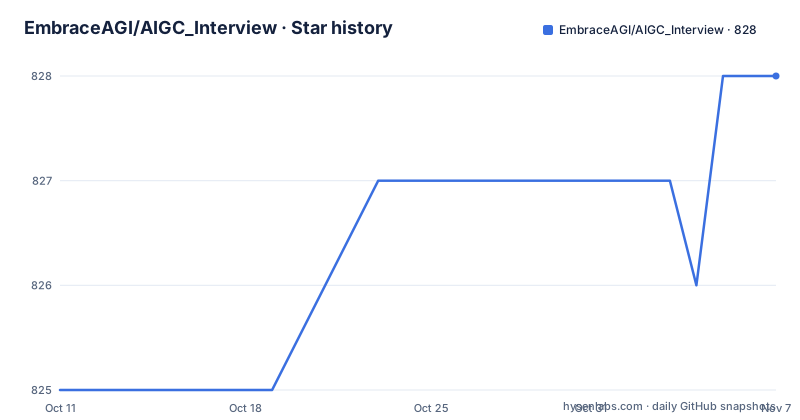
- EmbraceAGI/AIGC_Interview828 ★ · +3
| Repository | 2026-10-11 | 2026-11-07 |
|---|---|---|
| EmbraceAGI/AIGC_Interview | 825 | 828 |
3 Stars in the last 27 days, measured from the daily GitHub snapshot. Compare with other projects
Editorial analysis
Two job tracks in one repository: algorithm engineer versus prompt engineer
AIGC_Interview organizes its content around two distinct career paths. One serves engineers who want to work on AIGC algorithms, building and fine-tuning large language models, and the other serves people interested in the prompt engineering track, whose work centers on designing effective prompts rather than training models. Both tracks appear in the same repository, which reflects how different those two jobs are in the Chinese AIGC market: different interview formats, different hiring companies and different arguments about whether either career is worth pursuing.
The algorithm track attracts candidates who already have deep learning backgrounds. Its interview experiences include write-ups from people who applied at xAI and Nvidia and did not pass, and one detailed account of interviewing at 24 large-model companies and receiving 9 offers. The prompt engineering track differs: most of the resources it links to are opinion pieces rather than preparation guides, and several of them argue that the role has a short future.
Both tracks are grouped separately, and what each includes reflects different assumptions about what that candidate needs to read before an interview.
The algorithm track includes a failed OpenAI application and rejections at xAI and Nvidia
The algorithm track section opens with a Zhihu article asking whether ChatGPT will affect the job market for NLP engineers, then collects interview write-ups from several Chinese platforms. One account covers 24 large-model companies and 9 offers, tracing a months-long job search. Another reports a failed OpenAI application, written as a summary of the experience rather than a preparation guide. A third covers failed applications at xAI and Nvidia.
Those failure accounts sit alongside study materials. The section links to a series on using ChatGPT to prepare for algorithm engineer interviews on Zhihu, a question bank for large-model interviews and an article on deep learning fundamentals as they relate to AIGC. An Ant Group write-up covers a 2024 summer internship for an AIGC role, which is one of the few entry-level accounts in a section that otherwise covers full-time positions.
A Nowcoder thread and a CSDN blog post on algorithm interviews for AIGC roles also appear in the collection. The accounts span Zhihu, Nowcoder, CSDN, hub.baai.ac.cn and other platforms, written by different people across a range of years. The repository does not document when each linked article was last verified.
The prompt engineering opinion table lists articles predicting the role will disappear
The opinion section in the prompt engineering track makes an unusual editorial decision for an interview-prep resource. This collection includes an article titled 'Stop creating new job titles: there will be no prompt engineers in the future,' a piece called 'Transferring to the prompt engineer role is meaningless for ordinary people,' and a third covering prompt engineers who received high salaries and were laid off within six months.
Those articles appear in the same table as pieces arguing for the role's value, including one reporting that prompt engineer position monthly salaries on major Chinese job platforms run from 1.5万 to 6万 yuan. The repository's preface quotes a passage framing prompt engineering as a stepping stone: use the easily learned skill to enter the industry, then deepen technical knowledge afterward. That passage sits just above the opinion table, which immediately presents the counterargument without offering a synthesis.
Both positions appear side by side with no resolution. A candidate reading this section sees the range of professional opinion about the role, including opinions from practitioners who dismiss it. That is a more candid framing than most interview-prep collections provide.
A 2026 supplement lists Agent, MCP, Skills and reasoning models outside the two-track structure
The table of contents includes a section titled '2026 面试热点补充:Agent / MCP / Skills / 推理模型,' which translates as a 2026 interview hot topics supplement covering Agent, MCP, Skills and reasoning models. The section sits at the end of the document structure, after the main learning resources and AI fundamentals sections and outside both the algorithm and prompt engineering tracks.
The four named topics are Agent, MCP, Skills and reasoning models. The title uses the word 面试 (interview), identifying interview candidates as the intended audience. The section appears as an addition to the existing framework rather than a revision of the two main tracks.
A candidate preparing for large-model positions in 2026 needs to consult both the main track sections and this supplement. Agent and reasoning-model content is gathered here, not distributed across the algorithm or prompt engineering sections. Anyone who reads only one track will miss that content entirely.
The learning path subsection has not been written in a repository claiming completeness
Under the learning resources heading, the first subsection is titled '学习路径' (learning path) and its body contains only a note that it is yet to be written. The repository's opening header describes it as continuously being updated and claims to offer everything a candidate needs for AIGC job hunting, but the learning path, which would give a new learner a sequential route through the repository's resources, remains empty. It is the first subsection under the largest content category in the repository.
What the learning resources section does contain is organized across several subsections. Four items form the AIGC knowledge base: WayToAGI on Feishu, a structured prompt wiki called LangGPT, the Learn Prompting site and a ChatGPT Chinese guide on GitHub. An articles subsection links to Lilian Weng's AI agents blog, a Chinese translation of an LLM agent survey from Fudan NLP and miHoYo, and a LangChain agents video on YouTube. A prompt learning subsection lists Andrew Ng's ChatGPT Prompt Engineering for Developers course from DeepLearning.ai (also available in Chinese on Bilibili), a Microsoft Azure prompt engineering documentation page, and two GitHub repositories for structured prompt design: Mr.-Ranedeer-AI-Tutor and LangGPT.
Four subsections of resources are present, but no suggested reading order exists. The gap between the completeness claim and the empty learning path section is the most direct limitation the repository's own structure reveals.
Access is through the GitHub README or the website, with no installation required
AIGC_Interview is a Markdown file with a structured list of links, not a software project. There is nothing to install. The repository is at EmbraceAGI/AIGC_Interview on GitHub, and a homepage is listed at embraceagi.com. Top-level entries are .gitignore, README.md, docs/, imgs/ and resources/, which are listed in the repository but not described in the README.
For a first use, open the README and follow the table of contents to the track that matches the position being applied for. The algorithm track leads to write-ups on Zhihu, CSDN, Nowcoder and hub.baai.ac.cn. The prompt engineering track leads to opinion pieces and role definitions. No account, registration or local setup is required.
The repository description and preface are in Chinese. Most links point to Chinese-language articles. Learning resources include a few English-language items: the DeepLearning.ai course, Lilian Weng's English blog and a Microsoft Azure documentation page. Candidates who cannot read Chinese can access those English items but will find the majority of the interview write-ups and opinion pieces inaccessible.
An open contribution model with no link verification or inclusion criteria
Repository metadata lists no license identifier, and a '协议' section is named in the README table of contents with no identifier given. For a project that aggregates links to third-party articles, this leaves redistribution terms open.
Link verification is the second gap the repository does not address. The collection spans Zhihu, CSDN, Nowcoder, WeChat public accounts, 36kr, Feishu wiki pages, hub.baai.ac.cn and YouTube. No broken-link log exists in the repository.
Contributions are invited: the preface asks for sharing of interview experiences, referrals and job opportunities. The README gives no criteria for determining which submissions to include and describes no review process. Quality and accuracy of individual links therefore depend entirely on the original author of each piece, with no central verification applied.
A fixed-curriculum alternative linked from within the repository
The repository was last pushed on 2026-08-25, is not archived, and has no GitHub releases.
For candidates who want a fixed curriculum rather than a curated list, AIGC_Interview links to Andrew Ng's ChatGPT Prompt Engineering for Developers in its prompt learning subsection. That course is a collaboration between DeepLearning.ai and OpenAI developer Iza Fulford, available in English at DeepLearning.ai and in a Chinese-subtitled version on Bilibili. It covers a defined set of developer-focused prompt engineering topics. AIGC_Interview, by contrast, aggregates interview experiences, opinion pieces and external resources written by many different authors with no central editorial position.
The two serve different preparation needs. That course provides technical depth on prompt engineering for developers; AIGC_Interview provides a range of company names, interview formats and career opinions across many contributors. A candidate who wants both will find the course linked from inside the repository's prompt learning subsection, which means no separate search is needed.
Editorial conclusion
AIGC_Interview suits candidates preparing for AIGC jobs in China who can read Chinese. The algorithm track provides failure reports from xAI and Nvidia alongside success accounts of 24-company searches, and the prompt engineering track includes articles predicting the role will disappear alongside ones arguing for its value. Before relying on it, verify that the links you intend to use are still live, because no broken-link log is documented in the repository. The learning path section remains empty, and most linked articles are in Chinese.
Frequently asked questions
What is AIGC_Interview?
AIGC_Interview is a GitHub repository that collects interview write-ups, opinion pieces and learning resources for people seeking jobs in the AIGC field in China, covering both algorithm engineer and prompt engineering tracks.
Who is AIGC_Interview designed for?
The repository addresses two groups: engineers with deep learning backgrounds applying for AIGC algorithm roles, and candidates interested in prompt engineering positions. The preface notes it was created because systematic AIGC job-hunting resources were scarce.
Are all the resources in AIGC_Interview in Chinese?
Most links point to Chinese-language articles on Zhihu, CSDN, Nowcoder and similar platforms. The prompt learning subsection also links to English resources including Andrew Ng's ChatGPT Prompt Engineering for Developers and a Microsoft Azure prompt engineering documentation page.
Does AIGC_Interview cover both algorithm and prompt engineering interview preparation?
Yes. The repository has separate sections for algorithm-track interview write-ups and prompt engineering resources. A 2026 supplement adds Agent, MCP, Skills and reasoning models as a separate section outside those two tracks.
When was AIGC_Interview last updated?
The repository was last pushed on 2026-08-25. It is not archived. No GitHub releases have been published.
Official sources
Add this badge to your README
If you maintain this project, the badge below links readers to this analysis and shows its maintenance status from the daily GitHub snapshot. Paste the markdown into your README; add ?metric=license or ?metric=stars to the image URL for a different field.

[](https://hysenlabs.com/projects/embraceagi-aigc-interview)Star history chart for your README
[](https://hysenlabs.com/projects/embraceagi-aigc-interview)Was this useful?