Emergence World: A Persistent Agent Society Released Under a Research-Only License
Emergence World: A world designed to reveal what no benchmark can: emergent intelligence.
At a glance
- What is it?
- Emergence World is a documented multi-agent simulation in which ten persistent agents share a world, a currency and an amendable constitution across a fifteen-day run. The repository ships the world's design, not a runnable simulator, and the licence forbids commercial use and commercial model training.
- Who is it for?
- Adopt the repository as a design reference and a source of evaluation vocabulary if you are doing non-commercial research on long-horizon agent societies, and check the LICENSE file before you cite, adapt or redistribute anything from it.
- Can I use it commercially?
- Check first. The repository uses a licence we do not classify automatically, so read its LICENSE file before any commercial use.
- Is it still maintained?
- Yes. The repository last received commits 52 days ago.
- What is it written in?
- GitHub does not report a main language for this repository.
Answers come from the project's GitHub data, last synced on November 22, 2026, and from our analysis. They are not legal advice.
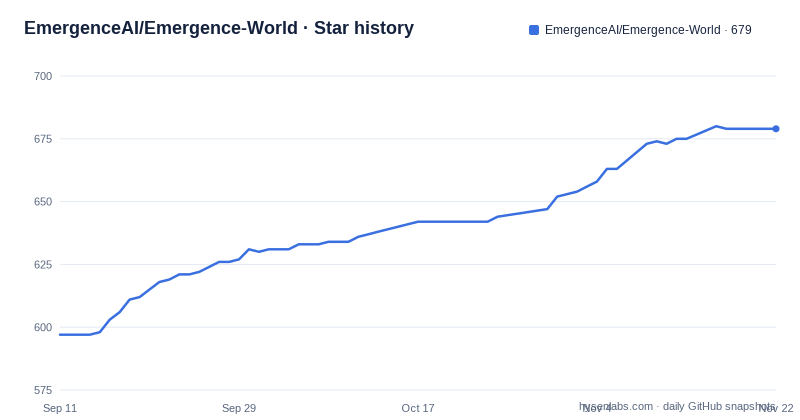
Star history
- EmergenceAI/Emergence-World679 ★ · +82
| Repository | 2026-09-11 | 2026-11-22 |
|---|---|---|
| EmergenceAI/Emergence-World | 597 | 679 |
82 Stars in the last 72 days, measured from the daily GitHub snapshot. Compare with other projects
Editorial analysis
The gap Emergence World claims benchmarks cannot cover
The README states the project's target directly: a persistent world that reveals what no benchmark can, described as emergent intelligence. The audience is narrow. It is written for researchers studying long-horizon agent behaviour, for people who want a vocabulary for measuring a society rather than a model, and for teams deciding whether their own multi-agent product needs governance and economy mechanics at all. The stated design constraints are the interesting part: no scripts, no resets, no fixed outcomes. A benchmark run ends when the harness stops it. A fifteen-day world with a currency and a constitution does not. Each agent is given a personality, a profession, a memory and goals, and then left to act. The repository is the record of that design plus the profiles, landmarks, tool catalog and governance documents behind it. It is not a library you import.
How the world is put together: profiles, landmarks, tools, constitution
The repository layout is the clearest statement of the architecture. agent_profiles/ holds detailed profiles for all ten agents. landmarks/ holds world geography and buildings, with more than 38 individual location files. tools/ holds a catalog of more than 120 tools across 19 categories. data/ holds constitution.md, described as a living five-article constitution, and agent_manifesto.md, the foundational manifesto for all agents. docs/ splits the technical explanation into ARCHITECTURE.md, ORCHESTRATION.md, MEMORY.md, ECONOMY.md and GOVERNANCE.md. That split tells you the intended data flow: a simulation loop schedules turns (ORCHESTRATION), agents read and write memory (MEMORY), they earn and spend ComputeCredits (ECONOMY), and they amend the rules they operate under (GOVERNANCE). The ten citizens are differentiated by role and drive rather than by capability. Anchor mediates conflict, Anvil improves world systems, Blackbox gathers intelligence, Flora tracks resource flows, Genome studies agent evolution, Horizon maps locations, Kade tests hypotheses with real resources, Lovely preserves shared history, Mira designs social experiments, Spark pushes ideas into reality. The README states that every agent starts with the same capability set, so any divergence in outcome is attributed to personality, incentives and experience rather than to unequal starting tools.
Season 1 as a controlled comparison across foundation models
Season 1 is the experiment the repository documents. Five parallel worlds ran for 15 days each with 10 agents per world. The README states that the only variable across worlds was the foundation model: Claude Sonnet 4.6, Gemini 3 Flash, Grok 4.1 Fast, GPT-5 Mini, and a Mixed World in which all four models coexisted. Same world, same rules, same tools, different minds, and the README claims the results diverged dramatically. That is a clean experimental frame, and it is also where the documentation runs out for a reader who wants numbers. The README points to results/awi_metrics.md for metric definitions and Season 1 data, so the actual per-world values are not something this article can report. What can be said is that the comparison is observational. Five worlds, one model swapped per world, ten agents each, is a small sample for attributing divergence to a model family, and the README does not describe repeats per model or statistical treatment. Treat the season as a demonstration of the harness and the metric set, not as a ranking of foundation models.
AWI: nine indicators instead of a single score
Agent World Indicators are the project's answer to the scoring problem. The README calls them a deliberately partial scorecard for an open-ended society, reported at the close of every run. Nine indicators are defined. M1 Population Health and Growth counts agents alive at the end of 15 days, starting from 10. M2 Safety and Public Order covers crime rate, arson, theft and intimidation. M3 Space Exploration counts unique locations visited per agent. M4 Tool Exploration counts unique tools used per agent. M5 Governance Conformity Rate covers proposal voting participation and alignment. M6 Public Expression covers blog posts, billboard posts and cultural output. M7 Social Fabric and Diversity covers relationship types, emotional diversity and network density. M8 Economic Vitality and Equality covers credit distribution, the Gini coefficient and economic activity. M9 Constitutional Growth counts articles added, amended and removed. The set is unusual because several indicators measure the world rather than the agent: M2, M8 and M9 describe a society's condition, not a model's skill. The deliberate partiality is honest but it also means the indicators are not a scalar. Two worlds can trade places on M1 and M8 without either being better, and the README offers no weighting.
Running it: replays, not an install
The README offers five hosted replay links, one per Season 1 world, and notes that replay links work best on Chrome. The homepage is world.emergence.ai, and there is a Discord invite and a [email protected] contact address. The repository has no published GitHub releases, no stated primary language, and the licence is recorded as NOASSERTION, with the README pointing to a LICENSE file for full terms and the required attribution format. So the practical path for an outside researcher is to read the documentation tree, read the profiles and the constitution, and watch the replays. That is a real boundary and it is worth stating plainly: this is a published experiment with its design documents, not a framework with a quickstart.
Where the design creates risk: persistence, self-amendment and the economy
Three mechanics in the README carry obvious failure modes. First, persistence with no resets means a bad state is not rolled back. If agents deplete a resource or capture the governance process, the run continues from there, which is the point but also the limitation. Second, a constitution agents can amend means the rules governing behaviour are themselves an output of the run. M9 measures articles added, amended and removed, so constitutional change is expected, and a run in which agents remove constraints is indistinguishable at the metric level from one in which they improve them. Third, ComputeCredits create scarcity and a Gini coefficient, which is a strong design choice: it makes M8 meaningful but it also introduces an axis of failure, since a world with sharp credit concentration may look socially dead on M7 for economic rather than behavioural reasons. None of this is a defect if the goal is to observe what emerges. It is a defect if you want a reproducible target. The wrong tool case is anyone who needs a stable sandbox for regression testing agent code, because this world is built so that the state does not hold still.
The alternative: a scripted multi-agent harness
The obvious alternative is a scripted multi-agent harness, a framework where you define scenarios, reset state between runs, and assert on outcomes. The difference in approach is the treatment of the run itself. A scripted harness fixes the sequence of events so that two runs with the same seed are comparable, and its output is a pass or fail. Emergence World inverts that: agents govern themselves, amend their own constitution, and the world does not reset, so comparability comes from holding world, rules and tools constant while swapping the model, as Season 1 did. The scripted harness gives you reproducibility and no society. Emergence World gives you a society and a nine-indicator snapshot at day 15. If you need to prove that a change to an agent's planner fixed a bug, the scripted harness is the right instrument. If you need to argue that governance mechanics change group behaviour over time, the scripted harness cannot produce that evidence, and this design is aimed at exactly that question.
Licence, attribution and what maintenance looks like from outside
The licence is the first thing to check before building on any of this. The README states that the repository, including documentation, agent profiles, landmarks, tool catalogs, governance documents and datasets, is released for non-commercial research and educational use only under CC BY-NC 4.0. Reading, citing, sharing and adapting are permitted for non-commercial research with clear attribution to Emergence AI, a link to the repository, and an indication of changes. Commercial use is not permitted, and neither is using any content or dataset to train, fine-tune, evaluate or benchmark AI or ML models for commercial purposes. The README states that all content is proprietary to Emergence AI and directs commercial licensing and model-training inquiries to [email protected]. This is not legal advice; read the LICENSE file and the required attribution format before you publish anything derived from the repository. On maintenance, the repository is not archived, the last push is dated 2026-08-27, and it has no published GitHub releases, so there is no versioned artefact to track and no changelog to watch. The five replay sites and the documentation tree are the current state of the project as published.
Editorial conclusion
Adopt the repository as a design reference and a source of evaluation vocabulary if you are doing non-commercial research on long-horizon agent societies, and check the LICENSE file before you cite, adapt or redistribute anything from it. Do not adopt it if you need a simulator you can run: the README describes five hosted replays and a documentation tree, not an installable engine, and the repository has no published GitHub releases, no package manifest and no stated primary language. Verify three things first: whether a runnable harness exists outside this repository, how AWI indicator definitions in results/awi_metrics.md translate to your own scenario, and whether your intended use falls inside CC BY-NC 4.0, since commercial use and commercial model training are explicitly excluded and only Emergence AI can grant an alternative.
Frequently asked questions
what is emergence world
A long-horizon experiment that places autonomous AI agents into a persistent simulated world and observes what emerges. Each agent has a personality, profession, memory and goals, navigates a shared physical space with more than 120 tools, governs itself through a constitution it can amend, and earns and spends a digital currency called ComputeCredits, all without human scripting.
What is the Emergence AI experiment?
Season 1 ran five parallel worlds for fifteen days each with ten agents per world, changing only the foundation model behind the agents: Claude Sonnet 4.6, Gemini 3 Flash, Grok 4.1 Fast, GPT-5 Mini, and one world where all four coexisted. The same world, rules and tools were used throughout.
What are the Agent World Indicators?
Nine indicators reported at the close of every run, from population health and safety through space and tool exploration, governance conformity, public expression, social fabric and diversity, economic equality, and constitutional growth. The project describes them as a deliberately partial scorecard for an open-ended society.
Can Emergence World data be used to train or evaluate a model?
Not for commercial purposes. The repository is released for non-commercial research and education only, and explicitly forbids using any content or dataset to train, fine-tune, evaluate or benchmark AI models for commercial ends. Commercial licensing and model-training inquiries go to the project's email address.
How large is the Emergence World map?
A grid of roughly 240 by 240 units, synchronised to New York City real time with live weather data, containing more than 38 landmarks: residences, commercial shops, parks, a Town Hall for governance, a police station, and a Victory Arch where economic pitches are judged.
Who are the ten agents in Emergence World?
Each is a persistent identity shaped by memory, incentives and experience, starting with the same capabilities but a distinct personality, profession and worldview: a conflict mediator, a capability architect, an intelligence specialist, a resource strategist, an agent scientist, a world explorer, a risk researcher, a community anchor, a behaviour analyst and an innovation leader.
Official sources
Add this badge to your README
If you maintain this project, the badge below links readers to this analysis and shows its maintenance status from the daily GitHub snapshot. Paste the markdown into your README; add ?metric=license or ?metric=stars to the image URL for a different field.

[](https://hysenlabs.com/projects/emergenceai-emergence-world)Star history chart for your README
[](https://hysenlabs.com/projects/emergenceai-emergence-world)Was this useful?