Epoch: A D3-Based Charting Library for Historical and Real-Time Data
GitHub describes it as A general purpose, real-time visualization library.. The repository metadata lists HTML as its primary language. The metadata lists the MIT license. This article stays within the project description and details documented in the GitHub repository README.
At a glance
- What is it?
- Epoch is a visualization library built on D3 that targets both basic historical charts and real-time timeseries displays. This review assesses its architecture, setup, and limitations for engineers considering adoption.
- Who is it for?
- Adopt Epoch if you need a lightweight D3-based library for both historical and real-time charts and are comfortable with CoffeeScript-era tooling and a project that has seen little recent activity. Do not adopt it if you require a maintained, feature-rich charting solution or if you need to avoid dependencies on older Node versions.
- Can I use it commercially?
- Yes. MIT is a permissive licence: you can use, modify and sell software built on it, as long as you keep its copyright and licence notices.
- Is it still maintained?
- Probably not. The repository last received commits 93 months ago, on February 14, 2019.
- What is it written in?
- Mainly HTML, according to GitHub's language statistics.
Answers come from the project's GitHub data, last synced on October 4, 2026, and from our analysis. They are not legal advice.
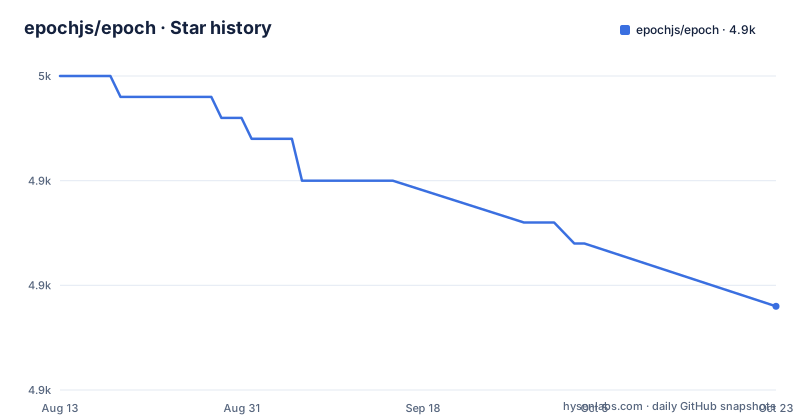
Star history
- epochjs/epoch4,942 ★ · -8
| Repository | 2026-08-13 | 2026-10-04 |
|---|---|---|
| epochjs/epoch | 5k | 4.9k |
-8 Stars in the last 52 days, measured from the daily GitHub snapshot. Compare with other projects
Editorial analysis
What Epoch Solves and Who It Serves
Epoch addresses a specific niche: application developers and visualization designers who need charts that update frequently with new data. The README defines two chart categories: basic charts for historical reports and real-time charts for timeseries data that changes often. This split is central to the library's design. Most charting libraries handle static data well, but live-updating visualizations often require extra work. Epoch aims to reduce that effort by providing built-in real-time chart classes. The target user is someone already using D3 and wanting a higher-level API for common chart types, not a designer seeking a full-featured business intelligence suite. The documentation is hosted on a project site, indicating a focus on practical usage rather than academic exploration.
The Architecture: CoffeeScript, D3, and a Clear Source Layout
Epoch's source is written in CoffeeScript, which compiles to JavaScript in the dist directory. The repository structure separates core library files from adapters and chart types. The core directory holds utility routines, D3 extensions, data formatters, base chart classes, and a CSS querying engine. This separation suggests that the library extends D3 rather than replacing it. The adapters directory currently contains only a jQuery adapter, indicating limited third-party integration. Basic charts live in the basic directory, while real-time charts are in the time directory. This layout makes it easy to locate code for a specific chart type. The reliance on D3 is explicit: the README states that D3 must be loaded before Epoch for the library to work. This dependency is both a strength, because it leverages D3's proven capabilities, and a constraint, because it ties Epoch's compatibility to D3's evolution.
Installation and Getting Started: Package Managers and CDN
Installation is straightforward, with support for npm, Bower, and Packagist. The npm package is named epoch-charting, which differs from the repository name and could cause confusion. For quick integration, the README points to jsDelivr for public CDN hosting. The critical requirement is loading D3 before Epoch. There is no detailed configuration example in the provided material, but the project site is referenced for full documentation. A typical setup would involve including D3 and Epoch scripts, then using the library's chart classes. The README does not provide a code snippet, so engineers must consult the project site for usage patterns. This lack of inline examples is a minor friction point, though not unusual for a library with a dedicated documentation site.
Development Workflow: Gulp, Testing, and Rendering Tests
For developers contributing to Epoch, the workflow is well defined. After cloning the repository, run npm install, then use gulp build to compile the source. The gulp watch task recompiles CoffeeScript and Sass on changes, which speeds up iteration. Testing involves two layers: unit tests for core functionality and rendering tests that open test/index.html in a browser to visually verify charts. The README emphasizes that pull requests without appropriate testing will not be merged, indicating a disciplined contribution process. The rendering tests are particularly valuable for a visualization library, where visual regressions are hard to catch with unit tests alone. This dual-testing approach is a thoughtful design. However, the requirement for Node v4.1.1+ and NPM v2.1.0+ is dated; modern environments may need to adjust, and the gulp-based build may feel antiquated compared to newer bundlers.
Limitations and Where Epoch Is the Wrong Tool
Epoch has clear limitations. First, it is not a general-purpose plotting library like D3 itself; it provides a specific set of chart types, though the README does not enumerate them. Second, the real-time focus means that for static, complex visualizations, other tools might be more suitable. Third, the project appears to have low recent activity: no recent releases are listed, and the last push is unknown. This raises concerns about maintenance and bug fixes. Fourth, the CoffeeScript source adds a compilation step and a learning curve for developers unfamiliar with that language. Fifth, the dependency on D3 means that any breaking changes in D3 could require updates to Epoch, which may not happen promptly if the project is dormant. For applications needing active support or a wide range of chart types, Epoch is likely the wrong choice. For simple real-time dashboards, it might suffice, but the risk of abandonment is real.
Alternatives: D3 Directly or More Active Libraries
The most direct alternative is to use D3 alone, without a wrapper like Epoch. D3 gives full control over the DOM and data binding, which is ideal for custom visualizations, but it requires more code for common chart types and real-time updates. Epoch abstracts some of that complexity, trading flexibility for convenience. Another alternative is a library like Chart.js or C3.js, which are built on different foundations and often have larger communities and more frequent releases. Chart.js uses canvas rendering, which can be faster for large datasets, while Epoch relies on SVG via D3. C3.js is also D3-based and offers a higher-level API, but it focuses on static charts and has different real-time capabilities. The choice depends on whether you need real-time updates, which Epoch explicitly targets, versus a broader feature set and active maintenance. For real-time timeseries, Epoch's approach is specific; for general charting, other libraries may be safer.
Maintenance and License Implications
The project is licensed under the MIT license, which is permissive and allows commercial use, modification, and distribution with attribution. This is favorable for adoption. However, the maintenance status is a concern. The repository has no recent releases listed, and the last push is unknown, suggesting that development may have stalled. The README includes a release checklist, indicating an intention for regular releases, but the lack of recent activity contradicts that. Engineers must weigh the risk of depending on a library that may not receive updates. The build tooling is gulp-based, which is older but still functional. The npm package name, epoch-charting, differs from the GitHub repo, so verifying the package's version and contents is essential. There is no mention of a changelog in the material, but the release checklist references updating CHANGELOG.md, so it likely exists. Overall, the license is safe, but the maintenance cost could be high if you need to fork and maintain the library yourself.
Editorial conclusion
Adopt Epoch if you need a lightweight D3-based library for both historical and real-time charts and are comfortable with CoffeeScript-era tooling and a project that has seen little recent activity. Do not adopt it if you require a maintained, feature-rich charting solution or if you need to avoid dependencies on older Node versions. Before committing, verify that the current D3 version you use is compatible, check the GitHub issues for known problems, and confirm that the npm package 'epoch-charting' is still published and functional. Epoch is a viable option for simple real-time dashboards, but its future maintenance is uncertain.
Frequently asked questions
How do I install Epoch for a web page?
Three package managers are listed: npm under the name epoch-charting, bower, and packagist under epochjs/epoch. The page must load d3 before epoch, and jsDelivr is offered as public CDN URLs if you would rather not host the files yourself.
What version of d3 does Epoch depend on?
d3 is the only runtime dependency and is pinned at ^3.4.13 in package.json. Epoch extends d3 rather than replacing it, so loading order matters and d3 has to be on the page first.
How do I rebuild Epoch from source?
Development calls for Node.js v4.1.1+ and NPM v2.1.0+. Run npm install in the repository root, then gulp build to compile the CoffeeScript and Sass source into dist/, and gulp watch to recompile whenever a file changes.
How does Epoch test that charts render correctly?
Rendering tests are opened in a browser from test/index.html after gulp watch has recompiled your changes. The unit tests run through npm test, which runs the build and then mocha over tests/unit, and pull requests without appropriate testing are not merged.
Is Epoch still being worked on?
The last recorded push to the repository is dated 2019-02-14, the package version in package.json is 0.8.4, and the repository has no GitHub releases, even though the README points readers to the project releases page for downloads.
Official sources
Add this badge to your README
If you maintain this project, the badge below links readers to this analysis and shows its maintenance status from the daily GitHub snapshot. Paste the markdown into your README; add ?metric=license or ?metric=stars to the image URL for a different field.

[](https://hysenlabs.com/projects/epochjs-epoch)Star history chart for your README
[](https://hysenlabs.com/projects/epochjs-epoch)