The hardhackerlabs book repository is a Nextra site, not a code library
'HardHacker: The Path to $12,000 ARR in Two Months' by the HardHacker team - a faithful record of the Podwise product journey in five chapters: Inspiration, Build, Launch, Growth and Retrospective, with lessons from both successes and failures.
At a glance
- What is it?
- A Next.js and Nextra site that publishes an open book about the Podwise product journey, with about twenty MDX chapters grouped into five parts and a license that forbids derivatives.
- Who is it for?
- This repository is worth reading as a worked example of shipping a book with a modern static site stack, and worth reading as the book itself if you are building an AI product from scratch. It is not a codebase to fork for its own sake: there is no test suite, no release history, and no published license file, and the CC BY-NC-ND 4.0 terms mean you may share the text but not translate, remix or republish it commercially.
- Can I use it commercially?
- Not without permission. GitHub finds no licence file in the repository, and without a licence all rights are reserved by default: you may read the code but not reuse it. Check the README, or ask the authors, before using it.
- Is it still maintained?
- Yes. The repository last received commits 76 days ago.
- What is it written in?
- Mainly MDX, according to GitHub's language statistics.
Answers come from the project's GitHub data, last synced on October 22, 2026, and from our analysis. They are not legal advice.
Star history
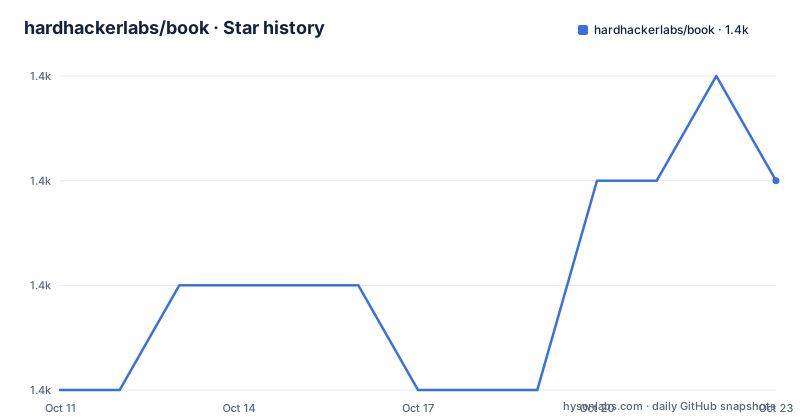
- hardhackerlabs/book1,376 ★ · +3
| Repository | 2026-10-11 | 2026-10-22 |
|---|---|---|
| hardhackerlabs/book | 1.4k | 1.4k |
3 Stars in the last 11 days, measured from the daily GitHub snapshot. Compare with other projects
Editorial analysis
What the repository actually contains
The first thing to establish is that this is a content repository with a website attached. The top-level tree is small and says so plainly: a `content/` directory, an `app/` directory, `mdx-components.js`, `next.config.mjs`, `package.json`, `package-lock.json`, `public/`, plus `.gitignore` and `.nvmrc`.
There is no `src/`, no library export, no test directory and no `.github/` directory with workflows in the tree. Nothing here is meant to be imported by another project. The `content/` directory is where the book lives, written in MDX, which is Markdown with React components available inline. That single choice is what lets a chapter embed a live demo or an interactive diagram instead of only showing a screenshot.
The README is written in Chinese and describes the book as a faithful record of the Podwise product journey, from first idea to revenue, and it is careful about what it claims. The authors say Podwise's results are far from a success story, that it has perhaps found product-market fit, and that the book is therefore not an authoritative guide and is for reference only. That framing is worth carrying into any decision about how much weight to put on it.
Next, Nextra and a Node version requirement
The build is the standard Next.js documentation setup. `package.json` names the package `hardhacker-handbook` at version 0.2.2, authored by HardHackerLabs, and pins the runtime:
"engines": {
    "node": "24.x"
  },
The runtime constraint matters more than it looks in a content repository, because a static site that renders MDX at build time will break on a Node major it was not tested against, and `.nvmrc` is in the tree precisely so that everyone building the site uses the same one.
The framework stack is Next with Nextra on top:
"next": "^16.3.0",
"nextra": "4.6.0",
"nextra-theme-docs": "4.6.0",
"react": "^19.2.8",
"react-dom": "^19.2.8"
Nextra pinned exactly at 4.6.0 while Next and React carry caret ranges is a deliberate-looking choice. Nextra's docs theme is the part that provides the sidebar, search and page navigation, and pinning it exactly avoids a theme upgrade landing in a commit that is supposed to be about prose. `@next/third-partries` is there for embeds, and TypeScript appears in devDependencies for type checking the MDX components.
Three scripts are defined, which is the whole build surface:
npm run dev
npm run build
npm run start
There is no lint script, no test script and no deploy script. Everything beyond these three is left to the hosting platform.
How the book is organised into five parts
The README lays out the whole table of contents, which is unusual for a book repository and useful, because you can see the argument before you read any of it. The structure follows the product lifecycle rather than a topic list, and the chapter URLs are grouped under path segments that match each part.
The first part covers inspiration, and its three chapters start from the community, move to a niche market sized in millions of dollars, and land on building an MVP. The second part covers building, with chapters on treating design and development as one activity, choosing a technology stack that is convenient and familiar, what you have to know about large language models, treating saved time as saved money, and not building services you could simply use.
The third part covers launch: acquiring the first 200 users, staying close to users after that, and setting prices with the cost side in view. The fourth part covers growth, split into choosing where to spend promotion when the leverage is highest, interacting and replying and following the long tail, and an unexpected breakout. The fifth part covers review, with chapters on the longer-term plan, the mistakes least worth making, and the things the authors expect to keep doing.
What that ordering shows is the argument. Acquisition is treated as a solved problem that produced 200 users, and the harder half is what happens afterwards, which is why feedback and pricing get their own chapters rather than being folded into launch.
What the book says about Podwise itself
The product is an AI knowledge management application built for podcast listeners. The README describes the mechanism plainly: you follow the podcasts you care about, and when an episode is published the platform transcribes it, extracts, summarises and analyses the content for you.
The integration list is the part that makes it a knowledge management tool rather than a transcription service. Podwise connects to Notion, Obsidian, Logseq and Readwise, so the output lands inside a note-taking workflow you already run instead of in a separate app. The stated goal is a second brain that also absorbs news, newsletters and blog posts from other channels.
The repository description frames the book as a two-month path to 12000 dollars in annual recurring revenue. That number is the author's own and it is stated as the book's premise rather than as a verified outcome, so it is better read as a scale of ambition than as a result to expect. A reader looking for a repeatable path from nothing to revenue will find the chapters on the first 200 users and on pricing far more useful than the headline figure.
The repository's own topics back this up: `book`, `indie-hackers`, `podcast`, `transcription`, `summarizer`, `mindmap`, `mrr` and `ai`. This is a book about an AI product built by people who publish a podcast, which explains the shape of the advice.
CC BY-NC-ND and the absence of a license file
The README states that the work is licensed under CC BY-NC-ND 4.0, and it spells out the three conditions in detail: you must give appropriate credit with a link to the license and say whether you changed anything, you may not use it commercially, and you may not distribute modified versions.
That third condition is the one that changes what you can do. No derivatives means you cannot publish a translation, cannot fork the text into your own book, and cannot adapt a chapter for a company wiki. You can share and copy it, with attribution, and that is the entire grant. For a book whose authors built the surrounding community as the business, that is a coherent choice rather than an oversight.
There is a gap worth flagging. GitHub reports no license for this repository, and the tree contains no LICENSE file, so the terms live only in the README prose. Anyone reusing the code rather than the text faces a weaker question, because the site's own `package.json` is covered by whatever default rights apply when no license is granted. If you want to reuse the Nextra setup itself, that is a separate conversation from reusing the book, and the repository does not answer it.
The site is published at book.hardhacker.com, with the cover and an ARR chart linked from hardhacker.com.
The community behind the book
A good deal of the README is not about the book. It describes a paid knowledge community, with four concrete benefits: at least 24 themed posts a year covering product stages from inspiration through build, launch and growth; about 50 podcast episodes a year as articles with searchable references; one show-notes advertising slot per membership, valued at 500 yuan, for members' own products; and occasional hackathons with cash prizes and incubation for winners.
Read honestly, that is a membership pitch appended to a book listing, and it tells you something the chapter list does not. The book is the free part, and the ongoing material, the podcast archive and the events are what the subscription is for. The README also says the podcast exists so the founders can tell their own story, and that the community's core members are three founders with more than a decade of internet entrepreneurship between them.
So there are two separate things to evaluate. The book is a document you can read and cite. The community is a subscription to a continuing stream of the same thinking. Neither substitutes for the other, and the second one is where the ongoing cost is.
For a technical reader the more transferable detail is the stack, which is ordinary and unremarkable on purpose: Next, Nextra, MDX, and a three-command npm workflow. That is the whole reason a book can ship continuously without a dedicated engineering team, and it is the part worth copying.
Editorial conclusion
This repository is worth reading as a worked example of shipping a book with a modern static site stack, and worth reading as the book itself if you are building an AI product from scratch. It is not a codebase to fork for its own sake: there is no test suite, no release history, and no published license file, and the CC BY-NC-ND 4.0 terms mean you may share the text but not translate, remix or republish it commercially. Start with the chapter on the first 200 users, since that is the part of the lifecycle with the least obvious advice in it, and check the terms on the repository page before assuming anything you can reuse.
Frequently asked questions
What is the hardhackerlabs book repository?
It is the source for an open book about the Podwise product journey, published as a website. The book is organised into five parts covering inspiration, building, launch, growth and review, and the README says it is a faithful record rather than an authoritative guide.
What framework is the book website built with?
Next.js with Nextra as the documentation layer, writing chapters as MDX. package.json pins nextra at 4.6.0 alongside nextra-theme-docs at the same version, with React 19 and TypeScript, and the scripts are npm run dev, npm run build and npm run start.
Can I translate or republish the content under its license?
Not without permission. The README states the work is licensed under CC BY-NC-ND 4.0, which permits sharing and copying with attribution but forbids commercial use and any distribution of modified versions. A translation counts as a derivative.
What is Podwise and why is it in this repository?
Podwise is an AI knowledge management application for podcast listeners that transcribes, summarises and analyses new episodes, and integrates with Notion, Obsidian, Logseq and Readwise. The book is a retrospective on building it, written by the community members behind the product.
Official sources
Add this badge to your README
If you maintain this project, the badge below links readers to this analysis and shows its maintenance status from the daily GitHub snapshot. Paste the markdown into your README; add ?metric=license or ?metric=stars to the image URL for a different field.

[](https://hysenlabs.com/projects/hardhackerlabs-book)Star history chart for your README
[](https://hysenlabs.com/projects/hardhackerlabs-book)