OMG-Seg: unified image and video segmentation with one model
Official Repo For OMG-LLaVA and OMG-Seg codebase [CVPR-24 and NeurIPS-24]
At a glance
- What is it?
- OMG-Seg is a research codebase for performing more than ten image and video segmentation tasks through a shared transformer encoder-decoder architecture. It suits research teams studying cross-task co-training, but the available documentation does not provide enough installation detail for a production-ready evaluation.
- Who is it for?
- Adopt OMG-Seg for research into joint segmentation, task-specific queries, and shared image or video models, especially when academic hardware constraints matter. Do not select it as a turnkey production component until the commands in INSTALL.md, supported environments, model checkpoints, dataset preparation, and applicable code and model license terms have been reviewed.
- Can I use it commercially?
- Check first. The repository uses a licence we do not classify automatically, so read its LICENSE file before any commercial use.
- Is it still maintained?
- Yes. The repository last received commits 61 days ago.
- What is it written in?
- Mainly Python, according to GitHub's language statistics.
Answers come from the project's GitHub data, last synced on November 6, 2026, and from our analysis. They are not legal advice.
Star history
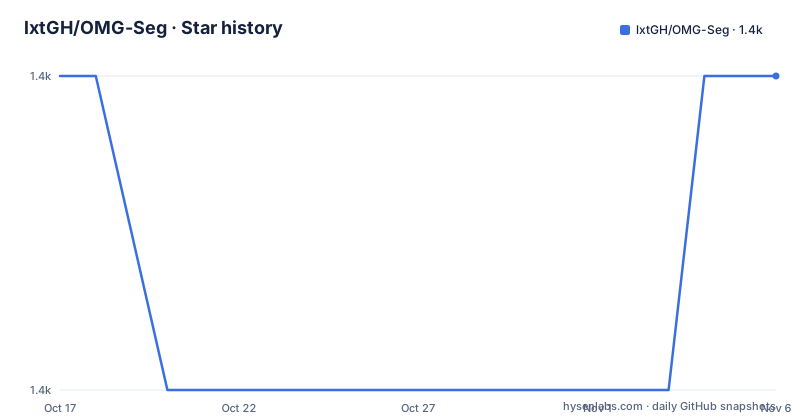
- lxtGH/OMG-Seg1,354 ★ · +0
| Repository | 2026-10-17 | 2026-11-06 |
|---|---|---|
| lxtGH/OMG-Seg | 1.4k | 1.4k |
0 Stars in the last 20 days, measured from the daily GitHub snapshot. Compare with other projects
Editorial analysis
What OMG-Seg unifies across image and video perception
OMG-Seg addresses a specific fragmentation problem in computer vision. Semantic segmentation, instance segmentation, panoptic segmentation, video segmentation, open-vocabulary segmentation, prompt-driven segmentation, interactive segmentation, and video object segmentation are often handled by separate or partially unified systems. Researchers who need several of these capabilities may consequently have to maintain different models, training procedures, and inference paths.
The repository presents OMG-Seg as one model intended to handle more than ten segmentation tasks. Its target users are computer vision researchers working with image-level categories, individual objects, pixel masks, video data, natural-language prompts, or interactive segmentation signals. The project is also relevant to labs that want to study how a single architecture behaves under joint co-training across multiple tasks and datasets.
This is a research codebase rather than a conventional application framework. The repository includes separate documentation for the project, dataset preparation, installation, embedding-related work, segmentation code, demos, and tools. The README says that code and models were released, while the news entries record the release of OMG-Seg models and test code on 2024-01-19, followed by training code on 2024-03-18. The absence of GitHub releases means the repository history is currently the clearer record of release milestones.
The task-specific query architecture behind OMG-Seg
OMG-Seg is described as a transformer-based encoder-decoder architecture with task-specific queries and outputs. That design is the central engineering idea. Instead of treating every segmentation problem as a completely separate model, the shared architecture can receive different query structures and produce the output required by a particular task.
The README lists semantic, instance, and panoptic segmentation, plus their video counterparts, among the supported categories. It also includes open-vocabulary segmentation, prompt-driven segmentation, interactive segmentation such as SAM-style use, and video object segmentation. The documentation does not expose the complete query definitions, loss functions, decoder implementation, or task-routing API in the repository overview, so the exact operational details must be confirmed in the source under `seg/`.
The repository also contains `ext/` and `tools/` directories, which suggests that part of the implementation depends on extensions or supporting utilities rather than being contained in a single Python module. Based on the available layout, a researcher should expect a research codebase organized around model code, external components, tools, configurations, and demonstrations. That structure can support extension and experimentation, but it also raises the integration cost compared with a packaged library with a stable public API.
OMG-LLaVA, which shares this repository, extends the same broad direction into multimodal reasoning. Its README describes a universal segmentation method as the visual encoder and says that image information, perception priors, and visual prompts are integrated into visual tokens supplied to a language model. The language model then produces text responses and pixel-level segmentation results. That extension is separate from the OMG-Seg segmentation focus, but it explains why the repository contains both `seg/` and `omg_llava/`.
Installing OMG-Seg and locating the first runnable example
The repository directs users to `INSTALL.md` for installation information, and `DATASET.md` is the relevant file for dataset preparation. The README overview does not reproduce the installation commands, dependency versions, environment variables, configuration keys, or hardware setup steps. Consequently, this review cannot provide a verified `pip`, Conda, PyTorch, CUDA, or model-download command without inventing details that are not available in the documented text.
For a first use, start with the documented installation file and dataset instructions rather than copying commands from an unrelated computer vision repository. Then inspect the demo documentation and the `demo/` directory, which contains `image_demo.py`, `video_demo.py`, a `README.md`, `configs/`, and sample images. These files are the repository's clearest entry points for determining how a checkpoint is loaded, how an image or video is supplied, and how a segmentation result is displayed.
The README also links to Hugging Face locations for OMG-Seg and OMG-LLaVA and to hosted demo applications. Those links provide possible routes to model or demo access, but the repository overview does not state their exact loading commands. A first run should therefore be treated as an integration check: confirm the environment from `INSTALL.md`, prepare data according to `DATASET.md`, identify the relevant demo configuration, and only then attempt inference. The expected result is a segmentation output produced by the documented demo path, but no exact output format can be confirmed from the available text.
Joint co-training benefits and the cost of a shared model
The main research value of OMG-Seg is not simply that it exposes one inference command. The README says the codebase supports joint image, video, and multi-dataset co-training, and it describes evaluation of inter-task influences and correlations during co-training. This makes the repository useful for studying transfer, interference, and task interaction across segmentation settings.
The proposed efficiency argument is also explicit. OMG-Seg is presented as a shared architecture with task-specific queries and outputs, and the README states that it has 70 million trainable parameters. It also says the project can be reproduced using one 32GB V100 or one 40GB A100 machine. Those statements describe the authors' design and reported setup, but the README excerpt does not provide enough detail to independently reproduce the memory profile or compare it with a separate model for every task.
The trade-off is architectural complexity. A multi-task model can reduce the number of separately maintained model components, yet it also requires correct task selection, compatible data preparation, balanced training, and task-specific evaluation. A failure in one task's data format or configuration may affect a co-training run even when the underlying architecture is shared. OMG-Seg therefore reduces the conceptual number of models, not the need to understand the requirements of each task.
Where OMG-Seg is the wrong tool
OMG-Seg is a poor fit when the requirement is a small, stable segmentation component with a conventional API and predictable dependency surface. The repository is organized as a research project with separate demo, tool, extension, dataset, and model-code areas. The README does not promise semantic versioning, a stable public Python interface, deployment packaging, or compatibility guarantees. It also has no GitHub releases, so release discovery depends on repository documentation and linked model pages.
It may also be unsuitable for teams that need only one narrow task and do not want to manage a shared multi-task architecture. For example, an application that requires only ordinary semantic segmentation may prefer a task-specific model if that model has a documented deployment path and a smaller operational surface. OMG-Seg becomes more compelling when several segmentation modes are genuinely needed or when cross-task co-training is itself part of the research question.
The repository identifies OMG-Seg as MIT-licensed and OMG-LLaVA as Apache-2.0. Check the license for the specific code and any separate checkpoint or dataset terms before deployment or redistribution.
OMG-Seg compared with separate task-specific models
The practical alternative is to use separate task-specific models for semantic segmentation, instance segmentation, video segmentation, or interactive segmentation. The difference is architectural and operational. Separate models can allow each task to use a model, loss, data pipeline, and deployment configuration selected for that job. Their drawback is the need to maintain several systems and reconcile their outputs when an application crosses task boundaries.
OMG-Seg takes the opposite approach. Its transformer encoder-decoder and task-specific queries are intended to let one model cover multiple segmentation tasks, including image, video, open-vocabulary, prompt-driven, and interactive cases. The repository also supports joint multi-dataset co-training, which can make the shared model useful for research into how tasks interact.
Neither approach automatically fits every product. A separate-model design can be easier to reason about when tasks have sharply different data, latency, or accuracy requirements. OMG-Seg is more relevant when avoiding separate model maintenance is important and when the team can handle a research-oriented architecture. The decision should therefore compare task coverage, checkpoint availability, inference interface, hardware requirements, and evaluation results for the actual target task, rather than relying on the shared-model concept alone.
Maintenance, licensing, and upgrade implications for OMG-Seg
The repository is not archived, and its last push was on 2026-09-08. That date is the most concrete maintenance signal available here. The repository has no GitHub releases, so there is no release-based upgrade path documented in the supplied information. Maintenance cannot be inferred from source activity alone, and the available text does not define a compatibility policy for Python, PyTorch, CUDA, model checkpoints, or external extensions.
The repository README identifies OMG-Seg as MIT-licensed and the related OMG-LLaVA component as Apache-2.0. Read the relevant license files and any terms attached to model weights and datasets.
For upgrades, the practical concern is research reproducibility. Checkpoints, dataset instructions, model code, demo configurations, and external code may need to remain synchronized. The README does not document a migration guide, rollback procedure, or version compatibility matrix. A team that adopts OMG-Seg should record the exact commit, model page, configuration, and dependency instructions used for an experiment before changing any of those inputs.
Editorial conclusion
Adopt OMG-Seg for research into joint segmentation, task-specific queries, and shared image or video models, especially when academic hardware constraints matter. Do not select it as a turnkey production component until the commands in INSTALL.md, supported environments, model checkpoints, dataset preparation, and applicable code and model license terms have been reviewed. The first verification point is whether one intended task can be reproduced from the documented checkpoint and inference entry point.
Frequently asked questions
What tasks does OMG-Seg support?
The README says OMG-Seg supports more than ten segmentation tasks, including semantic, instance, panoptic, video, open-vocabulary, prompt-driven, interactive, and video object segmentation. The repository presents these as categories handled by a shared architecture with task-specific queries and outputs.
Does OMG-Seg provide a documented installation process?
The README points to `INSTALL.md` for installation and `DATASET.md` for dataset preparation, but the available repository overview does not reproduce the commands or dependency versions. The README also links to model and demo pages on Hugging Face.
Can OMG-Seg train multiple segmentation tasks together?
Yes, according to the README. It says the codebase supports joint image, video, and multi-dataset co-training, while also describing evaluation of inter-task influences and correlations during co-training.
Official sources
Add this badge to your README
If you maintain this project, the badge below links readers to this analysis and shows its maintenance status from the daily GitHub snapshot. Paste the markdown into your README; add ?metric=license or ?metric=stars to the image URL for a different field.

[](https://hysenlabs.com/projects/lxtgh-omg-seg)Star history chart for your README
[](https://hysenlabs.com/projects/lxtgh-omg-seg)Was this useful?