Mario Kart Wii Service Pack: A C++ Mod That Rebuilds the Game, Not Just Its Textures
Mario Kart Wii - Service Pack
At a glance
- What is it?
- The Service Pack is an experimental, open-source mod for Mario Kart Wii that replaces core game logic with C++ code. It targets modders who want to go beyond custom tracks and need a structured, buildable codebase.
- Who is it for?
- Adopt this project if you are a developer who wants to modify Mario Kart Wii's internal logic and are comfortable with C, C++, and build tools like ninja and protoc. Do not use it if you just want to add tracks or simple cosmetic changes; the base game modding scene already covers that with simpler tools.
- Can I use it commercially?
- Yes. MIT is a permissive licence: you can use, modify and sell software built on it, as long as you keep its copyright and licence notices.
- Is it still maintained?
- Activity is slowing. The repository last received commits 10 months ago.
- What is it written in?
- Mainly C++, according to GitHub's language statistics.
Answers come from the project's GitHub data, last synced on October 22, 2026, and from our analysis. They are not legal advice.
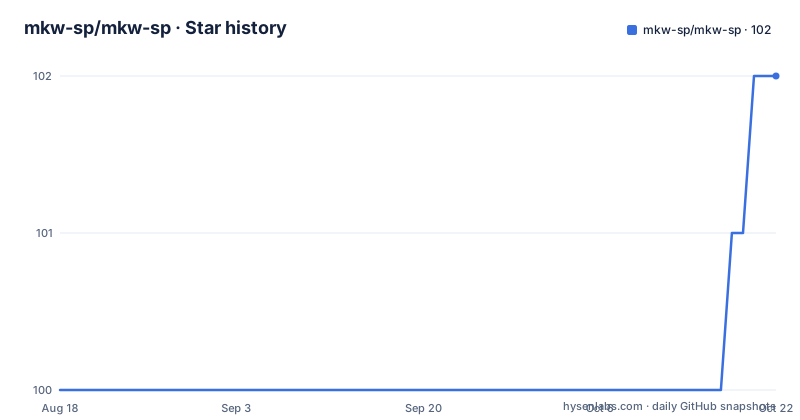
Star history
- mkw-sp/mkw-sp102 ★ · +2
| Repository | 2026-08-18 | 2026-10-22 |
|---|---|---|
| mkw-sp/mkw-sp | 100 | 102 |
2 Stars in the last 65 days, measured from the daily GitHub snapshot. Compare with other projects
Editorial analysis
What Problem Does the Service Pack Solve?
Standard Mario Kart Wii mods are often asset swaps: custom tracks, textures, and character models. They rarely touch the game's compiled logic. The Service Pack is different. It is an experimental, cross-platform mod that aims to provide new features and improvements over the base game by replacing and supplementing the game's own C++ code. The intended audience is not the casual player but the developer who wants to change how the game behaves internally. If you have ever wanted to alter physics, add new game modes, or fix long-standing bugs at the code level, this project gives you a structured starting point. It is not a drop-in package; it is a codebase you build and then integrate with the game.
How It Works: Replacing Game Code with C++ and Assembly
The repository contains both C and assembly code, with a clear preference for C in the contributing guidelines. Full function replacements and complex logic should be written in C. Assembly is reserved for wrappers that save and restore volatile registers, a necessity when you are injecting code into a game that was not designed for external modification. The project uses the devkitPPC toolchain, which targets the PowerPC architecture of the Wii. The build process is not a simple make; it involves generating code from protocol buffers using protoc and Python scripts. The output lands in an `out` directory with binaries and assets. This is a significant departure from traditional modding, where you might patch a binary directly. Here, you compile new code and then likely link or inject it into the game, though the exact integration steps are not detailed in the README.
Getting It Running: A Build Process with Unusual Dependencies
To build the Service Pack, you need devkitPPC with the DEVKITPPC environment variable set, ninja (or samurai), protoc, Python 3, and several Python libraries: pyjson5, pyelftools, itanium_demangler, and protobuf. The README explicitly warns that the pip package for pyjson5 is named `json5`, not `pyjson5`. That is a small but real trap. The actual build command is simple: `./build.py`. For a debugging build with symbols, you run `python3 build.py -- debug`. The process is automated, but the dependency list is long and includes a protocol buffer compiler, which is unusual for a game mod. This is not a project you can build with a single `make` command. You need a working Python environment and a specific toolchain. If you have never used devkitPPC, expect a learning curve just to get the build running.
The Ghidra Project and Other Resources: Why You Need Them
The README links to a Ghidra project, which it calls by far the most complete resource for understanding the game's code. This is a strong hint that the Service Pack does not work in isolation. You need to reverse-engineer the game's internal structures to write your own C replacements. The README also points to the MKW decompilation project, mkw-structures, and the Tockdom Wiki for file format documentation. That means the Service Pack is not self-contained. It assumes you have access to these external references. If you are new to Mario Kart Wii modding, this dependency on external resources is a barrier. The project gives you the build system and some code, but the actual logic of the game is documented elsewhere. You are expected to consult a decompilation or a Ghidra database to know what to replace.
A Genuine Limitation: It Is Experimental and Unmaintained
The project is explicitly described as experimental. The last push was in May 2023, and the latest release is v0.1.12. There is no guarantee that it works with the latest version of the game or with current devkitPPC versions. The README does not mention any testing on real hardware or emulators. That is a gap. You cannot confirm from the repository whether the generated binaries actually run on a Wii or in Dolphin. The contributing guidelines mention CI, but they do not specify what the CI does. The lack of a clear integration guide is another limitation. The build produces binaries and assets, but the README does not explain how to load them into the game. For a mod that replaces core logic, that is a significant missing piece. You are left to figure out the injection method yourself, possibly relying on other modding tools not listed here.
Alternatives: The Decompilation and Asset Modding Paths
The most direct alternative is the MKW decompilation project (riidefi/mkw), which the README itself links to as the most readable resource. The decompilation aims to recreate the game's source code in a form that can be compiled, but it is a different approach. The Service Pack is a mod that builds on top of the original game, while a decompilation is a full source replacement. If you want to understand how the game works, the decompilation might be more accessible. On the other side, traditional modding tools for Mario Kart Wii, such as custom track distributors or texture hacks, do not require any coding. They are the wrong tool if you need logic changes, but they are the right tool if you just want new courses. The Service Pack sits in between: it gives you code, but it does not give you the entire game. You still need the original game files to run it.
Maintenance and License Implications
The project is licensed under the MIT license, which is permissive. You can use, modify, and distribute the code, as long as you include the original copyright notice. That is a low barrier for adoption. However, the maintenance cost is real. The project has not been updated since 2023, and the dependencies are specific. If devkitPPC updates or Python packages change, the build may break. The README does not mention any long-term support policy. The contributing guidelines require clang-format 15, which is an older version. That suggests the codebase is tied to a specific toolchain era. You should expect to do some work to keep it building. There is no documentation on how to upgrade or what the release cadence is. The v0.1.x version numbers indicate an early stage, so breaking changes are possible. You are essentially adopting an experimental codebase with a permissive license but no promise of stability.
Editorial conclusion
Adopt this project if you are a developer who wants to modify Mario Kart Wii's internal logic and are comfortable with C, C++, and build tools like ninja and protoc. Do not use it if you just want to add tracks or simple cosmetic changes; the base game modding scene already covers that with simpler tools. Before adopting, verify that your devkitPPC environment matches the expected version and that you can install the Python dependencies, especially the json5 package, since the README warns about the naming mismatch. Also check the Ghidra project linked in the resources, as it is essential for understanding the game's internals. The project has not been updated since May 2023, so confirm that it still builds with current toolchains. If you need a stable, well-documented modding framework, this experimental codebase may require significant effort to maintain.
Frequently asked questions
Is there a downloadable installer for Mario Kart Wii Service Pack?
No. The project ships source and a build script rather than a prebuilt package. Running ./build.py with devkitPPC and the listed Python packages installed produces the binaries and assets in the out directory.
What do I need installed before I can build MKW-SP?
devkitPPC with the DEVKITPPC environment variable set, ninja (samurai also works), protoc, and Python 3, plus the pyjson5, pyelftools, itanium_demangler, and protobuf Python packages. If you install pyjson5 from pip, the package is named json5.
How do I get an unoptimised MKW-SP build with debugging information?
Run python3 build.py -- debug, which the README gives as the way to produce a unoptimised build with debugging symbols from the same script used for the normal build.
Where should I look when I need to understand how MKW-SP patches the game?
The README points at a Ghidra project as by far the most complete resource, the MKW decompilation as the most readable one if it has what you need, and mkw-structures if you still have not found it. The Tockdom Wiki is the reference for file formats.
Does MKW-SP have to be written in assembly to contribute a fix?
No. The contributing notes say C should be preferred for full function replacements and for any kind of complex logic. Assembly wrappers are for restoring and backing up volatile registers when a C rewrite cannot satisfy the ABI.
Official sources
Add this badge to your README
If you maintain this project, the badge below links readers to this analysis and shows its maintenance status from the daily GitHub snapshot. Paste the markdown into your README; add ?metric=license or ?metric=stars to the image URL for a different field.

[](https://hysenlabs.com/projects/mkw-sp-mkw-sp)Star history chart for your README
[](https://hysenlabs.com/projects/mkw-sp-mkw-sp)