Kimi K2.5: an open mixture-of-experts model built for visual agentic work
Open Visual Agentic Intelligence
At a glance
- What is it?
- Moonshot AI's 1T parameter model with 32B activated, a 256K context and a native vision encoder, documented through a spec table and a benchmark table rather than a codebase.
- Who is it for?
- What this repository provides is unusually good for a frontier model announcement, a precise architecture table and a comparison grid with four named competitors, and unusually little for anyone expecting to run or build against it. There is no code here, only a README, a figures directory, a docs directory and a technical report PDF, so the practical questions about inference, serving and evaluation are all answered outside GitHub.
- Can I use it commercially?
- Check first. The repository uses a licence we do not classify automatically, so read its LICENSE file before any commercial use.
- Is it still maintained?
- Yes. The repository last received commits 94 days ago.
- What is it written in?
- GitHub does not report a main language for this repository.
Answers come from the project's GitHub data, last synced on November 7, 2026, and from our analysis. They are not legal advice.
Star history
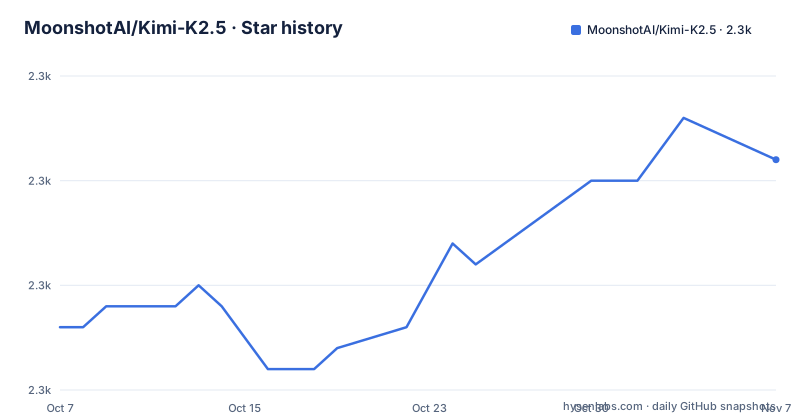
- MoonshotAI/Kimi-K2.52,321 ★ · +8
| Repository | 2026-10-07 | 2026-11-07 |
|---|---|---|
| MoonshotAI/Kimi-K2.5 | 2.3k | 2.3k |
8 Stars in the last 31 days, measured from the daily GitHub snapshot. Compare with other projects
Editorial analysis
A repository with no code, only a specification
The tree for this project has five entries: LICENSE, README.md, a docs directory, a figures directory, and a file named tech_report.pdf. There is no inference code, no training code, no configuration, and no Docker setup. Whatever you would need to actually run this model lives elsewhere, which is normal for a model announcement repository and worth saying plainly before anything else.
GitHub reports the description as Open Visual Agentic Intelligence, and the README frames K2.5 as an open-source, native multimodal agentic model built through continual pretraining on approximately 15 trillion mixed visual and text tokens on top of Kimi-K2-Base. Continual pretraining on top of a previous base is a different claim from training a model from scratch, and it matters for anyone reasoning about what the weights represent.
Three capabilities are highlighted. Native multimodality covers visual knowledge, cross-modal reasoning and agentic tool use grounded in visual inputs. Coding with vision means generating code from visual specifications such as UI designs and video workflows. The agent swarm is the most interesting claim, described as a move from single-agent scaling to a self-directed, coordinated swarm-like scheme that decomposes complex tasks into parallel sub-tasks executed by dynamically instantiated, domain-specific agents.
The README also mentions instant and thinking modes, and both conversational and agentic paradigms, without giving detail on how a caller selects between them.
The architecture table is the most useful thing here
Rather than describing the model in prose, the README publishes a specification table, and it is precise enough to be useful:
| | | |:---:|:---:| | Architecture | Mixture-of-Experts (MoE) | | Total Parameters | 1T | | Activated Parameters | 32B | | Number of Layers (Dense layer included) | 61 | | Number of Dense Layers | 1 | | Attention Hidden Dimension | 7168 | | MoE Hidden Dimension (per Expert) | 2048 | | Number of Attention Heads | 64 | | Number of Experts | 384 | | Selected Experts per Token | 8 | | Number of Shared Experts | 1 | | Vocabulary Size | 160K | | Context Length | 256K | | Attention Mechanism | MLA | | Activation Function | SwiGLU | | Vision Encoder | MoonViT | | Parameters of Vision Encoder | 400M |
The shape implied by those numbers is a sparse MoE with an unusually high expert count. There are 384 experts of which 8 are selected per token, plus one shared expert that is always active, across 61 layers of which only one is dense. The total-to-activated ratio of roughly 31 to 1 is what makes a 1T parameter model plausible to serve at a 32B cost per token.
MLA means multi-head latent attention, the same mechanism popularized by DeepSeek, and it is what allows the KV cache to stay small enough for a 256K context. The vision side is a 400M MoonViT encoder, which is modest relative to the language model and suggests the visual pathway was not where the parameter budget went.
The single dense layer is an implementation detail worth noticing: it suggests the architecture is not uniformly sparse, which usually means the embedding and output stages are kept dense for numerical reasons.
Reading the benchmark grid, where the tool-enabled column tells the real story
The evaluation table compares K2.5 in thinking mode against four named competitors: GPT-5.2 at xhigh, Claude 4.5 Opus with extended thinking, Gemini 3 Pro at high thinking level, and DeepSeek V3.2 in thinking mode. A sixth column for Qwen3-VL-235B-A22B shows a dash on every reasoning row.
On HLE-Full, K2.5 scores 30.1 against GPT-5.2 at 34.5 and Gemini 3 Pro at 37.5, placing it behind both. On GPQA-Diamond it records 87.6 against 92.4 and 91.9, again behind. On MMLU-Pro it reaches 87.1, which is above GPT-5.2 at 86.7 but below Claude 4.5 Opus at 89.3 and Gemini 3 Pro at 90.1.
The HLE-Full row with tools tells a different story, and it is the row to focus on. K2.5 scores 50.2, moving ahead of GPT-5.2 at 45.5, Gemini 3 Pro at 45.8 and Claude 4.5 Opus at 43.2. A jump of twenty points from the same benchmark with tools attached is a measurement of how effectively the model drives a scaffold, which is exactly what an agentic model is supposed to be optimized for, and it is also the number most sensitive to which tools were provided and how they were wired.
AIME 2025 comes out at 96.1 against GPT-5.2's 100. The asterisk that appears on some competitor values, such as Claude at 92.9 on HMMT and 78.5 on IMO-AnswerBench, is not explained in the visible portion of the table, so treat any comparison involving those cells with the footnote unresolved.
The license is the one place the repository contradicts itself
GitHub reports no license identifier for this repository, meaning the field is unset rather than that a license is absent. The README, meanwhile, displays a badge reading License-Modified_MIT, linking to the LICENSE file in the repository root.
Both statements are true at once and they are not equivalent. A license file exists in the tree, and the project's own summary of it is a modified MIT, which in practice means additional restrictions on top of the standard MIT grant. A missing SPDX identifier in repository metadata usually means nobody configured the license field, not that no license was granted.
The practical consequence is that you have to read the LICENSE file rather than infer terms from the badge, and you cannot infer them from the metadata either. Modified MIT licenses in this space most often modify the use grant rather than the attribution requirement, which is precisely the clause a deployer needs to check. If you are planning to serve this model commercially, that file is the starting point, and a hosting platform's own terms are a separate question from the weights.
The repository is not archived and the last push recorded is 2026-08-06, with 327 forks and 50 open issues.
Editorial conclusion
What this repository provides is unusually good for a frontier model announcement, a precise architecture table and a comparison grid with four named competitors, and unusually little for anyone expecting to run or build against it. There is no code here, only a README, a figures directory, a docs directory and a technical report PDF, so the practical questions about inference, serving and evaluation are all answered outside GitHub. The benchmark grid is worth reading with care, because the strongest claims come from the tool-enabled column rather than the bare one, and a row that reads 50.2 with tools against 30.1 without says as much about scaffolding as about the model. If you are evaluating the weights, read the technical report in the repository root, then check the Hugging Face organization for the actual artifacts and licensing terms before planning any deployment.
Frequently asked questions
What is Kimi K2.5 good for?
The README highlights three areas: native multimodality covering visual knowledge, cross-modal reasoning and tool use grounded in visual inputs; coding from visual specifications such as UI designs and video workflows; and an agent swarm scheme that decomposes complex tasks into parallel sub-tasks run by dynamically instantiated domain-specific agents. Its strongest benchmark result is on HLE-Full with tools, where it scores 50.2.
How many parameters does Kimi K2.5 have?
One trillion total, with 32 billion activated per token. It is a sparse mixture-of-experts model with 384 experts of which 8 are selected per token, plus one always-active shared expert, spread across 61 layers of which a single one is dense. The context length is 256K and the vision encoder is a 400M parameter MoonViT.
What license is Kimi K2.5 released under?
The README shows a badge for a modified MIT license and a LICENSE file exists in the repository root, but GitHub reports no license identifier in the repository metadata. Since a modified MIT grant adds terms beyond the standard one, read the LICENSE file directly rather than relying on either the badge or the metadata field.
Can I run Kimi K2.5 from its GitHub repository?
Not from this repository. It contains a README, a figures directory, a docs directory, a technical report PDF and a LICENSE file, but no inference or training code. The practical artifacts, including weights and serving instructions, are distributed through the Hugging Face organization and the Kimi chat product linked from the README.
Official sources
Add this badge to your README
If you maintain this project, the badge below links readers to this analysis and shows its maintenance status from the daily GitHub snapshot. Paste the markdown into your README; add ?metric=license or ?metric=stars to the image URL for a different field.

[](https://hysenlabs.com/projects/moonshotai-kimi-k2-5)Star history chart for your README
[](https://hysenlabs.com/projects/moonshotai-kimi-k2-5)Was this useful?