OceanBase: what a Paxos-based distributed SQL engine actually documents
OceanBase is the unified distributed database for the AI era — open-source, multi-model, one engine for your most demanding workloads.
At a glance
- What is it?
- OceanBase is Ant Group's distributed relational database, written in C++ and released under the Apache License, Version 2.0. Its README makes strong scale, availability and MySQL compatibility claims while leaving install pinning, tenant creation and the Kubernetes path to other documents.
- Who is it for?
- Pick OceanBase Database if you want a MySQL-compatible, Paxos-based distributed relational engine and can commit to a C++ codebase whose cluster behavior is documented outside this repository. Do not choose it from the TPC figures alone: the fastest install path is a Linux-only piped script with no version pin, the container demo is one standalone observer, and no compatibility matrix or version-matched operator is named.
- Can I use it commercially?
- Yes. Apache-2.0 is a permissive licence: you can use, modify and sell software built on it, as long as you keep its copyright and licence notices.
- Is it still maintained?
- Yes. The repository last received commits 2 days ago.
- What is it written in?
- Mainly C++, according to GitHub's language statistics.
Answers come from the project's GitHub data, last synced on November 15, 2026, and from our analysis. They are not legal advice.
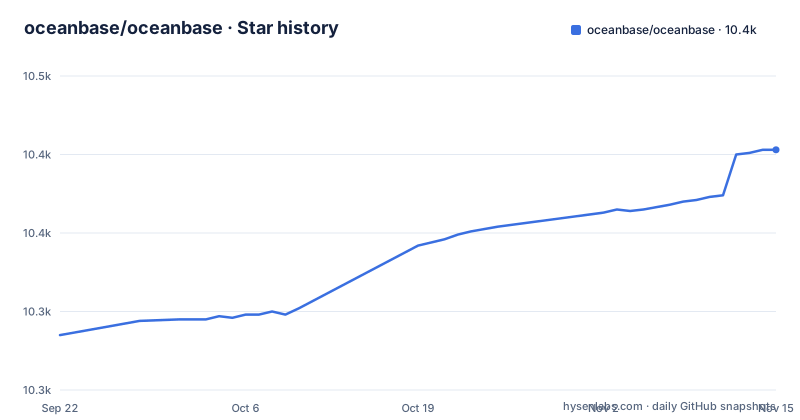
Star history
- oceanbase/oceanbase10,403 ★ · +118
| Repository | 2026-09-22 | 2026-11-15 |
|---|---|---|
| oceanbase/oceanbase | 10.3k | 10.4k |
118 Stars in the last 54 days, measured from the daily GitHub snapshot. Compare with other projects
Editorial analysis
Availability numbers that trace back to a Paxos quorum
OceanBase Database is a distributed relational database developed entirely by Ant Group, built on a common server cluster and based on the Paxos protocol, which it links to Lamport's paper. High availability and linear scalability are presented as consequences of that structure, and the engine is not dependent on specific hardware architectures..
The availability figures follow the same logic: RPO = 0(zero data loss) and RTO < 8s(recovery time), plus support for HTAP without additional cost. No test setup, hardware list, or workload accompanies those numbers, and the README does not explain how a failed replica is detected, how quickly a leader change is forced, or what a client observes while a quorum re-forms. Treat the eight second figure as a vendor claim until you kill a node yourself and measure the outage your own workload absorbs.
The all-in-one install is a piped shell script, and it is Linux only
To try a stand-alone OceanBase Database, the project hands you an all-in-one package marked Linux Only. The install runs a script fetched over the network through bash -c, then sources an env script and lets obd perform a demo deployment.
# download and install all-in-one package (internet connection is required)
bash -c "$(curl -s https://obbusiness-private.oss-cn-shanghai.aliyuncs.com/download-center/opensource/oceanbase-all-in-one/installer.sh)"
source ~/.oceanbase-all-in-one/bin/env.sh

# quickly deploy OceanBase database
obd demo
The comment on that block confirms an internet connection is required. Nothing in the command pins a version, and no checksum is shown, so there is no way to tell which build you received or to reproduce it later, and there is no offline route at all. On a locked-down or air-gapped host this path simply does not work, and you have to find another distribution channel. Read the installer before you run it, because whatever it downloads becomes your database engine.
MODE=mini boots one standalone observer, not the cluster the numbers describe
The container path is the shortest route to a running instance, and the command's own comment calls it a mini standalone instance.
# Deploy a mini standalone instance.
docker run -p 2881:2881 --name oceanbase-ce -e MODE=mini -d oceanbase/oceanbase-cedocker exec -it oceanbase-ce obclient -h127.0.0.1 -P2881 -uroot # Connect to the root user of the sys tenant.Only port 2881 is published, the container runs detached, and obclient connects as root in the sys tenant. This is a single node evaluation setup. The scalability and performance claims describe something else entirely: 1,500 nodes, PB data and a trillion rows in one cluster, TPC-C 707 million tmpC and TPC-H 15.26 million QphH @30000GB. A mini instance cannot show you what happens when quorum, partition routing or cross node replication matter, so do not use it to validate those claims. No data volume is mounted in the command either, and further details are deferred to the Docker Readme in the oceanbase/docker-images repository.
Three registries are offered because one of them has pull problems
Images are published on dockerhub, quay.io and ghcr.io, and the advice for a dockerhub pull failure is to try the other two. Each mirror is written out as a complete command.
# Deploy a mini standalone instance using image from quay.io.
# docker run -p 2881:2881 --name oceanbase-ce -e MODE=mini -d quay.io/oceanbase/oceanbase-ce

# Deploy a mini standalone instance using image from ghcr.io.
# docker run -p 2881:2881 --name oceanbase-ce -e MODE=mini -d ghcr.io/oceanbase/oceanbase-ce
Switching registries steps around a pull failure without explaining it: no cause, no rate limit detail and no retry guidance is given, so a network that blocks one host may block the others too. None of the three examples names a tag, which means a pull resolves to whatever the registry currently marks as the default, and that default can change under a name you assumed was fixed. Tag listing pages are linked for all three registries if you want a specific release. Pin a tag in your own scripts, because a moving default is how a demo turns into an unplanned upgrade.
The Kubernetes route lives in a separate repository with no version named
For Kubernetes deployments OceanBase points to ob-operator, a project in its own repository, and to a Quick Start for ob-operator document for the details. Nothing that runs the cluster is stored here. The top level of this tree is C++ source and build material: src/, test/, unittest/, mittest/, tools/, cmake/, deps/, script/, package/ and rpm/, with no manifest, chart or operator image among the entries.
The consequence is that a Kubernetes install means adopting and versioning a second project yourself, and the README does not name which OceanBase release the documented operator path targets, so the operator and the image you pull can drift apart without the docs flagging it. Nor does the README state whether the operator manages the sys tenant, application tenants or both, which is the first question you will hit when you create your first tenant. Read the operator documentation and the community edition release notes before assuming the two agree, and remember this route inherits every registry caveat above, since the same images still have to be pulled.
MySQL compatibility is one sentence with no compatibility level attached
The compatibility claim is a single bullet: MySQL Compatible, easily migrated from MySQL database. The quick start fits that story, reaching the server with obclient on port 2881 as root. Beyond that sentence, no compatibility level, no list of supported MySQL versions, no storage engine coverage and no migration tool is named in the README.
Even tenant creation is missing. The connection command identifies a sys tenant and a root user, which implies a multi-tenant model you have to learn from the OceanBase documentation site instead of from this README, and the cost claim of 70% to 90% storage savings is given without the compression or tiering settings that produce it. The HTAP bullet, supports HTAP without additional cost, promises one system for analytical and transactional work, yet nothing explains how a query is routed to the row store or the column store, or what isolation each side offers. Audit your own workload against a real tenant before you cut a MySQL application over.
Two of the four documented support channels are Chinese only
Four ways in are offered: Discord, described as the place for questions, feedback, news and meeting other users; GitHub Issues, described as the place for bugs and feature proposals; a Chinese User Forum, marked for Chinese users only; and a WeChat Group reached by adding the assistant with WeChat ID: OBCE666, also for Chinese users only. The header also links a StackOverflow tag.
For readers who do not read Chinese, the documented channels narrow to Discord and GitHub Issues, and no English forum, mailing list or support contract appears anywhere. No response time is promised for either channel, so a blocking question has no deadline attached to it. Bug reports and roadmap discussion share the same tracker, since Product Iteration Progress is tracked as issue 1839, which means public triage rather than a private support path. If your schedule depends on someone answering, treat community support as untimed and read the customer stories on en.oceanbase.com, since the README says the project serves more than 2000 customers across financial services, telecom, retail and internet, before you commit a deadline to it.
Two Community Edition lines are moving at once, and BP is undefined
The recent tags show three Community Edition lines advancing in parallel: v5.0.1_CE on 2026-08-10, v4.4.2_CE_BP3 on 2026-09-15 and v4.2.5_CE_BP8 on 2026-10-21. The highest version number is not the newest tag, and nothing in the repository explains what the BP suffix in the 4.4.2 tags stands for, so you cannot tell from this tree which line gets fixes first. The default branch is master and the last push landed on 2026-10-31, so master has moved since the newest release.
Building from source is a CMake job: build.sh and CMakeLists.txt sit at the top with cmake/ and deps/ for third party code, and the repository carries both a .github directory with a compile workflow and a .gitlab-ci.yml, plus a .devcontainer directory for editor setup. The developer documentation covers compiling and deploying a manually compiled observer, but the system libraries needed to build master are not listed in the README, so expect to gather them from the build and run pages yourself. Pin a release tag rather than tracking master, and record the exact version string you deployed, because two lines are in flight.
Editorial conclusion
Pick OceanBase Database if you want a MySQL-compatible, Paxos-based distributed relational engine and can commit to a C++ codebase whose cluster behavior is documented outside this repository. Do not choose it from the TPC figures alone: the fastest install path is a Linux-only piped script with no version pin, the container demo is one standalone observer, and no compatibility matrix or version-matched operator is named. Before committing, pin a release tag, run your own MySQL workload against a real tenant, and pull a node to see whether the recovery claim holds in your environment.
Frequently asked questions
what is oceanbase database
OceanBase Database is a distributed relational database developed entirely by Ant Group, built on a common server cluster and based on the Paxos protocol, which the project links to Lamport's paper. The repository is written in C++ and licensed under the Apache License, Version 2.0.
is oceanbase open source
The repository is licensed under the Apache License, Version 2.0, with the LICENSE file at the top level and a NOTICE file beside it. The code is published at github.com/oceanbase/oceanbase with the default branch master.
oceanbase vs mysql
OceanBase states one thing about MySQL: MySQL Compatible, easily migrated from MySQL database, and its quick start connects with obclient on port 2881. No compatibility level, supported version list or migration tool is named in the repository, so compare your own workload before you move.
oceanbase vs oracle
No comparison with Oracle appears in the README. What is documented is that OceanBase Database is a distributed relational database based on the Paxos protocol, not dependent on specific hardware architectures, and released under the Apache License, Version 2.0.
oceanbase vs tidb
TiDB is not mentioned in the README, so no side by side claim is available from this repository. The architectural facts given are a common server cluster, the Paxos protocol, RPO = 0(zero data loss) and RTO < 8s(recovery time).
Official sources
Add this badge to your README
If you maintain this project, the badge below links readers to this analysis and shows its maintenance status from the daily GitHub snapshot. Paste the markdown into your README; add ?metric=license or ?metric=stars to the image URL for a different field.

[](https://hysenlabs.com/projects/oceanbase-oceanbase)Star history chart for your README
[](https://hysenlabs.com/projects/oceanbase-oceanbase)Was this useful?