github-daily-rank: a daily leaderboard of GitHub projects by stars gained
Github开源项目:每天📈飙升榜 top10,每天早上8:30更新
At a glance
- What is it?
- OpenGithubs' github-daily-rank is not a program. It is a daily record: each morning the README is rewritten with the ten GitHub projects whose star count grew fastest over the previous day, and each day's list is archived under a year directory. The ranking measures velocity rather than size, which makes it a good popularity signal and a poor importance signal.
- Who is it for?
- This repository fits someone who wants a daily, already-computed view of what is spreading on GitHub, and who is happy to consume the page, the subscription channels or the archived files rather than run anything. It does not fit a team that needs a reliable metric for project health, because daily star growth mostly measures how recently a project launched and how loudly it was shared, and the repository publishes no licence, so reusing the data as data is on shaky ground.
- Can I use it commercially?
- Not without permission. GitHub finds no licence file in the repository, and without a licence all rights are reserved by default: you may read the code but not reuse it. Check the README, or ask the authors, before using it.
- Is it still maintained?
- Yes. The repository last received commits 1 day ago.
- What is it written in?
- GitHub does not report a main language for this repository.
Answers come from the project's GitHub data, last synced on November 7, 2026, and from our analysis. They are not legal advice.
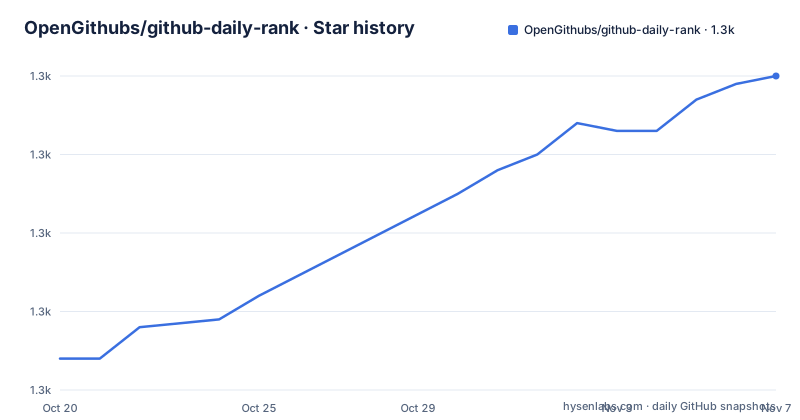
Star history
- OpenGithubs/github-daily-rank1,330 ★ · +36
| Repository | 2026-10-20 | 2026-11-07 |
|---|---|---|
| OpenGithubs/github-daily-rank | 1.3k | 1.3k |
36 Stars in the last 18 days, measured from the daily GitHub snapshot. Compare with other projects
Editorial analysis
The metric is velocity, and velocity rewards novelty
The repository description is short and precise: a daily rising-stars top ten, updated every morning at 8:30. The published homepage is a rank page at discoverhub.cn under the trend and github sections, with a type parameter in the URL.
What the ranking sorts on is the change in star count over a day, not the total. The README's table for 14 October 2026 makes the difference visible, because the two columns are so far apart. The second placed project has 12.2k stars in total and gained 1399 that day. The eighth has 14.3k and gained 334. The first, wheresryan22/anatomy, had 9.8k and gained 1809, which is about a fifth of its total in a single day.
That ratio is the whole story. A project that has existed for two years and gains a hundred stars a day is barely visible in this ranking, and a project launched three days ago and shared widely is at the top. The detail entries make it even clearer, because each project lists its daily, weekly and monthly growth, and for ARahim3/DigUp, opened on 14 October, the three figures are all 1192, since all of its stars arrived in one day.
So the board answers a narrow question: what is moving fast right now. That is a useful question and a poor proxy for quality, and anyone reading it should hold both halves of that sentence at once.
The artefact is a rewritten README, and the archive is the dataset
There is no software here, and the repository layout says so: a .gitignore, a README, and three year directories, 2024, 2025 and 2026. The README holds the current board, and each day adds another file to the current year's directory.
That design choice has consequences. The content of the repository is the history. Instead of a service you query, there is a sequence of daily snapshots, one per day, each with the top ten, each project described by its owner and name, its total star count, its growth over the day, over the week and over the month, the date it was opened, and the description from its own repository page.
The data is therefore structured, and consistently so across every entry: the same fields for every project, every day, in a machine-readable table for the top ten and a per-project detail block with the growth breakdown. That consistency is what makes a directory of daily files useful as a corpus rather than as a blog, and it is the reason a project that started on 12 October can sit next to one that started on 14 October and still be comparable.
The project descriptions come from the upstream repositories, which is where the useful and the risky meet. The board is only as good as the descriptions it copies, and the descriptions are written by whoever made the project, on a schedule set by the project rather than by the ranking.
One publisher, and a distribution network around the ranking
Around the daily board sits a community and a set of distribution channels, and this is where the project's real shape becomes visible.
The README links a discovery community site at discoverhub.cn, an OpenGithub community at open.itc.cn, the OpenGithubs GitHub organisation, a WeChat public account, a Toutiao account, a Zhihu page, and two sibling repositories, one for a weekly and one for a monthly selection. It also links three subscription lists for the daily, weekly and monthly rankings, each of them a WeChat album.
The architecture is a content pipeline. The rank computation produces one artefact a day, that artefact is published as a web page, and the page is then redistributed through a set of channels that reach readers in China through platforms other than GitHub. The ranking is the raw material for a newsletter-like operation, not a developer tool.
That context explains some choices in the artefact itself. The output is Markdown with embedded HTML styling rather than a data file, the language is Chinese, and the metadata that a machine would want, a stable project identifier and a machine-readable timestamp, is secondary to the human presentation. The tables use rounded figures, 9.8k rather than 9,794, because the output is meant to be read on a phone.
For an adopter, the practical question is which of those surfaces to use. The web page, the WeChat subscription lists, the archived files and the weekly and monthly sibling repositories are four different cadences over partly the same data, and the daily file is the only one that is complete and consistent.
The missing licence, and the missing methodology
Two things a reader might reasonably expect are not in the repository, and both matter depending on what you intend to do with it.
The first is a licence. The repository's licence is not classified, and there is no licence file in the top level listing, which for a repository whose entire content is generated data and formatted prose is an unusual thing to leave unspecified. A common licence such as MIT would be unremarkable here. What is there instead is a note that the data statistics are in the repository, and nothing about what a reader or a downstream project may do with them. For a human reader, following the links is obviously fine. For anyone wanting to compute on the data, publish a derived leaderboard, or feed it into a model, the position is unclear.
The second is the methodology. The README does not say how the top ten is chosen, how the daily growth is measured, how the daily winner is picked, or what excludes a project from appearing. There is no note about the sources, no description of the scoring, and no mention of how repeats are handled, which matters in a data set where a single author's several projects appear together in one day.
Neither gap makes the project wrong. It is a community artefact produced for a community, and it does the job it sets out to do. But a reader who wants to treat it as a dataset rather than as a newsletter has to make their own decisions about trust and reuse, and should not assume that the numbers are audited in any way the README describes.
What the board is for, and when it is the wrong tool
The right use of this repository is discovery. It is a way to find out what is spreading on GitHub on a given day, cheaply and without a search, and the daily, weekly and monthly lists give you three different time horizons over the same activity.
It is the wrong tool for anything that needs a stable, comparable measure of a project. Star growth is dominated by launch-day attention, and this particular board shows that directly, with a project at number one that was opened two days earlier and a number three that was opened the day the board was published. A ranking where a project's score depends mostly on its age is measuring announcements, not health.
It is also the wrong tool for evaluating a specific project. The board tells you that a repository gained stars, not whether the code is maintained, whether the issues get answered, or whether the release cadence holds. And because the daily file is overwritten into the README each morning, the live page only ever shows today, which means a reader who arrives mid-afternoon is looking at a list that is already hours old.
The alternative approach, and the one to weigh against, is to compute the same ranking yourself from the GitHub API. The difference in approach is editorial rather than technical. Your own script gives you control over the window, the filters and the tie-breaking, and it produces numbers you can explain, but it produces no selection: the daily winner in this board is a judgement that a human or a curator made, and a script cannot reproduce that judgement.
So the choice is between a board someone else has already thought about, and a number you produced yourself. For discovery, take the board. For a metric you intend to build a decision on, compute your own.
Editorial conclusion
This repository fits someone who wants a daily, already-computed view of what is spreading on GitHub, and who is happy to consume the page, the subscription channels or the archived files rather than run anything. It does not fit a team that needs a reliable metric for project health, because daily star growth mostly measures how recently a project launched and how loudly it was shared, and the repository publishes no licence, so reusing the data as data is on shaky ground. Before you build on it, read a few days of the archive and check how much the top ten changes, then decide whether the signal is worth the noise.
Frequently asked questions
What does the github-daily-rank repository contain?
It contains a daily list of the ten GitHub projects whose star count grew fastest, written into the README each morning and archived as files under the 2024, 2025 and 2026 directories, together with per-project details including total stars, daily, weekly and monthly growth, the project opening date and its description.
How is the github-daily-rank ranking calculated?
The README sorts the top ten by the change in star count over a day rather than by total stars, and each entry also lists weekly and monthly growth. The repository does not describe the selection method beyond that, and it does not explain how the daily best project is chosen.
Where can I read the github-daily-rank list online?
The homepage in the repository metadata points to a rank page at discoverhub.cn under the trend and github path with a type parameter, and the README links daily, weekly and monthly ranking subscription lists, plus weekly and monthly companion repositories under the OpenGithubs organisation.
Is the github-daily-rank data licensed for reuse?
The repository's licence is not classified and no licence file appears in the top level listing. The README only notes that the data statistics are in the repository, so treating the output as a reusable dataset is not something the project grants explicitly.
Official sources
Add this badge to your README
If you maintain this project, the badge below links readers to this analysis and shows its maintenance status from the daily GitHub snapshot. Paste the markdown into your README; add ?metric=license or ?metric=stars to the image URL for a different field.

[](https://hysenlabs.com/projects/opengithubs-github-daily-rank)Star history chart for your README
[](https://hysenlabs.com/projects/opengithubs-github-daily-rank)Was this useful?