OpenSearch: a search and observability suite distributed by governance, not by language
Open source distributed and RESTful search engine. OpenSearch is an open-source, enterprise-grade search and observability suite that brings order to unstructured data at scale.
At a glance
- What is it?
- opensearch-project/OpenSearch is a Java, Apache-2.0 search and observability suite whose README is mostly governance links and which includes certain Apache-licensed Elasticsearch code. This looks at how the licence, trademark and security boundaries are drawn, and at what a reader cannot learn from the README alone.
- Who is it for?
- Judge OpenSearch by whether an Apache-2.0 licence and an independent trademark are what your organisation needs, and by whether you can source your setup instructions elsewhere. The repository is credible for provenance and project structure, and silent on installation, API usage and configuration, so an adopting team should plan to read the documentation site and the Downloads page rather than the README.
- Can I use it commercially?
- Yes. Apache-2.0 is a permissive licence: you can use, modify and sell software built on it, as long as you keep its copyright and licence notices.
- Is it still maintained?
- Yes. The repository received new commits within the last day.
- What is it written in?
- Mainly Java, according to GitHub's language statistics.
Answers come from the project's GitHub data, last synced on November 13, 2026, and from our analysis. They are not legal advice.
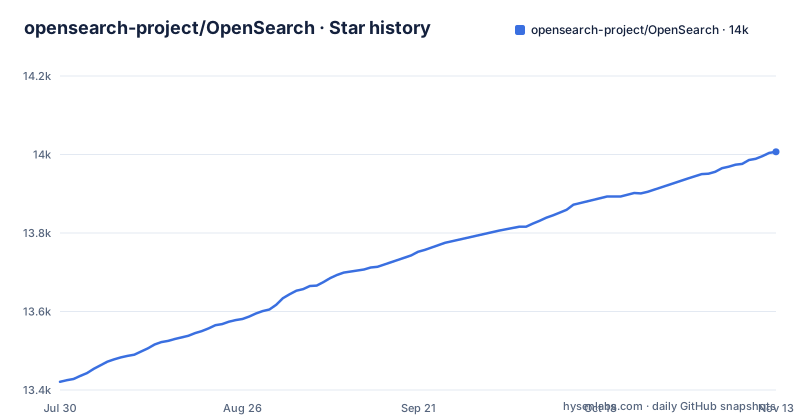
Star history
- opensearch-project/OpenSearch14,007 ★ · +586
| Repository | 2026-07-30 | 2026-11-13 |
|---|---|---|
| opensearch-project/OpenSearch | 13.4k | 14k |
586 Stars in the last 106 days, measured from the daily GitHub snapshot. Compare with other projects
Editorial analysis
The README is a governance document that describes a software suite
The one substantive product sentence here describes OpenSearch as an open-source, enterprise-grade search and observability suite that brings order to unstructured data at scale. Everything else in the file is process. The project resources point at the website, the Downloads page, documentation at docs.opensearch.org, Forums and Slack, plus a stack of governance documents: CONTRIBUTING.md, MAINTAINERS.md, RELEASING.md, ADMINS.md, TESTING.md and SECURITY.md. No install command, configuration key, endpoint or client example appears anywhere in it. For a reader deciding whether to adopt the project, this file answers questions about governance and says nothing about how to run it.
Apache-licensed Elasticsearch code sits inside an independent trademark
The licence section is short: the project is licensed under the Apache v2.0 License, and copyright is held by OpenSearch Contributors with details in NOTICE.txt. The trademark section is where the separation is drawn. OpenSearch states it is a registered trademark of LF Projects, LLC, and that the project includes certain Apache-licensed Elasticsearch code from Elasticsearch B.V. alongside other source code, with Elasticsearch B.V. not being the source of that other code. ELASTICSEARCH is separately a registered trademark of Elasticsearch B.V. The consequence for an adopter is specific: the code carries Apache-2.0 obligations that do not travel with the Elasticsearch name, and any branding decision has to respect two trademark owners rather than one.
Security reports bypass the public issue tracker by instruction
Vulnerabilities have a channel of their own. The security section asks that anyone discovering a potential security issue notify OpenSearch Security directly by email to [email protected], and explicitly says not to create a public GitHub issue. A reporter who follows it avoids disclosing a flaw in a public tracker. The cost is on the other side: an organisation that watches only public trackers will not see these reports, so its own vulnerability monitoring needs a direct relationship or a watch on the advisories rather than on issue activity.
The build is Gradle with checked-in wrappers and a buildSrc directory
The tree shows how the code is assembled: `gradlew` and `gradlew.bat` are both committed, so a contributor needs no system Gradle, and `gradle/`, `buildSrc/` and `dev-tools/` are the conventional Gradle build layout. `settings.gradle`, `build.gradle` and `gradle.properties` sit at the top level. The source tree is split the way a distributed search engine would be, into `server/`, `modules/`, `plugins/`, `libs/` and `client/`. Then there are directories whose purpose is verification rather than functionality: `benchmarks/`, `PERFORMANCE_BENCHMARKS.md`, `qa/`, `test/`, `rest-api-spec/` and `codecov.yml`.
Two release lines ship at once: 3.x and 2.19.6
Three recent releases are visible and they do not form one line. Version 2.19.7 is dated 2026-10-20, after version 3.9.0 on 2026-09-29 and version 3.8.0 on 2026-08-05, while carrying a 2.x number. So this project is maintaining two major series concurrently, and the 2.x line received a maintenance release after 3.9.0 shipped. The release process behind that lives in RELEASING.md, with release notes under `release-notes/`, a `sandbox/` directory and `.ci/` for pipeline configuration. Nothing here states which line receives fixes, and nothing states a support window. That is a material gap for a reader pinning a version.
The suite bundles formal models, link checking and licence tracking
Several top level directories point to process the project applies to itself. `formal-models/` suggests protocol or interface definitions held in a machine-checkable form, `licenses/` tracks dependency licences, and `.lychee.excludes` configures an exclusion list for a link checker, which implies outbound documentation links are validated in CI. A `doc-tools/` directory and a `CHANGELOG.md` at the top level round that out, alongside `.whitesource` and `whitesource.config` for dependency scanning. None of this affects how you run OpenSearch, and all of it tells you something about how seriously the project treats supply chain and documentation drift. It is worth knowing which entries are about your dependencies rather than about your cluster.
A codebase this size has no readable setup path in the README
Here is the practical limit of the source tree as a guide. The repository contains `server/`, `modules/`, `plugins/`, `libs/`, `client/`, `docs/`, `qa/`, `test/`, `benchmarks/`, `scripts/`, `sandbox/`, `distribution/` and `dev-tools/`, and it points to six separate documents for how to work on it. The README offers a downloads link, a documentation link, Forums and Slack, and then stops. There is no JVM requirement, no memory configuration, no cluster bootstrap, no port and no security setup in any of it.
Editorial conclusion
Judge OpenSearch by whether an Apache-2.0 licence and an independent trademark are what your organisation needs, and by whether you can source your setup instructions elsewhere. The repository is credible for provenance and project structure, and silent on installation, API usage and configuration, so an adopting team should plan to read the documentation site and the Downloads page rather than the README. Teams wanting a single page that answers how to install, configure or query OpenSearch will not find one here.
Frequently asked questions
Is OpenSearch the same as Elasticsearch?
No. OpenSearch states that it includes certain Apache-licensed Elasticsearch code from Elasticsearch B.V. together with other source code, and that Elasticsearch B.V. is not the source of that other code. ELASTICSEARCH is a registered trademark of Elasticsearch B.V., while OpenSearch is a registered trademark of LF Projects, LLC.
What is OpenSearch used for?
OpenSearch describes itself as an open-source, enterprise-grade search and observability suite that brings order to unstructured data at scale. It is written primarily in Java and licensed under the Apache v2.0 License, with copyright held by OpenSearch Contributors.
Is OpenSearch part of Elasticsearch?
It is not. The project states that Elasticsearch B.V. is not the source of the other source code that sits alongside the Apache-licensed Elasticsearch code it includes. The two are separately trademarked, and the repository is published from the opensearch-project organisation.
Is OpenSearch an AWS product?
The repository is not presented as a vendor product. OpenSearch is a registered trademark of LF Projects, LLC, licensed under Apache v2.0 with copyright held by OpenSearch Contributors, and the README points to the project website and to the OpenSearch Foundation rather than to any single cloud provider.
how to install opensearch
The README contains no installation command. It links to the downloads page at opensearch.org/downloads and to documentation at docs.opensearch.org, and for help it points to Forums and Slack. Version and packaging choices are left to those pages.
Official sources
Add this badge to your README
If you maintain this project, the badge below links readers to this analysis and shows its maintenance status from the daily GitHub snapshot. Paste the markdown into your README; add ?metric=license or ?metric=stars to the image URL for a different field.

[](https://hysenlabs.com/projects/opensearch-project-opensearch)Star history chart for your README
[](https://hysenlabs.com/projects/opensearch-project-opensearch)Was this useful?