Prometheus Community helm-charts: a signed chart repository with no chart list
Prometheus community Helm charts. Prometheus Community Kubernetes Helm Charts This functionality is in beta and is subject to change.
At a glance
- What is it?
- The prometheus-community/helm-charts repository publishes Prometheus charts through a Helm repository index and an OCI mirror, signs every chart with gpg, and its README documents almost none of what is inside them.
- Who is it for?
- Choose this repository if you want Prometheus community charts served from a signed index with an OCI mirror alongside, and you are willing to keep a local gpg agent running to verify them. Walk away if you need values documentation, a Kubernetes version matrix or upgrade guidance in the same place, because none of that is in the README.
- Can I use it commercially?
- Yes. Apache-2.0 is a permissive licence: you can use, modify and sell software built on it, as long as you keep its copyright and licence notices.
- Is it still maintained?
- Yes. The repository last received commits 1 day ago.
- What is it written in?
- Mainly Mustache, according to GitHub's language statistics.
Answers come from the project's GitHub data, last synced on November 14, 2026, and from our analysis. They are not legal advice.
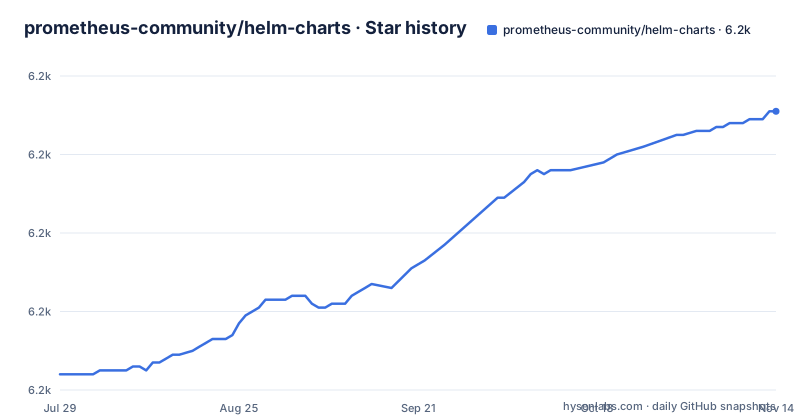
Star history
- prometheus-community/helm-charts6,231 ★ · +67
| Repository | 2026-07-29 | 2026-11-14 |
|---|---|---|
| prometheus-community/helm-charts | 6.2k | 6.2k |
67 Stars in the last 108 days, measured from the daily GitHub snapshot. Compare with other projects
Editorial analysis
The chart index is generated, and the source is the charts directory
Every chart here reaches a cluster through a Helm repository URL, not through a clone of this project. What that URL serves is a generated index, and the README carries a maintainer note explaining why: full links to repository files stay absolute because the README syncs from main to gh-pages. The source of truth is the charts/ directory on main; the address you hand to Helm is a published artifact of that directory.
That split is the first thing to sort out before reading anything else. The default branch is main, the project homepage is https://prometheus-community.github.io/helm-charts/, and the root of the tree carries .github/, scripts/, changelog/, renovate.json and a run of process documents: AGENTS.md, CLAUDE.md, MAINTAINERS.md, PROCESSES.md, REVIEW_GUIDELINES.md, SECURITY.md, CONTRIBUTING.md and CODE_OF_CONDUCT.md. The recorded primary language is Mustache, which is the chart template layer rather than a compiled binary. This is a repository with an editorial process attached, not one chart dropped in by a single author.
One command registers the index, and enumeration is a separate step
Helm has to exist before any of this is reachable, and the README defers that install to Helm's own documentation rather than restating it. Once Helm is in place, a single command registers the index:
helm repo add prometheus-community https://prometheus-community.github.io/helm-chartsThe first argument is the local alias you pick, and it becomes the prefix on every later install, upgrade and search. Enumeration is a separate call, `helm search repo prometheus-community`, and it is the only way the README describes the repository's contents. There is no chart index in the README, no per-chart documentation, no values reference. The final heading in that README is 'Helm charts build status', which points outward instead of adding a list.
So you cannot read this file and know what is available. The chart names the project does surface, kube-prometheus-stack, prometheus-statsd-exporter and prometheus-postgres-exporter, reach you because each one was cut as a release, not because anything here enumerated them.
Signature verification starts with a gpg agent, not a flag
Every chart in this repository is signed, and checking the signature is a setup step rather than a flag you can flip at install time. The key is served from the same host as the index:
curl https://prometheus-community.github.io/helm-charts/pubkey.gpg | gpg --importAfter the import, `--verify` passed to `helm install` turns on chart signature validation. The prerequisite is where this usually stalls: the README states that a locally running gpg agent is mandatory. Not recommended, not optional. There is no fallback described for an environment without one, and no instruction for pinning or rotating the key beyond the import itself.
On an isolated or ephemeral build runner, that is a stop rather than an inconvenience. The price of consuming it is a daemon you have to provision before the first install.
ghcr.io carries the same charts as OCI artifacts
The GitHub Pages index is not the only delivery path. OCI artifacts of all Prometheus Helm charts are published under the prometheus-community organisation on ghcr.io, which means a cluster holding registry credentials can pull a chart by its OCI reference instead of resolving it through a Helm repository at all.
The README says this in one sentence and then moves on. No example command accompanies it, no reference format is given, no list says which chart versions have OCI counterparts, and nothing covers mirroring. Whether a given release has landed in ghcr.io, and under what tag, is something you look up rather than read.
The practical result is that the two paths are documented to very different depths. Adding the repository and searching it is written out step by step and can be followed from the README alone. The OCI route is announced as available and then left to you.
No chart list, no values reference, no version matrix
This is a packaging repository, and the packaging is only half documented. There is no chart catalogue, no values reference, no Kubernetes version support matrix, no statement of which Prometheus version a given chart expects, and no upgrade or rollback guidance anywhere in the README. Someone inheriting a cluster running one of these charts cannot learn from the README how to configure it or how to move it to a different release.
The release history does reveal the shape of the versioning, because each chart carries an independent line. kube-prometheus-stack-92.17.1 shipped on 2026-11-03, prometheus-statsd-exporter-1.1.1 on 2026-11-03, prometheus-postgres-exporter-8.2.2 on 2026-11-02. The stack sits in its nineties while the two exporters are at 1.1.1 and 8.2.2. Those are separate compatibility tracks, and nothing in the repository offers a single command that moves them together.
The last push landed on 2026-11-02 and the repository is not archived, so the tree is moving even where the documentation is silent.
Beta, as-is, with no support SLA behind it
The README opens with its terms and they are unusually blunt: this functionality is in beta and subject to change, the code is provided as-is with no warranties, and beta features are not subject to the support SLA of official GA features. Three disclaimers before the first heading.
What that licenses you to expect is a values change between two kube-prometheus-stack point releases as a legitimate outcome rather than a defect, with no compatibility promise attached to any of it. The licence is Apache 2.0, the permissive one you would expect for infrastructure packaging, but a permissive licence and a beta stability warning are separate facts and only one of them is a promise.
The maintainer files point the same way. MAINTAINERS.md, REVIEW_GUIDELINES.md and PROCESSES.md exist as distinct documents, and renovate.json in the tree root means dependency bumps are handled by automation rather than by hand.
No comparison to another catalog, Terraform or operators
People reach this repository already holding a comparison in mind, and the repository does not meet them there. No section places these charts against another chart catalog, against Terraform, or against Kubernetes operators. Those alternatives are absent from the documentation rather than addressed in it, which leaves the comparison to be made somewhere else.
What the tree does support is narrower and still worth stating. The root holds charts/ as the single place chart sources live, scripts/, .github/ for workflows, and .agents/ next to AGENTS.md and CLAUDE.md, which points to automated tooling being woven into how work happens here. Renovate is wired in at the root.
Editorial conclusion
Choose this repository if you want Prometheus community charts served from a signed index with an OCI mirror alongside, and you are willing to keep a local gpg agent running to verify them. Walk away if you need values documentation, a Kubernetes version matrix or upgrade guidance in the same place, because none of that is in the README. First thing to check: register the index and run helm search repo prometheus-community to see what it actually serves, since the README lists no charts.
Frequently asked questions
How do you install Helm charts from Prometheus Community?
Add the index with helm repo add prometheus-community https://prometheus-community.github.io/helm-charts, then list it with helm search repo prometheus-community. Import the signing key with curl https://prometheus-community.github.io/helm-charts/pubkey.gpg | gpg --import and pass --verify to helm install; the README states a locally running gpg agent is mandatory.
How do I install Prometheus Helm charts in Kubernetes?
The charts are pulled from the registered Helm index, or taken as OCI artifacts from the prometheus-community organisation on ghcr.io. The README gives no per-chart install command, so the chart name and version come from running helm search repo prometheus-community against the index.
What are OCI Helm charts for Prometheus Community?
They are the same charts delivered by registry reference rather than through a Helm repository index. The README states that OCI artifacts of all Prometheus Helm charts are available in ghcr.io, without an example command, tag format or list of mirrored versions.
What are Helm charts used for in Prometheus Community?
They package Prometheus community components for Kubernetes deployment. The releases in this repository include kube-prometheus-stack-92.17.1 from 2026-11-03, prometheus-statsd-exporter-1.1.1 from 2026-11-03 and prometheus-postgres-exporter-8.2.2 from 2026-11-02, each on its own version line.
Official sources
Add this badge to your README
If you maintain this project, the badge below links readers to this analysis and shows its maintenance status from the daily GitHub snapshot. Paste the markdown into your README; add ?metric=license or ?metric=stars to the image URL for a different field.

[](https://hysenlabs.com/projects/prometheus-community-helm-charts)Star history chart for your README
[](https://hysenlabs.com/projects/prometheus-community-helm-charts)Was this useful?