MCP-Nest's description still promises a module that v2 removed
A NestJS module to effortlessly create Model Context Protocol (MCP) servers for exposing AI tools, resources, and prompts.
At a glance
- What is it?
- A NestJS transport strategy rather than a module: tools live on @McpController() classes, one /mcp endpoint answers two protocol revisions at once, and the authorization server moved into a separate package marked beta.
- Who is it for?
- Anyone upgrading from the module API should read docs/migration-to-v2.md before touching a controller, and anyone serving this over STDIO has to silence the logger first, since stdout carries the protocol. Check which protocol revision your client speaks before relying on progress reporting, and plan around the beta authorization package rather than depend on it.
- Can I use it commercially?
- Yes. MIT is a permissive licence: you can use, modify and sell software built on it, as long as you keep its copyright and licence notices.
- Is it still maintained?
- Yes. The repository last received commits 2 days ago.
- What is it written in?
- Mainly TypeScript, according to GitHub's language statistics.
Answers come from the project's GitHub data, last synced on November 15, 2026, and from our analysis. They are not legal advice.
Star history
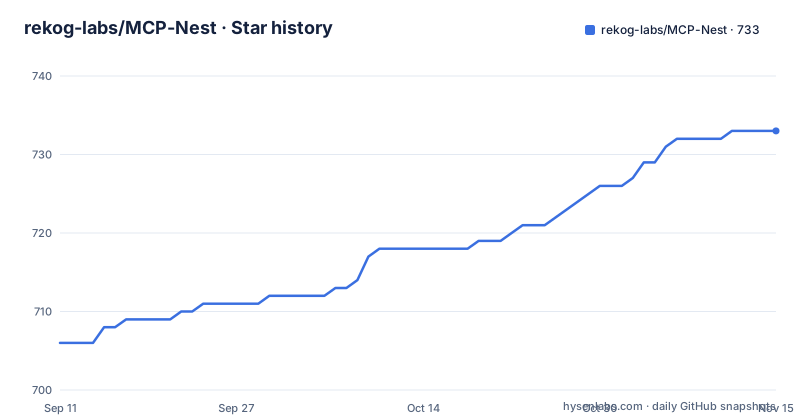
- rekog-labs/MCP-Nest733 ★ · +27
| Repository | 2026-09-11 | 2026-11-15 |
|---|---|---|
| rekog-labs/MCP-Nest | 706 | 733 |
27 Stars in the last 65 days, measured from the daily GitHub snapshot. Compare with other projects
Editorial analysis
The one line description promises a module that v2 deleted
Search results and the repository summary still call this package a NestJS module for creating Model Context Protocol servers that exposes AI tools, resources and prompts. The v2 code has moved past that. MCP runs as a CustomTransportStrategy, tools, resources and prompts sit on classes marked @McpController(), and the quick start says outright that the strategy is the whole configuration and that there is no McpModule. A migration guide at docs/migration-to-v2.md is linked from the first feature bullet for exactly that reason. So an McpModule.forRoot() call lifted from an older tutorial has nothing left to bind to, while the guards, pipes, interceptors and exception filters that used to sit outside the module now apply to the handlers natively, because those handlers are ordinary @MessagePattern methods.
Progress reporting is a no-op on the older protocol era
The /mcp endpoint answers two protocol generations at once. The same @Tool methods serve the 2025-era protocol with its initialize handshake and sessions, and the stateless 2026-07-28 revision, concurrently and with no change to the tool code. The catch sits in the next paragraph. ctx.reportProgress({ progress: 50, total: 100 }) reaches a 2026-07-28 client as it is, but on a 2025-era client it does nothing at all unless the transport is session aware, which means constructing StreamableHttpTransport with statefulMode: true, or using StdioTransport. On the legacy stateless default the call is silent, so the failure mode is a progress bar that never moves rather than an error. docs/protocol-revisions.md covers the split, and docs/mrtr.md does the same job for multi round-trip work such as elicitation, sampling and roots on the newer revision.
STDIO replaces the bootstrap and asks for a silent logger
There are two bootstrap paths and they share almost nothing. For HTTP, main.ts hands the adapter to the strategy with mcp.setHttpAdapter(app.getHttpAdapter()), connects the microservice, calls startAllMicroservices() and only then listens on port 3000, a port that also serves the ordinary HTTP routes of the same Nest application. The page flags the ordering as load bearing: startAllMicroservices() has to run before listen() so the MCP routes are mounted before connections arrive. For STDIO the shape changes, since NestFactory.createMicroservice(AppModule, { strategy: mcp }) replaces the adapter call and the transports array becomes [new StdioTransport()]. That variant also asks you to disable logging, because stdout is reserved for the protocol. A logger left at its NestJS default writes into the same stream the client is parsing.
Two of the three TypeScript samples end mid expression
The controller sample closes right after `return { content: [{ type: 'text',`, so the response payload that every tool has to return is left unwritten, and the sample that builds the strategy closes on a single character, the p of the providers key it had annotated two lines earlier. main.ts is the one sample that runs to its last line. That ordering is unfortunate for a reader, because the controller is the first file most people open and it is the file that stops halfway, while the provider wiring that would let another class inject the strategy for runtime or dynamic tool registration is exactly the part that is missing.
The workspace root still reads 2.0.0-alpha.0 while tags sit at 2.0.7
The root package.json is a private workspace file named mcp-nest-workspace, its version field reads 2.0.0-alpha.0, and its own description calls it the workspace root for @rekog/mcp-nest and @rekog/mcp-nest-auth. That is the version a clone reports, and it trails the published tags, where the recent releases are v2.0.7 from 2026-09-21, v2.0.5 from 2026-09-09 and v2.0.4 from the same day. The release list has a hole of its own, since no v2.0.6 sits between the 2.0.5 and 2.0.7 entries. Nothing on the page connects the two numbers, so read them as descriptions of different objects: one names the checkout you are standing in, the other names what the registry hands you.
bun runs the tests and jest.config.js sits in the root anyway
Three package managers have left fingerprints in one checkout. The build runs bun run --filter across both workspace packages, the test script is bun test fed by find over the tests and packages directories, and e2e does its own bun install before bun test, while prepare, e2e:local and e2e:published go back to npm run. A package-lock.json and a pnpm-workspace.yaml sit beside each other, and the workspaces field in package.json is the one actually in use. One leftover stands out: jest.config.js is in the root listing, but no script in package.json calls jest, and coverage is gathered by bun's own coverage reporter instead. Reaching for jest tooling on a fresh clone means reading a config the test command never touches.
Four authentication routes, and the built-in server is a beta package
Authentication is offered at four levels, and they differ in maturity. Guards with OAuth support come first, then per-tool authorization for fine-grained checks, then a built-in authorization server, then an external one such as Keycloak or Auth0. The built-in server is the one that moved. It now lives in a package installed beside the main one, and the page marks it Beta:
npm install @rekog/mcp-nest-authUsing its TypeORM store adds two more optional peer dependencies:
npm install @nestjs/typeorm typeormThe examples tree shows the spread, with azure-ad-oauth-provider, azure-ad-provider, built-in-authorization-server, external-authorization-server-casdoor, per-tool-authorization, per-tool-authorization-jwt and per-tool-authorization-oauth all present. The workspace devDependencies carry @nestjs/jwt and @nestjs/passport, and the root holds both CLAUDE.md and SECURITY-AUTOMATION-PLAN.md.
Twenty-two examples and a script that swaps local for a dist tag
There are 22 directories under examples/, running from azure-ad-provider to tools, including one named perf-benchmark that the page never mentions again. Three scripts drive them: examples:local calls bash scripts/use-examples.sh local, examples:published calls the same script with published, and e2e:published passes a third argument, next, which aims the end-to-end run at a distribution tag rather than at the workspace. One naming detail sits in the samples paragraph. It invites you to build ChatGPT widgets or MCP apps with @rekog/MCP-Nest, written with capitals, and points at a samples repository under the account rinormaloku rather than rekog-labs. Every install command on the page spells the package in lower case as @rekog/mcp-nest, and the Context7 link uses the lower case repository path too.
Editorial conclusion
Anyone upgrading from the module API should read docs/migration-to-v2.md before touching a controller, and anyone serving this over STDIO has to silence the logger first, since stdout carries the protocol. Check which protocol revision your client speaks before relying on progress reporting, and plan around the beta authorization package rather than depend on it.
Frequently asked questions
What changed in MCP-Nest v2?
MCP now runs as a NestJS CustomTransportStrategy instead of a module, and the page states there is no McpModule. Tools, resources and prompts live on classes marked @McpController() and are real @MessagePattern handlers, so guards, pipes, interceptors and exception filters apply to them. A migration guide is linked as docs/migration-to-v2.md.
Why does MCP-Nest call startAllMicroservices() before listen()?
The order is deliberate: startAllMicroservices() must run before listen() so the MCP HTTP routes are mounted before the server accepts connections. main.ts also passes the adapter to the strategy through mcp.setHttpAdapter(), which is needed for HTTP transports, and the same port 3000 also serves the normal HTTP routes.
Does MCP-Nest still ship its own authorization server?
Not inside the main package. The built-in authorization server now lives in @rekog/mcp-nest-auth and is marked Beta, with @nestjs/typeorm and typeorm as optional peer dependencies when the TypeORM store is used. External authorization servers such as Keycloak and Auth0 are documented as a separate option.
What happens to ctx.reportProgress in MCP-Nest on a 2025-era client?
It is a no-op there unless the transport is session aware. A StreamableHttpTransport built with statefulMode: true, or StdioTransport, is needed; the call reaches a 2026-07-28 client as it is, so progress can stream back on a sessionless request.
Which MCP SDK versions does the MCP-Nest workspace develop against?
The workspace devDependencies pin @modelcontextprotocol/client, @modelcontextprotocol/core, @modelcontextprotocol/node and @modelcontextprotocol/server at ^2.0.0-beta.5. The install command on the page leaves those packages unversioned and pins only zod@^4.
What version does the MCP-Nest package.json report?
The root file is named mcp-nest-workspace, is marked private and still carries version 2.0.0-alpha.0, while the recent published tags are v2.0.7, v2.0.5 and v2.0.4, with no v2.0.6 among them.
Official sources
Add this badge to your README
If you maintain this project, the badge below links readers to this analysis and shows its maintenance status from the daily GitHub snapshot. Paste the markdown into your README; add ?metric=license or ?metric=stars to the image URL for a different field.

[](https://hysenlabs.com/projects/rekog-labs-mcp-nest)Star history chart for your README
[](https://hysenlabs.com/projects/rekog-labs-mcp-nest)Was this useful?