ru-de/faq: a Russian-language Markdown wiki for people who moved to work in Germany
Полезная информация о жизни в Германии
At a glance
- What is it?
- A repository of plain Markdown files answering practical questions about visas, taxes, registration and daily life in Germany, written by and for Russian-speaking IT workers. It has no code, no build pipeline and no releases, which is exactly why it is useful.
- Who is it for?
- ru-de/faq earns its place for one specific reader: a Russian-speaking developer, sysadmin or database administrator who has just taken a job in Germany and needs a straight answer about Anmeldung, the Blue Card, taxes or a landlord's deposit. It is documentation, not software, so there is nothing to install and nothing to keep patched, and the fact that the site is generated from files in a repository means every page has a visible edit history and an open pull request.
- Can I use it commercially?
- Yes. MIT is a permissive licence: you can use, modify and sell software built on it, as long as you keep its copyright and licence notices.
- Is it still maintained?
- Yes. The repository last received commits 126 days ago.
- What is it written in?
- Mainly Shell, according to GitHub's language statistics.
Answers come from the project's GitHub data, last synced on November 7, 2026, and from our analysis. They are not legal advice.
Star history
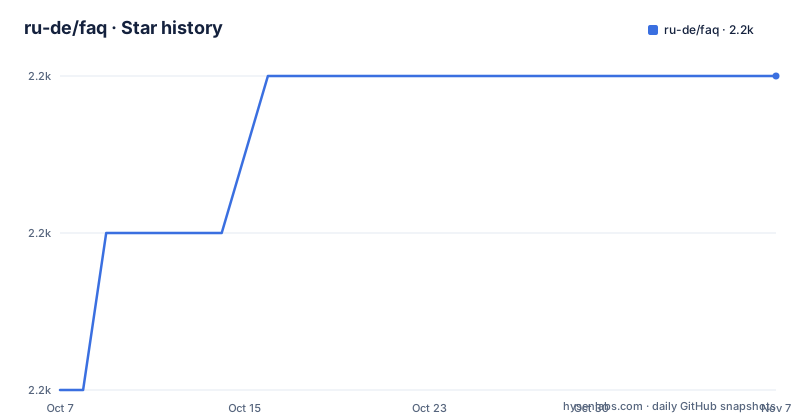
- ru-de/faq2,214 ★ · +2
| Repository | 2026-10-07 | 2026-11-07 |
|---|---|---|
| ru-de/faq | 2.2k | 2.2k |
2 Stars in the last 31 days, measured from the daily GitHub snapshot. Compare with other projects
Editorial analysis
A knowledge base that is nothing but Markdown files
The repository has no build step, no package manifest worth speaking of and no releases. Its language tag on GitHub reads Shell, which reflects a handful of maintenance scripts rather than the content. What is actually in the tree is a directory of Markdown files with Russian names, one per topic, plus `CONTRIBUTING.md`, `misc.md` and a `LICENSE`.
The topic names are the fastest way to understand the scope. There are files for `Виза.md`, `ПМЖ.md`, `Гражданство.md`, `Подтверждение диплома.md` and `Регистрация места жительства.md`, which together cover the visa, permanent residence, citizenship, diploma recognition and address registration questions that dominate the first two years. Alongside them sit `Налоги.md`, `Финансы и Банки.md`, `Страховки.md`, `Работа.md` and `Фриланс.md` for the money and employment side, then a long practical tail: `Квартирный вопрос.md`, `Мобильная связь.md`, `Транспорт.md`, `Электричество.md`, `Мусор.md`, `Интернет.md`, `Детские пособия.md`, `Велосипеды.md`, `Домашние животные.md`, `Телевидение.md`, `Медицина.md` and `Отпуск и отдых.md`.
One file stands out for a different reason. `План действий для получивших оффер.md` is a checklist for someone who has just received a job offer, and there is a second file, `Предупрежден - значит вооружен.md`, whose title translates roughly as forewarned is forearmed. Those two read as the load-bearing documents in the set. The last push was on 2026-07-04, so the content is being touched, and the default branch is `master`.
Who the README says the audience is
The README states the intended audience in one sentence: IT people, programmers and sysadmins who have moved to Germany to work under the Blue Card programme, living mainly in Berlin or Munich. That is a narrower promise than the file list suggests, and it matters when you judge the advice. Someone writing about `АБХ.md` or `Консульство.md` is writing from a specific professional context, and the pages that cover city-level services are likely to assume you already know the basic bureaucratic vocabulary.
The README also names a site mirror at `https://ru-de.github.io/faq/`, so the content has a browsable HTML form without a local clone. Nothing in the repository indicates how that site is built or deployed, which is worth knowing if you were hoping to reuse the pipeline.
What the README does not do is explain an editorial process beyond pointing at `CONTRIBUTING.md`. There is no review checklist, no named maintainer and no versioning scheme for the content. The relevant signal is the file list itself: with forty-plus topic files maintained by whoever feels like it, coverage depth will vary, and a page that has not been touched in two years is not obviously worse than one edited last month, since neither has an expiry date.
Contributing through the GitHub edit button, no terminal required
The contribution instructions are unusually concrete, and they are aimed at people who do not normally use Git. The README describes clicking the pencil icon at the top of any page on GitHub, which automatically creates your own fork of the repository, editing files there in the browser, and then opening a pull request back to the main repository. It states explicitly that no console or other program is required, and it recommends reading `CONTRIBUTING.md` first for what content is welcome and how to format it.
That design has a direct consequence for anyone assessing the project. The friction of contributing is near zero, so the pool of contributors is wide and the entry barrier to fixing an out-of-date page is a single click. It also means review load falls on whoever handles pull requests, and the README does not say who that is. A wide contributor base with an unclear review process is a normal shape for a community wiki, and it is the reason the README bothers to spell out licensing.
On that point the README is careful and the tree backs it up. Contributors are told that if they edit the repository, the licence terms apply to their changes from that point, and that they confirm they hold the rights to grant them. There is a `LICENSE` file in the tree and the GitHub license field reads MIT, so the terms are the permissive default rather than a copyleft obligation on the prose.
The disclaimer is unusually direct about what this is not
There is a dedicated section on authorship and liability, and it is more candid than most community wikis manage to be. It states that the materials are created and edited by different people on a voluntary basis, that they are a collection of knowledge and opinions accumulated by those people, and that the authors do not bear responsibility for the accuracy, precision or currency of what is written. It says the materials may contain inaccuracies and errors, and are provided without any warranty of any kind.
Then comes the sentence that decides how you should read the whole repository: the materials cannot be treated as legal, medical, tax or other advice. If you use them you do so at your own risk, and you should always re-check anything that matters. The README even gives the reason content goes stale: laws and subordinate regulations change.
This is the single most important thing to understand about ru-de/faq before drawing any conclusion from it. Read a page on `Налоги.md` and you are reading a volunteer's summary of German tax mechanics at some point in time, written for someone in a particular employment arrangement. The advice may be excellent and the reasoning sound, and none of that makes it a substitute for checking the current rule with the authority that publishes it. Treat the repository as an unusually well-organised map of where the answers live, and then go read the answers.
The community rooms the README funnels readers into
Because the wiki cannot answer everything, the README spends a long section listing where to ask instead. Two Slack workspaces are named. One is `berlinru.slack.com`, described as a Slack for people from Berlin and the rest of Germany with more than 2200 users, and access requires filling in a form linked from the README. The second is `germany-ru.herokuapp.com`, described as an alternative Slack for people living and working in Germany, and it requires registration with a phone number and real names. Both invitation mechanisms are web forms hosted on separate domains, which is worth knowing before you try to sign up.
The Telegram list is longer and organised by city and by topic. There is a general Germany chat, and per-city rooms for Berlin, Hamburg, Munich, Nuremberg, Frankfurt, Dortmund and Ingolstadt. Within those, some rooms are specialised: an IT Berlin room, a Munich car chat, a board game room, and Germany-wide rooms for IT, marketing, business and finance. Two of the German-wide rooms are specifically about law: `lawgermany` for law and legislation, and `business_germania` for business matters. For a reader whose question is stuck on a legal detail, that pairing is the more useful part of the list.
A Facebook group for the Berlin IT crowd is also named. The README presents all of these as community channels rather than as official support, which is the right framing given the liability section.
Where this repository stops being useful
There are three honest limits worth stating before anyone spends an afternoon on this. The first is that it is not a product with a maintenance schedule. There are no GitHub releases, no changelog and no version field for the content, so there is no way to tell whether a page reflects German rules as they stand now or as they stood two years ago. The last push date tells you someone changed something; it does not tell you what.
The second is that the city coverage is uneven in practice. Berlin and Munich are named as the two centres in the README, and the Slack invitations skew heavily toward Berlin. A reader in Leipzig or Bremen is working from files written with two other cities in mind, and city-specific procedures, particularly around registration offices and local tax details, are exactly the kind of thing that does not travel between Länder.
The third is scope. This is administrative and practical life in Germany for a particular kind of immigrant professional. It is not a general reference on German law, and it is not a comparison of visa options for every nationality and family situation. Used within that scope, with the README's own warning in mind, it is a better starting point than most search results, because the files are organised around the sequence of decisions a new arrival actually faces. Used outside it, the liability paragraph is the correct answer to your question.
Editorial conclusion
ru-de/faq earns its place for one specific reader: a Russian-speaking developer, sysadmin or database administrator who has just taken a job in Germany and needs a straight answer about Anmeldung, the Blue Card, taxes or a landlord's deposit. It is documentation, not software, so there is nothing to install and nothing to keep patched, and the fact that the site is generated from files in a repository means every page has a visible edit history and an open pull request. What it cannot be is authoritative: the authors state plainly that they carry no responsibility for accuracy and that nothing here counts as legal, medical or tax advice, which is the right thing for a volunteer wiki to say and also a real limit on what to rely on. Start by reading the file whose name matches your immediate question, use the Telegram and Slack rooms listed near the bottom of the README when the page is vague, and treat any figure you find there as a starting point to confirm with the relevant authority rather than as a settled fact.
Frequently asked questions
What is ru-de/faq, and who is it written for?
It is a Russian-language collection of Markdown files answering practical questions about living and working in Germany, covering visas, permanent residence, taxes, banking, housing and mobile service. The README states the original audience is IT specialists such as programmers and sysadmins who moved to Germany on the Blue Card programme, mainly to Berlin or Munich.
Is the information in ru-de/faq reliable enough to act on for a visa or tax question?
The README states that the authors do not bear responsibility for the accuracy, precision or currency of the content, that it may contain inaccuracies, and that it cannot be treated as legal, medical or tax advice. It advises re-checking anything of interest, and notes that information goes stale when laws and regulations change.
Do I need to use Git or a terminal to contribute to ru-de/faq?
No. The README describes a browser-only flow: click the pencil icon at the top of the page, which creates your own fork of the repository, edit files there, then open a pull request back to the main repository. It recommends reading `CONTRIBUTING.md` first for what content is welcome and how to format it.
Which communities does the ru-de/faq README point readers to?
Two Slack workspaces, one for people from Berlin and the rest of Germany with more than 2200 users and one alternative workspace for people living and working in Germany, each requiring registration through a linked web form. There is also a list of Telegram rooms organised by city, including a Germany-wide IT room and a room for law and legislation questions.
Official sources
Add this badge to your README
If you maintain this project, the badge below links readers to this analysis and shows its maintenance status from the daily GitHub snapshot. Paste the markdown into your README; add ?metric=license or ?metric=stars to the image URL for a different field.

[](https://hysenlabs.com/projects/ru-de-faq)Star history chart for your README
[](https://hysenlabs.com/projects/ru-de-faq)Was this useful?