DSAlgo: twenty three numbered topic folders, one release from 2023, and notes kept on Google Drive
📚A repository that contains all the Data Structures and Algorithms concepts and solutions to various problems in Python3 stored in a structured manner.👨💻🎯
At a glance
- What is it?
- DSAlgo collects data structure and algorithm solutions in Python3 under numbered directories rather than a package, its only tagged release is v1.0 from March 2023, and the handwritten notes for its largest section live on an external Drive file instead of in the repository.
- Who is it for?
- DSAlgo suits someone who wants a browsable set of Python3 solutions organised by topic, with an SDE sheet track that pairs each day with a short note. Three things to know before depending on it.
- Can I use it commercially?
- Check first. The repository uses a licence we do not classify automatically, so read its LICENSE file before any commercial use.
- Is it still maintained?
- Yes. The repository last received commits 4 days ago.
- What is it written in?
- Mainly Python, according to GitHub's language statistics.
Answers come from the project's GitHub data, last synced on November 15, 2026, and from our analysis. They are not legal advice.
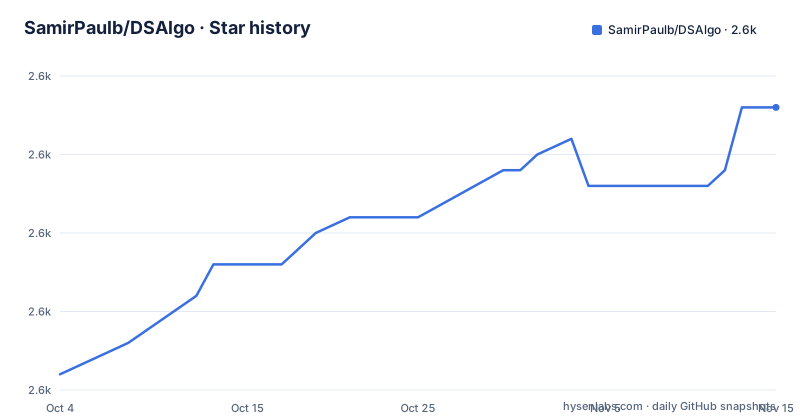
Star history
- SamirPaulb/DSAlgo2,618 ★ · +17
| Repository | 2026-10-04 | 2026-11-15 |
|---|---|---|
| SamirPaulb/DSAlgo | 2.6k | 2.6k |
17 Stars in the last 42 days, measured from the daily GitHub snapshot. Compare with other projects
Editorial analysis
One release in 2023, and commits recorded through 2026
The repository has a single tagged release, v1.0, published on 24 March 2023, and nothing since. The commit record tells a different story: the last push recorded for the repository is dated 17 June 2026, three years after that tag. So the release history and the working tree disagree by three years, and there is no second version to point a dependency at. Nothing here is packaged for installation either. The top level carries a Python file, a licence, the README and an index.html, with the topic directories beside them, and there is no package manifest, no module entry point and no test suite outside the .github directory. The practical shape of using this project is cloning it and reading, which means the main branch is the artifact and the release tag is historical. The licence file sits at the root while the repository's own licence field records no value, so the terms are knowable from the file and not from the metadata.
Twenty three numbered folders do all the organizing
The organising idea is a numeric prefix on every topic directory, and it runs in a fixed order from 01 to 23: LeetCode problems, dynamic programming, sorting, linked lists, object oriented programming, binary trees, graph algorithms, heap, matrix, trie, binary search, backtracking, stack, queue, greedy, string, bit manipulation, array, hashmap, depth first and breadth first search, two pointers, math and recursion. Reading the list in order is close to a syllabus, and each entry links straight to its directory. Two features sit outside that sequence. A folder named 30-Days-SDE-Sheet-Practice follows a Striver SDE sheet with a solution and a short note for each day, and a Questions-Sheet folder holds questions described as coming from top product based companies. The numbering has a visible gap between 23 and 30, so the scheme reserves space it does not use, and anyone extending the list has to decide which gap to fill rather than simply appending the next integer.
The dynamic programming notes are on Google Drive, not in the repository
The largest section of the documentation makes a claim that the repository cannot itself verify. It says the dynamic programming folder contains the questions from a named video playlist that are covered and, just as pointedly, the ones that are not covered, folder wise, together with handwritten notes. The notes themselves are not in the repository. The link for them points at a file on Google Drive, so the part of that section a reader most wants, the handwritten material, sits outside version control, outside the tree and outside the release tag. A Drive link also has properties a file in the repository does not: it can be replaced, made unavailable, or changed without any commit appearing here. The folder-wise promise is unverifiable from the outside as well, since whether every uncovered question is present is a judgement about someone else's playlist. What the repository does guarantee is the directory structure, not the completeness of the mapping to the video.
The homepage is an index.html that opens the repository in an online editor
There is an index.html at the root of a repository that contains no website otherwise, and the homepage points at a GitHub Pages address serving it. The README frames that page as a way to view the repository in an online version of VS Code, so the site exists to give a browser based editor for the files rather than to document the project. It is the only JavaScript or HTML surface in the tree, and it is the piece most likely to break silently, since a Pages deployment can fail or be replaced without any commit in the repository. The rest of the reading experience is plain directory browsing on the forge itself, with every topic folder linked from the README's checklist and the checklist marked as completed items, which is a presentation choice rather than a status signal.
Contributions are ranked by complexity, not by coverage
The contribution guidance opens with a request to replace what already exists rather than to add to it: improve an existing solution with a better one, judged by better complexity. That single line sets the bar for the project. Two of the other asks are additive, adding new questions and solutions in Python3 to the relevant directory and adding resources to the two auxiliary folders, and one is maintenance, solving issues raised by other people or by yourself. The fifth ask is qualitative, well documented source code with detailed explanations. A code quality dashboard link is embedded inside the first bullet, so the complexity claim has somewhere to be checked. The opening of the README asks readers to star the repository as a way of encouraging the work, which tells you how the project expects to be rewarded for attention, and the closing paragraph asks for contributions in the same spirit.
The important questions table is one video transcribed into rows
A collapsible block near the end of the README holds a table of important questions, and its provenance is a single recommendation from one video, which the README credits by name and links. The table has three columns, a topic, a problem statement and a link, and each row is one problem from a public problem site rather than a solution. The transcription runs through several topics, including array problems such as reversing a character array, removing the minimum and maximum element, finding the kth largest element and sorting an array of zeros, ones and twos without a sorting algorithm. The table then stops partway through an array row, at a problem about moving negative elements to one side of the array, so the remaining rows are not present. As a reading list it is convenient and dated at once: it is one person's selection from one video, with no indication of difficulty or of how the list has aged.
Python3 throughout, with one competitive programming template at the root
Everything in this repository is Python3, and the README states it as the language of the solutions rather than as a preference. That choice answers the language question that readers often bring to a repository like this one, though it answers it by omission as much as by intent: there is no C++ or Java content, and nothing in the text compares the languages or claims one is better for practice. At the root there is a single Python file named as a competitive programming template, which sits outside the numbered folders and outside the topic checklist, so it is easy to miss. It is the one artifact here meant to be copied into a working setup rather than read, and it sits next to the topic directories without appearing in the list of topics they cover. The numbered folders, the SDE sheet practice folder, the questions sheet and the two resource directories together make up the entire structure; there is no tooling, no build and no code generation anywhere in the tree.
Editorial conclusion
DSAlgo suits someone who wants a browsable set of Python3 solutions organised by topic, with an SDE sheet track that pairs each day with a short note. Three things to know before depending on it. It is a repository of files, not an installable library, so there is nothing to import and no versioned package after v1.0 from 2023. The dynamic programming notes the documentation leans on are hosted on an external Drive file, which is a link that can break independently of the code. And the numbered folder scheme, which is the one real structural idea here, means adding a topic means inventing the next number, which is why the numbering jumps from 23 to 30.
Frequently asked questions
What is DS Algo?
DSAlgo is a repository of data structure and algorithm solutions and concepts written in Python3, organised into 23 numbered topic directories running from LeetCode problems through dynamic programming, graphs, tries and recursion. It also holds a 30 day SDE sheet practice folder, a questions sheet, a competitive programming template file and an index.html. It is a collection of files to read, not a library to install.
Does DSAlgo cover languages other than Python?
No. The README states that the solutions are in Python3 and the contribution guidance asks for new solutions in Python3 in the relevant directory. There is no C++ or Java content and no comparison between the languages.
What version of DSAlgo should I use?
The repository has one tagged release, v1.0 from 24 March 2023, and the last push recorded for it is dated 17 June 2026. Nothing is packaged for installation, so the main branch is what you read and there is no later version to pin.
Can I finish DSA practice in three months with DSAlgo?
The repository gives no schedule and makes no time estimate. It does offer a 30-Days-SDE-Sheet-Practice folder with a solution and a short note per day, which is a sequence of practice days rather than a plan with a duration attached to it.
Where are the handwritten notes in DSAlgo?
For the dynamic programming section, the handwritten notes are not stored in the repository. The link points at a file on Google Drive, so that material sits outside version control and can change without a commit here.
Official sources
Add this badge to your README
If you maintain this project, the badge below links readers to this analysis and shows its maintenance status from the daily GitHub snapshot. Paste the markdown into your README; add ?metric=license or ?metric=stars to the image URL for a different field.

[](https://hysenlabs.com/projects/samirpaulb-dsalgo)Star history chart for your README
[](https://hysenlabs.com/projects/samirpaulb-dsalgo)Was this useful?