GVS5H: the code and run data behind a ledger-based self-orchestration paper for coding models
GVS5H: Five Qwen3.8-27B Models Match Claude Fable 5 on LiveCodeBench Hard | Fable 5 Level Coding for a Fifth the Price - or on a Single GPU
At a glance
- What is it?
- slee-persis/GVS5H is the research repository for a paper claiming that fresh instances of one model, coordinating through a shared filesystem, can approach frontier accuracy on LiveCodeBench Hard. It is a benchmark harness with a license split, not a package to install.
- Who is it for?
- GVS5H is for researchers who want to rerun or inspect a multi-instance orchestration experiment on 100 LiveCodeBench Hard problems, and it is a poor fit if you want a drop-in coding assistant. Treat the headline numbers as the authors' claims until you reproduce them, and read NOTICE.md before reusing anything outside the MIT licensed code.
- Can I use it commercially?
- Yes. MIT is a permissive licence: you can use, modify and sell software built on it, as long as you keep its copyright and licence notices.
- Is it still maintained?
- Yes. The repository last received commits 21 days ago.
- What is it written in?
- Mainly Python, according to GitHub's language statistics.
Answers come from the project's GitHub data, last synced on November 26, 2026, and from our analysis. They are not legal advice.
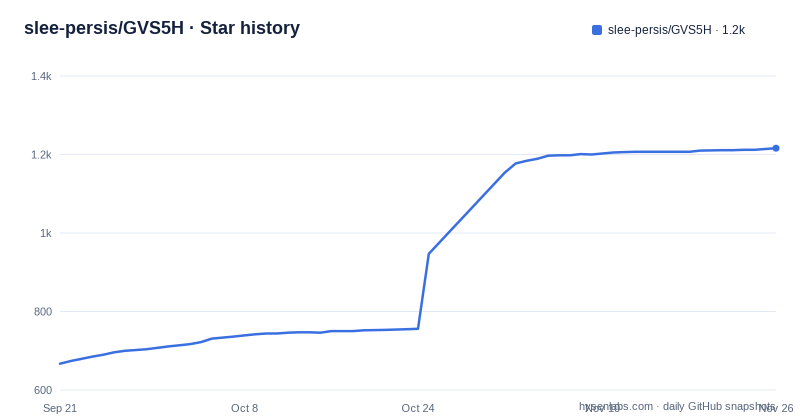
Star history
- slee-persis/GVS5H1,216 ★ · +549
| Repository | 2026-09-21 | 2026-11-26 |
|---|---|---|
| slee-persis/GVS5H | 667 | 1.2k |
549 Stars in the last 66 days, measured from the daily GitHub snapshot. Compare with other projects
Editorial analysis
Fresh instances of one model coordinate through a plan, notes and a current solution on disk
The method the paper introduces is called ledger-based zero-shot self-orchestration. It needs no training. Instead, fresh instances of a single model decompose a problem and coordinate through a shared filesystem that holds three things: a plan, notes, and the current solution. No instance carries a long conversation. The state lives in files, and each new instance picks it up from there.
The repository name reads Gorilla vs. 5 Humans, and the title speaks of five Qwen3.8-27B models. In the run command, the flag that selects this mode is --engine multiagent, which runs the manager, while --engine single is the one call baseline you compare against. That pairing is the whole experiment: the same model, once as a single call and once as a managed group, scored on the same problems. Anyone rerunning it should keep both runs, since the claimed gain only exists as the difference between them.
The headline numbers come from the authors' own abstract and one row is not like the others
According to the abstract, the study spans eleven open and closed weight models on the 100 latest hard LiveCodeBench problems. It reports gains of up to 25.6 percentage points on pinned backends. Orchestrated Qwen3.8 Flash Next reaches 93.0% pass@1 against Fable 5's 90.4% at 9% of the cost. Locally served, open weight Qwen3.8-27B rises from 66.8% to 92.4%.
There is a caveat printed directly under the Results heading. Opus 5 ran on an earlier version of the scaffold, in a single pass served through OpenRouter rather than five on a pinned backend. So that comparison row was produced differently from the pinned backend rows. If you are reading a results table, check which rows used which setup before comparing them. Nothing in the repository shows an independent reproduction, and this article has not rerun any of it.
Some models gain nothing, so the method is not a general upgrade
The abstract says outright that gains are not universal and that some models are unchanged or worse. It attributes the gain to decomposition and persistent context, based on transcript analysis. The consequence for a reader is direct: pointing this scaffold at an arbitrary model is a gamble, and a model that cannot make good use of a plan and notes may do worse than a plain single call.
That is why the baseline engine exists. Before you trust the multi instance route for your own model, you need the --engine single result next to it. The abstract frames the two routes to frontier level accuracy as cost (a cheaper orchestrated model matching a pricier one) and self hosting (open weights served locally). Neither route is promised for a model outside the eleven tested.
The benchmark command sets generous token and timeout limits and needs a key per provider
Running needs uv and an API key for the model you want to test. The full command from the repository is:
cd codebase/v2-current
export OPENAI_API_KEY=...

LCB_RELEASE=release_v6 \
ESCALATION_CLOUD_MAX_TOKENS=128000 \
ESCALATION_CLOUD_TIMEOUT=7200 \
MULTIAGENT_MODEL=openai:gpt-5.6-terra \
uv run --no-project --python 3.12 --with 'datasets<4' --with numpy --with anthropic \
  python escalation/run_bench.py --engine multiagent --only lcb --lcb 100 --parallel 8
The environment variables carry the weight. LCB_RELEASE picks release_v6 of LiveCodeBench, ESCALATION_CLOUD_MAX_TOKENS is set to 128000, and ESCALATION_CLOUD_TIMEOUT is 7200, which reads as two hours per call. MULTIAGENT_MODEL chooses the model. Other providers use the prefixes anthropic:, dashscope: and openrouter:, each with its own API key variable. The flags --lcb 100 and --parallel 8 run 100 problems eight at a time. A full run therefore means many long model calls billed to your key, and the repository does not give a cost figure for it.
Where results land and what you get back
The pass@1 score prints at the end of a run. Results are written to runs/results.json, and per problem workspaces are written to runs/ws/. Those workspaces are where the plan, notes and current solution files from each problem would sit, so they are the place to look when you want to understand why one problem passed and another failed.
The top level also contains a runs/ directory already, next to codebase/, paper/ and paper_plot_script/. That layout suggests the run data behind the paper is checked in beside the code that produced it. For a skeptical reader that is the most useful part: you can compare your own runs/results.json against the one in the repository rather than trusting a table in the abstract.
The pyproject.toml covers plotting, not the benchmark, so there is no pip install route
The project file at the root declares the name gvs5h, version 0.1.0, a placeholder description reading Add your description here, and requires-python of 3.12 or higher. Its only dependencies are matplotlib, numpy and scipy, which fits the paper_plot_script/ directory and a main.py at the top level.
The benchmark itself does not use that file. The run command passes --no-project to uv and adds its own packages with --with: datasets below version 4, numpy, and anthropic. So there are two separate dependency setups in one repository. If you run uv sync at the root and then try the benchmark, you will not get the packages it needs. There is also no GitHub release and no published package, so the way to get the code is to clone it, and the version string 0.1.0 tells you nothing about which commit produced which result.
Four licenses cover different paths and NOTICE.md is the map
The code is under the MIT License. The paper, figures and run data are under CC BY 4.0, in a separate LICENSE-CC-BY-4.0 file. The LiveCodeBench fork, the benchmark problem statements and the LaTeX template files keep their own licenses. The repository includes an IEEE Transactions LaTeX2e templates zip at the top level, which is one of those carved out files.
If you plan to reuse the harness in a product, MIT covers the code, but the problem statements are not yours to redistribute under MIT. NOTICE.md says which license covers which path, so read it before copying a directory. The last push was on 2026-10-29. There are no releases, and the paper is hosted at arXiv 2608.26480 with a Hacker News thread linked from the README.
Editorial conclusion
GVS5H is for researchers who want to rerun or inspect a multi-instance orchestration experiment on 100 LiveCodeBench Hard problems, and it is a poor fit if you want a drop-in coding assistant. Treat the headline numbers as the authors' claims until you reproduce them, and read NOTICE.md before reusing anything outside the MIT licensed code.
Frequently asked questions
How do I run GVS5H?
Change into codebase/v2-current, export an API key such as OPENAI_API_KEY, and run escalation/run_bench.py through uv with --engine multiagent --only lcb --lcb 100 --parallel 8. You need uv installed.
What does GVS5H claim about Qwen3.8-27B?
The paper abstract says locally served, open weight Qwen3.8-27B rises from 66.8% to 92.4% pass@1 on 100 hard LiveCodeBench problems. It also says gains are not universal and some models are unchanged or worse.
Is GVS5H free to reuse?
The code is MIT licensed, and the paper, figures and run data are CC BY 4.0. The LiveCodeBench fork, problem statements and LaTeX templates keep their own licenses, which NOTICE.md maps by path.
Official sources
Where developers are discussing it
Posts on Hacker News, dev.to and Lobsters that link to this repository, found by our scan of those communities. 0 in the last 30 days; newest first.
- Five Qwen3.8-27B models match Fable 5 Using GVS5H HarnessHacker News · Oct 25, 2026 · 185 points · 75 comments
- GVS5H: Five Qwen3.8 Models Match Claude Fable 5 on LiveCodeBench HardHacker News · Sep 17, 2026 · 2 points · 0 comments
- Qwen3.8 models outperforms Fable 5 Using GVS5H HarnessHacker News · Sep 16, 2026 · 5 points · 1 comments
- GVS5H: Five Qwen3.8-27B Models Match Claude Fable 5 on LiveCodeBench HardHacker News · Sep 12, 2026 · 6 points · 0 comments
Add this badge to your README
If you maintain this project, the badge below links readers to this analysis and shows its maintenance status from the daily GitHub snapshot. Paste the markdown into your README; add ?metric=license or ?metric=stars to the image URL for a different field.

[](https://hysenlabs.com/projects/slee-persis-gvs5h)Star history chart for your README
[](https://hysenlabs.com/projects/slee-persis-gvs5h)Was this useful?