Tectonic's XeTeX core, its 24 crate Rust workspace, and the submodule that only promises semantics
A modernized, complete, self-contained TeX/LaTeX engine, powered by XeTeX and TeXLive.
At a glance
- What is it?
- Tectonic is a TeX and LaTeX engine forked from the XeTeX extension to Web2C, packaged as a Rust workspace of 24 crates around a C core. This is what the repository is actually for, and what it leaves you to find elsewhere.
- Who is it for?
- Tectonic fits you if you want a TeX engine you can embed from Rust or drop into CI without hand assembling a TeX installation, and if you accept that its repository page documents engine internals rather than everyday use. Installation and build steps live in the project book, the crate has its own README at CARGO_README.md, and API reference sits on docs.rs.
- Can I use it commercially?
- Check first. The repository uses a licence we do not classify automatically, so read its LICENSE file before any commercial use.
- Is it still maintained?
- Yes. The repository last received commits 106 days ago.
- What is it written in?
- Mainly C, according to GitHub's language statistics.
Answers come from the project's GitHub data, last synced on November 15, 2026, and from our analysis. They are not legal advice.
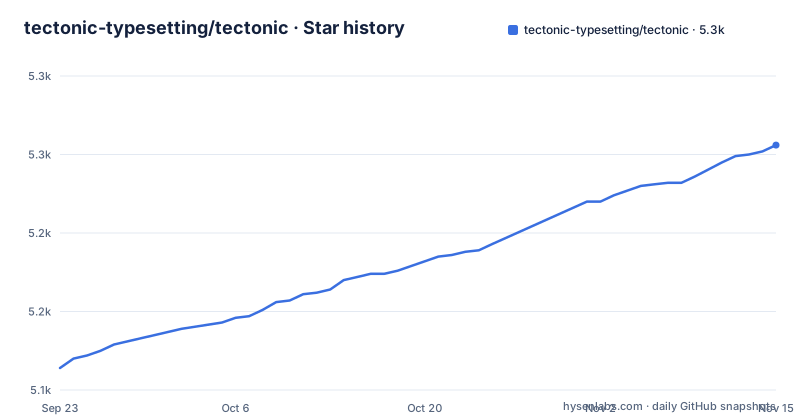
Star history
- tectonic-typesetting/tectonic5,256 ★ · +142
| Repository | 2026-09-23 | 2026-11-15 |
|---|---|---|
| tectonic-typesetting/tectonic | 5.1k | 5.3k |
142 Stars in the last 53 days, measured from the daily GitHub snapshot. Compare with other projects
Editorial analysis
The repository page is aimed at readers of engine internals, not document authors
The first section of this README, titled Read this first, sends anyone who just wants to compile TeX documents to the main Tectonic website and states that the page is primarily aimed at people interested in how Tectonic works under the hood. If you want to build the crate, the page points at CARGO_README.md instead. That framing matters before anything else on the page, because a reader arriving with an install question will not find an install command here.
What the developer dashboard does offer is a map. It links the user website, community discussion through GitHub Discussions, an installation page and a separate build instructions page in the project book, API documentation for the crate on docs.rs, the issue tracker, and a changelog. Note where the changelog link points: the `release` branch rather than `master`, although a CHANGELOG.md also sits at the top level of the tree. Every operational answer about installing or compiling sits outside this repository page.
A C core wrapped in a 24 crate Rust workspace
The repository is listed with C as its primary language, which matches the crate description: Tectonic is forked from the XeTeX extension to the classic Web2C implementation of TeX and uses the TeXLive distribution of support files. The build around that code is Rust, edition 2021, and the workspace enumerates its members explicitly:
[workspace]
members = [
    "crates/bridge_flate",
    "crates/bridge_fontconfig",
    "crates/bridge_freetype2",
    "crates/bridge_graphite2",
    "crates/bridge_harfbuzz",
    "crates/bridge_icu",
    "crates/bridge_png",
    "crates/bundles",
    "crates/cfg_support",
    "crates/dep_support",
    "crates/docmodel",
    "crates/engine_bibtex",
    "crates/engine_spx2html",
    "crates/engine_xdvipdfmx",
    "crates/engine_xetex",
    "crates/errors",
    "crates/geturl",
    "crates/io_base",
    "crates/mac_core",
    "crates/pdf_io",
    "crates/status_base",
    "crates/xdv",
    "crates/xetex_format",
    "crates/xetex_layout",
]
The package block shows what a consumer sees before any of that:
[package]
name = "tectonic"
version = "0.0.0-dev.0"
license = "MIT"
edition = "2021"
exclude = ["/dist/", "/reference_sources/", "/release-bundle/"]
The version is a placeholder, and the exclusion list tells you the reference submodule never ships in a published crate.
Seven bridge crates wrap the libraries XeTeX sits on
The naming in that member list describes the layering. Seven crates carry the `bridge_` prefix: flate, fontconfig, freetype2, graphite2, harfbuzz, icu and png. Those are the bindings to the libraries the typesetting core needs.
Above them sit the engines and the formats: `engine_xetex` is the typesetter itself, `engine_xdvipdfmx` turns XDV into PDF, `engine_spx2html` handles the special-case HTML path, and `engine_bibtex` covers bibliography. Around those are the format and document crates (`xetex_format`, `docmodel`, `xdv`), the output side (`pdf_io`, `io_base`, `status_base`, `errors`, `geturl`), and the platform and support pieces (`mac_core`, `bundles`, `cfg_support`, `dep_support`).
The consequence for a reader is narrow but real: the page never says which of these are optional at build time, nor how to point fontconfig at a specific font directory, so those questions have to be answered from the book rather than from the crate list.
reference_sources guarantees semantics, not matching source
Much of the core code is derived from XeTeX, and the project states it strives to track and maintain compatibility with upstream. It then draws the line clearly: the nature of the project means its source code is going to diverge from XeTeX over time, because the team can track the semantics of changes to XeTeX while the expression of those changes in source form may change greatly.
The mechanism that makes this checkable is the `reference_sources` Git submodule, which links to a staging repository tracking the XeTeX source used as reference. The version pinned there is the most recent code whose semantics are guaranteed to be expressed in Tectonic, to the best of the efforts of the maintainers. You do not need to clone it to build, which the page says is good because people are always confused by submodules. Its only job is to give Git a record of the exact reference code in use.
For a reader this sets expectations: if you plan to read the engine next to upstream XeTeX, the submodule gives you the right revision, but a line by line diff between them will not be meaningful. Behaviour is what the project commits to.
Version 0.0.0-dev.0, and a changelog kept on another branch
The manifest comment on the version field says it is assigned with cranko, which is why the checked in value is `0.0.0-dev.0` rather than a release number. Real version numbers appear at crate level instead. The recent release feed shows `tectonic` 0.17.0 and `tectonic_engine_bibtex` 0.3.4, both published on 2026-07-27, plus a release tagged `continuous` and named Continuous Deployment, published on 2026-07-31. The last push to `master` was on 2026-08-01.
Two consequences follow. First, the manifest version is a placeholder; you pin a released version such as `[email protected]` or the crate versions you depend on, or you take the moving `continuous` tag and accept that it changes without a version bump. Second, a 0.x number on a support crate such as engine_bibtex carries no stability promise, and the page does not make one. The categories in the manifest, command-line-interface, parser-implementations, rendering, science and text-processing, describe intended uses rather than a compatibility contract.
The caching and biber story lives in the CI actions, not here
The technical ecosystem section points at the places where Tectonic gets exercised by other people. There is a `setup-tectonic` action in the GitHub Actions marketplace, which lets a workflow use Tectonic directly and supports caching, with biber optionally enabled. There is also `compile-latex`, contributed by Vinay Sharma and powered by Tectonic. Separately, tt.ente.ninja runs Tectonic against a subset of the arxiv.org corpus the way the Rust tool Crater runs a candidate compiler against crates, a project called tectonic-on-arXiv by @Mrmaxmeier.
That list is where the operational detail actually lives. If you are weighing Tectonic for a document pipeline, the caching behaviour, the biber option and the corpus coverage are the things you need, and none of them are described on this repository page. Worth separating too: the corpus runner is third party, so a failure it reports is evidence about compatibility, not a supported test suite of the project.
What the top level reveals, and which questions it leaves open
The root of the repository is short enough to read at a glance:
.config/
.github/
.rustfmt.toml
CARGO_README.md
CHANGELOG.md
Cargo.lock
Cargo.toml
Cross.toml
build.rs
bundles/
codecov.yml
crates/
docs/
fuzz/
reference_sources
src/
tests/
Several of those entries are unexplained here. The page says nothing about what `fuzz/` targets, what `Cross.toml` configures, or how `bundles/`, `dist/` and `docs/` relate to the TeXLive support files the engine depends on. It also names no supported platform list, no TeXLive year or bundle scheme, and no upgrade or rollback procedure for a server that already runs Tectonic.
The practical consequence is that anyone packaging Tectonic into a distribution or a CI image cannot decide from the tree alone which support bundle to ship or which platforms to claim. That work belongs in the book, in `docs/`, and in CARGO_README.md.
Editorial conclusion
Tectonic fits you if you want a TeX engine you can embed from Rust or drop into CI without hand assembling a TeX installation, and if you accept that its repository page documents engine internals rather than everyday use. Installation and build steps live in the project book, the crate has its own README at CARGO_README.md, and API reference sits on docs.rs. Before building from source, decide whether you need the reference_sources submodule at all: it pins the XeTeX revision whose behaviour the project guarantees is expressed in Tectonic, and the source form of that code is expected to drift from upstream. The default branch is master, the last push was 2026-08-01, and the release feed carries per crate tags such as tectonic 0.17.0 and tectonic_engine_bibtex 0.3.4.
Frequently asked questions
How do I install tectonic?
The repository page carries no install command. It sends anyone who just wants to compile documents to the main Tectonic website, and the developer dashboard links both an installation page and a separate build instructions page in the project book. If you are building the crate itself, the file to read is CARGO_README.md.
How do I use tectonic once it is installed?
The engine is described as modernized, complete and self-contained, forked from the XeTeX extension to the classic Web2C implementation of TeX, and it uses the TeXLive distribution of support files. Day to day usage is documented on the project website rather than on this repository page, which points there in its first section.
How closely does tectonic track upstream XeTeX?
The project says it strives to track and maintain compatibility with upstream, and commits to following the semantics of changes to XeTeX. It also says the source code is going to diverge over time, because expressing those changes in source form may change greatly. The reference_sources submodule pins the most recent XeTeX code whose semantics are guaranteed to be expressed in Tectonic.
Official sources
Add this badge to your README
If you maintain this project, the badge below links readers to this analysis and shows its maintenance status from the daily GitHub snapshot. Paste the markdown into your README; add ?metric=license or ?metric=stars to the image URL for a different field.

[](https://hysenlabs.com/projects/tectonic-typesetting-tectonic)Star history chart for your README
[](https://hysenlabs.com/projects/tectonic-typesetting-tectonic)Was this useful?