TFX: four minor versions missing from the compatibility table
TFX is an end-to-end platform for deploying production ML pipelines
At a glance
- What is it?
- TensorFlow Extended is a Google-scale pipeline platform whose front page is mostly a dependency grid, and that grid is the interesting part. It jumps from the 1.17 line to 1.21, its Python ceiling disagrees with the packaging metadata, and the master row pins a nightly TensorFlow where the release row pins a number.
- Who is it for?
- TFX suits a team with an existing TensorFlow estate that needs pipeline components with recorded runs and resumable state, rather than someone starting a new project from scratch. Check three things before you pin it.
- Can I use it commercially?
- Yes. Apache-2.0 is a permissive licence: you can use, modify and sell software built on it, as long as you keep its copyright and licence notices.
- Is it still maintained?
- Yes. The repository last received commits 2 days ago.
- What is it written in?
- Mainly Python, according to GitHub's language statistics.
Answers come from the project's GitHub data, last synced on November 15, 2026, and from our analysis. They are not legal advice.
Star history
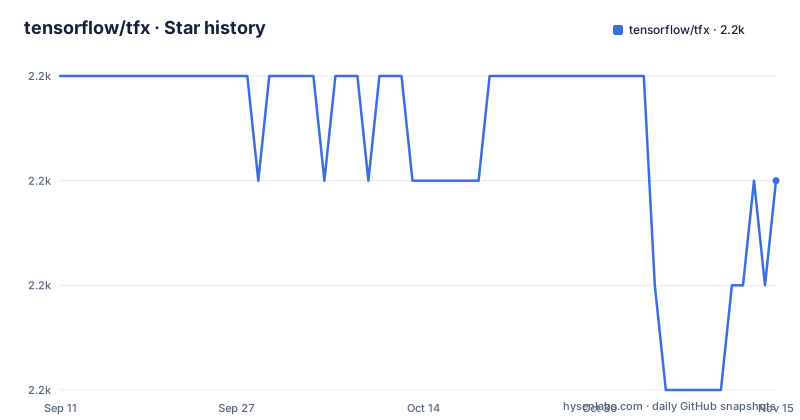
- tensorflow/tfx2,191 ★ · -1
| Repository | 2026-09-11 | 2026-11-15 |
|---|---|---|
| tensorflow/tfx | 2.2k | 2.2k |
-1 Stars in the last 65 days, measured from the daily GitHub snapshot. Compare with other projects
Editorial analysis
The table skips four minor releases
The compatibility table is the bulk of the page, and the first thing to check in it is what is missing.
The newest rows are the GitHub master branch, then version 1.21.0, then 1.17.2, 1.17.1 and 1.17.0, then 1.16.0 and downward. So between the 1.17 line and 1.21.0 there are no rows at all for 1.18, 1.19 or 1.20.
The release list agrees with the gap rather than explaining it. There is a 1.17.3 published on 2026-04-10 and a 1.21.0 published on 2026-06-18. Between those two tags the numbering advanced by four and nothing was published, or nothing was recorded here.
For anyone upgrading, that is the practical problem. The table is where you go to find which Beam version, which metadata version and which Transform version go with your release, and a four version hole means an intermediate upgrade path is undocumented. The release notes file is linked above the table for that.
The table also carries a caveat in the paragraph above it: the combinations are determined by the project's testing framework, but other untested combinations may also work. Which is true of every compatibility table ever written, and worth more here than usual because the grid is eleven columns wide.
The packaging metadata and the table disagree about Python 3.13
Read the two halves of the project side by side and one number does not match.
The compatibility table says the current release and the master branch both require Python greater than or equal to 3.10 and below 3.13. The package metadata declares the requirement as greater than or equal to 3.10 and below 3.14, and the classifier list names 3.10, 3.11, 3.12 and 3.13.
So the metadata admits 3.13 and the table does not. Whichever is right, an install on 3.13 will succeed and leave you in a configuration the testing grid says was never exercised.
The floor has also moved over the project's life, and the table records the whole history of it. The 1.7 through 1.13 releases required Python 3.7 or newer and stopped before 3.10. The 1.14 to 1.16 line required 3.8 or 3.9. The 1.17 line required 3.9 and stopped before 3.11. The current line requires 3.10.
So a project that was comfortable on an older Python a few releases ago now needs a newer interpreter, which is the kind of change that ends up in a dependency conflict six months later.
Master pins a nightly TensorFlow, releases pin a number
The TensorFlow column is where the table stops being a version list and starts being a decision.
For the 1.21.0 release it pins 2.21. For the GitHub master branch it does not pin anything: the cell reads nightly, at the 2.x line. Every other row has a specific number, going back through 2.17, 2.16, 2.15 and the 1.15 era entries that list two versions at once.
That means installing TFX from master means installing a nightly build of TensorFlow, whatever the rest of your environment looks like. For a project whose own classifier calls it production or stable, that is a large difference between the branch you read and the branch you install.
The rest of the grid is the reason to read the table at all. Each release pins eleven things: the Python range, Beam, ML Metadata, pyarrow, TensorFlow, data validation, model analysis, the serving API, Transform and two internal packages. Almost all of them move in lockstep, and the internal ones move with the TFX version itself, which tells you the project is internally consistent first and externally conservative second.
requirements.txt is two lines and pins nothing
There is a requirements file at the root of the repository, and it contains two lines. The first sets the package index. The second installs the project itself in editable mode.
So the file that looks like it should tell you what to install tells you nothing about versions. The actual constraints live in two other files at the top level, one for test runs and one for nightly test runs, which is how the project keeps a stable environment and a bleeding edge one side by side.
That arrangement is coherent for a library whose supported combinations are published in the compatibility table rather than in a requirements file, and it explains why the page carries no install command at all. There is no pip install line to copy, and there is not meant to be one: the page points to the user guide for setup and publishes a matrix instead.
For a reader arriving from a package index, that is unusual. The install instruction is a table, and the row you want is the one for your Python version.
Two build systems and a second product's readme
The tree carries the residue of several eras of tooling, all still present.
There is a Bazel setup at the root, with a version file, a configuration file and a workspace definition, which is how the project builds itself and its tests at Google scale. There is also a conventional Python packaging pair, a declarative project file and a setup script, and the setup script is doing unusual work. It reads the project file at run time to decide which package to build, switching on a name held in a module of its own, and it subclasses the wheel building command to do it. The version, the dependencies and the scripts are all marked dynamic in the project file, because the setup script fills them in.
There is a patch directory, which is what you expect in a project that pins dependencies across a wide matrix, and two constraint files as described earlier.
The tree also has a readme for a second product: the machine learning pipelines SDK, sitting beside the main one at the top level, with its own file and no mention in the main page. If you came looking for that SDK, this repository is where the file lives.
The test configuration is worth one more detail. Tests are named with the suffix convention rather than the prefix one, and the test discovery is told to skip the custom components directory and the experimental orchestration core, which tells you where the project's own tests are not.
The metadata backend is what makes a pipeline resumable
Strip away the table and the front page makes three claims, and the third is the load bearing one.
The first is scope: an end to end platform for deploying production machine learning pipelines, providing a configuration framework to express pipelines made of TFX components.
The second is portability of control. Pipelines can be orchestrated with Airflow or with Kubeflow Pipelines, and both the components and the integrations with orchestration systems can be extended. Extension is called out twice, which tells you custom components and custom orchestrator glue are expected rather than exceptional.
The third is state. TFX components talk to an ML Metadata backend that keeps a record of component runs, of input and output artifacts, and of the runtime configuration each run used. That record is what makes experiment tracking possible, and it is what lets a model be warm started or resumed from a previous run instead of retrained from nothing.
That is the part to evaluate first. A pipeline framework without recorded artifacts is a job runner, and the metadata backend is where the cost of running one lives.
Around it sit the ordinary governance artefacts: a user guide in the documentation directory, a roadmap updated quarterly, a release notes file, a list of current and past requests for comment, and a pointer to the wider TensorFlow RFC process. There is one worked example, a taxi pipeline for Chicago.
Editorial conclusion
TFX suits a team with an existing TensorFlow estate that needs pipeline components with recorded runs and resumable state, rather than someone starting a new project from scratch. Check three things before you pin it. Which TFX version you are installing, since the release line jumped from 1.17 to 1.21 and the compatibility table skips the versions in between. Which Python you are on, because the table and the packaging metadata disagree about 3.13. And which TensorFlow you will get, because installing from master means installing a nightly build of TensorFlow, which is not what a production pipeline wants by accident.
Frequently asked questions
What is TFX used for?
TFX is TensorFlow Extended, a general purpose machine learning platform from Google for deploying production pipelines. It provides a configuration framework for expressing pipelines of TFX components, and those pipelines can be orchestrated with Apache Airflow or Kubeflow Pipelines.
Which Python versions does TFX support?
The compatibility table says the current release and master both require Python 3.10 or newer and below 3.13, while the packaging metadata declares 3.10 or newer and below 3.14 and lists classifiers through 3.13. The two sources disagree about 3.13.
What is the newest TFX release, and are the versions continuous?
Version 1.21.0, published 2026-06-18, following 1.17.3 in April 2026. The compatibility table jumps from the 1.17 line straight to 1.21.0, with no rows for 1.18, 1.19 or 1.20.
Which TensorFlow version does TFX require?
The table pins 2.21 for the 1.21.0 release, and for the GitHub master branch the cell reads nightly at the 2.x line, so installing from master means installing a nightly TensorFlow build.
Can a TFX pipeline be resumed or warm started?
Yes. Components interact with an ML Metadata backend that records component runs, input and output artifacts, and runtime configuration, which is what enables experiment tracking and warm starting or resuming models from previous runs.
How do I install TFX?
The page gives no install command. It points to the user guide for setup and publishes a compatibility table instead; the root requirements file only sets a package index and installs the project itself in editable mode, with version constraints held in separate test constraint files.
Official sources
Add this badge to your README
If you maintain this project, the badge below links readers to this analysis and shows its maintenance status from the daily GitHub snapshot. Paste the markdown into your README; add ?metric=license or ?metric=stars to the image URL for a different field.

[](https://hysenlabs.com/projects/tensorflow-tfx)Star history chart for your README
[](https://hysenlabs.com/projects/tensorflow-tfx)Was this useful?