Tongyun1/from-minimind-to-more: A Chinese Study Guide to MiniMind
🎓从0开始训练一个大模型Minimind项目的超详细解析,包括但不限于用到的架构,算法,以及大模型面试经验
At a glance
- What is it?
- Tongyun1/from-minimind-to-more is a Python-oriented documentation repository that explains MiniMind and related large-language-model concepts through source annotations, architecture notes, algorithm chapters, and interview material. It is most useful for learners who want a structured path through tokenizer, embedding, Transformer architecture, pretraining, fine-tuning, and model optimization topics.
- Who is it for?
- This repository fits readers studying MiniMind or preparing for large-language-model interviews, but it is not a packaged training application because the repository documents no installation procedure or runnable interface. Readers should first verify which chapters match their existing knowledge, then inspect the linked `src/` directory for implementation details, and treat the missing license as an unresolved adoption constraint.
- Can I use it commercially?
- Not without permission. GitHub finds no licence file in the repository, and without a licence all rights are reserved by default: you may read the code but not reuse it. Check the README, or ask the authors, before using it.
- Is it still maintained?
- Yes. The repository last received commits 166 days ago.
- What is it written in?
- Mainly Python, according to GitHub's language statistics.
Answers come from the project's GitHub data, last synced on November 7, 2026, and from our analysis. They are not legal advice.
Star history
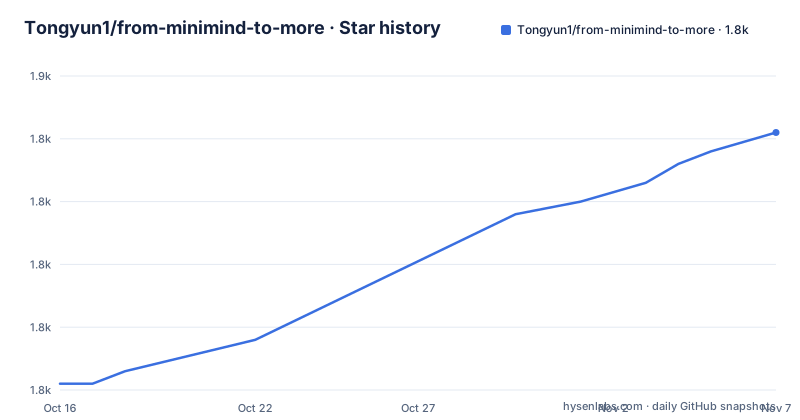
- Tongyun1/from-minimind-to-more1,841 ★ · +40
| Repository | 2026-10-16 | 2026-11-07 |
|---|---|---|
| Tongyun1/from-minimind-to-more | 1.8k | 1.8k |
40 Stars in the last 22 days, measured from the daily GitHub snapshot. Compare with other projects
Editorial analysis
What from-minimind-to-more Covers
This project addresses the difficulty of understanding how a small language-model implementation relates to the broader large-language-model field. Its README describes the work as learning notes and personal reflections based on `https://github.com/jingyaogong/minimind`, with the goal of helping readers understand MiniMind while building a broader view of the technical system. The target audience appears to include people studying model architecture and training, plus readers preparing for interviews related to large language models.
The repository is primarily a collection of Markdown explanations. Its navigation covers tokenization, MiniMind's design, embeddings and positional encoding, normalization techniques, KV Cache, Flash Attention, mixture-of-experts models, and a chapter about assembling a model. The algorithm section covers pretraining, supervised fine-tuning, an overview of reinforcement-learning algorithms for large models, DPO, PPO, GRPO, related variants, and SPO. The repository also contains `大模型八股100问.md`, described as a 100-question interview reference.
The distinction between this repository and MiniMind itself matters. The repository presents itself as an explanatory companion, not as a separate model package or training service. The README says that source annotations and algorithm explanations are included, but the available repository description does not define an installation command, a model checkpoint, or a complete training workflow.
Architecture and Data-Flow Material
The chapters are organized around the path from text representation to model construction and training. The foundations section starts with tokenization, then examines MiniMind's design and the roles of embeddings and positional encoding. This reflects a model-development sequence in which text must first be converted into tokens, token representations need positional information, and the resulting sequence is passed into a model architecture.
The architecture section adds normalization, KV Cache, Flash Attention, and mixture-of-experts material. The repository lists `架构篇:超级拼装.md` as a chapter for assembling a large model, while the normalization and optimization chapters explain topics that sit around the main Transformer computation path. The README does not provide a complete class-level execution trace, so the exact tensor shapes, tensor-parallel boundaries, memory flow, and framework calls cannot be confirmed from the information available here.
The algorithm chapters extend that explanation into training behavior. The README identifies dedicated treatment of `Pretrain`, `SFT`, `DPO`, `PPO`, `GRPO`, and `SPO`. The `GRPO` chapter is described as including source analysis and algorithm variants such as `Dr.GRPO`, `DAPO`, `GSPO`, `SAPO`, and `GTPO`. The presence of `src/` in the repository layout indicates that source material is present, but the README does not state whether the top-level repository is executable by itself or whether it expects the separate MiniMind repository.
Reading Path for Python Learners
The README gives no installation steps, package index, dependency file, or launch command for this repository. It says that readers can use the Markdown files, and it warns that web rendering may misdisplay formulas or images, recommending that readers download the material locally when that occurs. Because no installation procedure is documented, there is no verified `pip` command or executable example to reproduce.
A practical first use is therefore navigation through the checked files. A reader could begin with `基石:关于Tokenizer你所需要知道的一切.md`, then read `基石:语义的几何与时空的折叠:Embedding与位置编码.md`, followed by `基石:Minimind的设计目录.md`. This is a documentation path inferred directly from the repository's table of contents, not a command supplied by the project.
After the foundations, the reader can select `架构篇:超级拼装.md` for model construction and then use the algorithm chapters to connect construction with training objectives. The repository also separates completed foundations and algorithm material from unfinished optimization topics. LoRA and knowledge distillation are marked as planned or coming soon, so they should not be treated as completed explanations.
Maintenance Status and License Boundary
The repository is not archived. Its last push was on 2026-05-25, which is within the six-month period relevant to the available maintenance record. The README also contains dated update entries through 2026-04-17, and it describes Phase 4, covering optimization material, as in progress. Those facts indicate ongoing repository activity, but the README does not establish a release schedule or guarantee that unfinished chapters will be completed.
No GitHub releases are listed. The repository metadata provides no recognized license identifier, and the README does not state licensing terms. This is a concrete adoption issue for readers who need to confirm permission to copy, modify, redistribute, or incorporate the explanatory text and source annotations. The absence of a documented license should be checked with the repository owner before treating the material as reusable in a commercial or institutional setting.
The README asks readers to submit Issues or pull requests when they find errors or better explanations. That is a collaboration mechanism, not evidence of a formal support policy or guaranteed response time.
Useful Limitations for Adoption Decisions
The main limitation is scope and packaging. The repository is strongest as a guided reading collection and weakest as a turnkey implementation guide, because the README does not provide installation commands, dependencies, a configuration example, or a documented command that launches training. Readers who need a reproducible MiniMind training environment may have to consult the original MiniMind project separately.
The learning path is also uneven by design. Foundations, architecture, and listed algorithm chapters are marked complete, while the optimization section still lists LoRA and knowledge distillation as unfinished. The optional chapter on large-scale inference and training optimization is present in the repository layout, but the table of contents describes it as optional reading. A reader looking specifically for complete LoRA or distillation guidance would not find that material documented as complete here.
The interview content is split between the repository and an external Xiaohongshu profile. The README marks `大模型八股100问.md` as available in the repository, but says the interview question bank has been updated on Xiaohongshu. That split makes it harder to treat the project as one self-contained corpus. The web-rendering warning also matters for technical material because formulas and images may appear incorrectly outside a local Markdown viewer.
Difference from Reading MiniMind Source Alone
A direct alternative is to study the original MiniMind repository's source and documentation without this companion guide. That approach is closer to implementation-first work: it exposes the actual training code and avoids an explanatory layer. This repository takes a different approach, using MiniMind as the organizing example and adding Chinese-language explanations, source annotations, related architecture topics, and interview questions.
The choice depends on the reader's goal. Someone debugging or modifying a specific MiniMind component may prefer the original source and its own execution context. Someone who needs a staged conceptual map may find this repository more useful because it connects tokenization, embeddings, architecture, optimization mechanisms, and training algorithms in one navigation table. The repository does not claim to replace the original project, and its README explicitly acknowledges MiniMind as the upstream basis.
For model-training engineers, the missing installation and dependency details are more significant than the lack of a commercial feature list. The documented value is educational organization. Adoption should be based on whether that organization matches the reader's learning goals, not on treating the repository as a production training platform.
Editorial conclusion
This repository fits readers studying MiniMind or preparing for large-language-model interviews, but it is not a packaged training application because the repository documents no installation procedure or runnable interface. Readers should first verify which chapters match their existing knowledge, then inspect the linked `src/` directory for implementation details, and treat the missing license as an unresolved adoption constraint.
Frequently asked questions
What is Tongyun1/from-minimind-to-more?
It is a Python-oriented Chinese learning-notes repository based on MiniMind. It explains model foundations, architecture, training algorithms, optimization topics, and interview concepts.
Does the repository provide an installation command for training MiniMind?
No installation command is documented in the README. The README directs readers to the Markdown chapters and notes that formulas and images may render incorrectly in a web browser, so local viewing may be preferable.
Which algorithms does from-minimind-to-more explain?
The algorithm chapters cover pretraining, SFT, DPO, PPO, GRPO, related GRPO variants, and SPO. The repository also lists an overview of reinforcement-learning algorithms for large models.
Is the LoRA and knowledge distillation material complete?
No. The README marks LoRA and knowledge distillation under the optimization section as coming soon or unfinished.
Official sources
Add this badge to your README
If you maintain this project, the badge below links readers to this analysis and shows its maintenance status from the daily GitHub snapshot. Paste the markdown into your README; add ?metric=license or ?metric=stars to the image URL for a different field.

[](https://hysenlabs.com/projects/tongyun1-from-minimind-to-more)Star history chart for your README
[](https://hysenlabs.com/projects/tongyun1-from-minimind-to-more)Was this useful?