Free coding models, measured by p95 and jitter, at a cost paid in your provider quota
Find, benchmark and install in CLI 170+ FREE coding LLM models across 15+ providers in real time
At a glance
- What is it?
- free-coding-models is an npm CLI that pings every free coding model it knows about, ranks them on a stability score built from p95 latency, jitter, spike rate and uptime, then writes the winner into another coding tool's config and launches it. The mechanics are documented well, including the awkward parts: probes spend quota, paid siblings of a free model are deliberately dropped, and the container binds every interface with an empty origin allowlist.
- Who is it for?
- This tool is useful for one specific job, which is telling you which free endpoint is actually answering quickly right now rather than which one looked good in a table last month, and it is candid about the cost of finding out. Three things to decide before you point it at your keys.
- Can I use it commercially?
- Check first. The repository uses a licence we do not classify automatically, so read its LICENSE file before any commercial use.
- Is it still maintained?
- Yes. The repository last received commits 6 days ago.
- What is it written in?
- Mainly HTML, according to GitHub's language statistics.
Answers come from the project's GitHub data, last synced on November 15, 2026, and from our analysis. They are not legal advice.
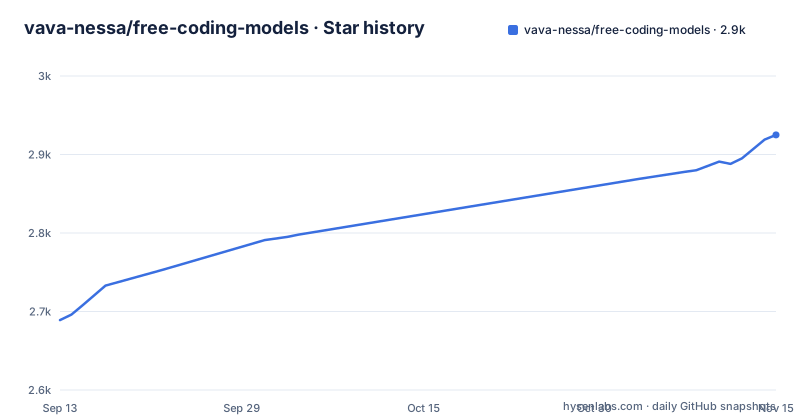
Star history
- vava-nessa/free-coding-models2,925 ★ · +236
| Repository | 2026-09-13 | 2026-11-15 |
|---|---|---|
| vava-nessa/free-coding-models | 2.7k | 2.9k |
236 Stars in the last 63 days, measured from the daily GitHub snapshot. Compare with other projects
Editorial analysis
Free is a property of a pair, and paid siblings are dropped on purpose
The catalog is described as 25 active providers and 271 live models, generated from a sources file at the repository root rather than typed into the page, and the provider table is regenerated from that file by a script so the counts cannot drift out of date. The definition of free is the part worth reading twice, because it is narrower than the word suggests. Free is a property of the provider and model pair, never of the provider as a whole. A row appears only when that exact model id costs nothing to call through that provider, whether by permanent free tier, a :free variant or a free plan, and it is verified live at audit time. The same open weights model can be free on one host and paid on another, and the paid siblings are excluded on purpose. The top eight rows by model count are onomeo with 33, Alibaba DashScope with 29, Pollinations AI with 21, OpenRouter with 18, Kilo and Ollama Cloud with 17 each, NVIDIA NIM with 16 and OVHcloud AI with 15, and all eight are marked as reaching the highest tier.
Health probes spend your quota, and a 429 is what makes it pause
The tool pings models in parallel on every run, which is the whole trick and also its bill. The page says plainly that health probes consume provider quota, and describes what happens when a provider complains: FCM auto-pauses a provider on a 429, backs off exponentially per failing model, and shows a footer chip while that provider rests. The consequence for a user is that leaving a key in the tool spends a little of it every run, whether or not you end up choosing that provider's model. The escape hatch is that an empty key is not fatal: anonymous liveness probes still work for most providers, so you can look at the field before committing to signing up anywhere. Quota is read live from response headers rather than estimated, which is why the display can tell you a tier is nearly spent before you commit to it.
The score is p95 plus jitter plus spikes, because averages lie
Ranking is done on a Stability Score from 0 to 100 that combines p95 latency, jitter, spike rate and uptime, and the reasoning given is that average latency on its own is misleading, with the example being a model that randomly spikes to six seconds and is therefore not reliable even when its mean looks excellent. Above that sit two other signals. A tier scale is derived from SWE-bench Verified results, with S+ at 70 percent or above at the top and C at the bottom, and the table also carries models.dev enrichment with drift detection, so a model whose published characteristics move is visible rather than silently stale. A persistent 24 hour probe cache is shared by every surface, which is what lets a terminal run, a browser dashboard and an agent extension agree on the same numbers. There is also an AI Speed Test that issues real completions and reports latency and tokens per second, and a Smart Recommend wizard that asks three questions and returns three picks.
Choosing a model rewrites another tool's config file
The launch path is the part with side effects. Once you pick a row, the tool writes that model into the target coding tool's configuration and opens the tool, which is how the page sells a ten second path from question to coding. The target is chosen in advance or cycled live with Z, through a list that names nineteen tools including OpenCode, OpenClaw, Crush, Goose, Aider, Kilo CLI, Qwen Code, OpenHands, Amp, Hermes, Continue, Cline, Xcode, Pi, ZCode, ForgeCode, Copilot, jcode and Caveman Code. The same selection can be made from the command line:
free-coding-models --goose --tier S      # Goose, pre-filtered to S-tier only
free-coding-models --crush --origin groq # Crush, Groq models only
free-coding-models --fiable              # print the single most reliable model and exit
One inconsistency worth noticing: the npm package summary names Cursor as a destination, and Cursor is not in that list of nineteen.
MIT in the manifest, no license recorded for the repository, two lockfiles
Three packaging details sit oddly together. The npm manifest declares MIT and a LICENSE file is present in the tree, but the repository itself carries no recognised license identifier, so the grant you rely on is the one in the package rather than one the repository host records. Second, the tree holds both package-lock.json and pnpm-lock.yaml, and the two are used by different paths: users install from npm, while the container image enables corepack, activates pnpm 10.33.2 and installs with a frozen lockfile in production mode. A third follows from the first install instruction, which asks for Node.js 18 or later with no native build and no sudo, while the container image is built on node 20 alpine. The package files list is selective, and the only scripts it ships are the drift check and the benchmark update, alongside bin, src, sources, the web build and the two OpenClaw patch scripts.
The container binds every interface with an empty origin allowlist
The compose service publishes port 19280 to the host and sets FCM_HOST to 0.0.0.0, which is the value that makes the dashboard reachable from outside the machine. The allowlist for browser origins, FCM_ALLOWED_ORIGINS, defaults to an empty string. Telemetry is switched off in the file with FREE_CODING_MODELS_TELEMETRY set to 0, matching the same default baked into the image. Then come roughly two dozen provider key slots, NVIDIA, Groq, Cerebras, Google, two Cloudflare variables, OpenRouter, Mistral, DashScope, Kilo, Pollinations, Ollama, OVH's access token and more, each defaulting to an empty value. GITHUB_TOKEN and GH_TOKEN both appear, so two variables for one service. The comment above the block names the maintenance cost plainly: the source of truth for that list is the ENV_VARS map in the core config module, and a new provider has to be added there and here.
The test suite is node's built in runner, and two scripts maintain the numbers
Tests run on the runtime's own runner rather than a framework, with the test script pointing at the files in the test directory through node --test, and two further scripts covering extended benchmarks and the models.dev integration. Keeping the data honest is delegated to two more scripts, one that updates benchmarks and one that checks for drift, and those two are also the only scripts included in the published package. Releases move quickly: v0.5.95 on 22 September 2026, v0.5.96 on 26 September and v0.5.97 on 29 September, which is also the current manifest version and the date of the last commit. The tree also holds four surfaces rather than one, with the terminal interface, a browser dashboard, agent extensions for OpenCode and Pi, and a local OpenAI-compatible router daemon with automatic failover, plus agent side configuration directories for two of the supported tools.
The root carries five screenshots, two frontends and two task folders
The top level listing is wide, and some of it looks like working leftovers rather than structure. Five PNG files named after a person, in merged, final, full, mobile and viewport variants, sit at the root beside icon.png. There are two frontend directories, web and website, and a shell script called sync-website-sources.sh that appears to keep one of them fed. There are also both task and tasks directories, an architecture-review directory, an ideas directory, a new_providers_report.md, and an audit_state.json. Alongside the src directory sit opencode-plugin and pi-extension, with a packages directory holding the rest, plus two OpenClaw patch scripts at the root and the sources file that the provider table is generated from. Documentation for contributors is spread across AGENTS.md, CLAUDE.md, CONTRIBUTORS.md, CODEOWNERS and SECURITY.md.
Editorial conclusion
This tool is useful for one specific job, which is telling you which free endpoint is actually answering quickly right now rather than which one looked good in a table last month, and it is candid about the cost of finding out. Three things to decide before you point it at your keys. Probing is billable quota, since health checks hit real endpoints and a 429 is what triggers the pause, so keep the key list to the providers you intend to use. The router and the dashboard extend the blast radius beyond a local TUI, so set FCM_ALLOWED_ORIGINS before binding 0.0.0.0 and understand that FCM_HOST is what exposes it. And pick a model deliberately: it rewrites the config of whichever tool you target, so know which file is about to change before you press Enter.
Frequently asked questions
How many free coding models does free-coding-models track?
The page states 25 active providers and 271 live models, generated from the sources file in the repository. The provider table is regenerated from that same file by a script, so the counts are not maintained by hand.
What does free mean in free-coding-models?
It is a property of the provider and model pair, never of the provider as a whole. A row is listed only when that exact model id costs nothing to call through that provider, by permanent tier, a :free variant or a free plan, verified live at audit time, and paid siblings of the same open weights model are excluded.
Does probing models with free-coding-models cost anything?
It consumes provider quota, because the health checks are real requests. The tool auto-pauses a provider on a 429 and backs off exponentially per failing model, and an empty key still allows anonymous liveness probes for most providers.
How is the free-coding-models Stability Score calculated?
It is a value from 0 to 100 combining p95 latency, jitter, spike rate and uptime, on the grounds that average latency is misleading when a model spikes. A separate tier scale comes from SWE-bench Verified results, with S+ at 70 percent or above down to C.
Which Node version does free-coding-models need?
The quick start states Node.js 18 or later, with no native build and no need for sudo, and installation is a global npm install. The container image is a different floor, built on node 20 alpine.
What happens when I pick a model in free-coding-models?
The chosen model is written into the target coding tool's configuration and that tool is launched. The target is cycled with Z or named on the command line with flags such as --goose or --crush, and --fiable prints the single most reliable model and exits without launching anything.
Official sources
Add this badge to your README
If you maintain this project, the badge below links readers to this analysis and shows its maintenance status from the daily GitHub snapshot. Paste the markdown into your README; add ?metric=license or ?metric=stars to the image URL for a different field.

[](https://hysenlabs.com/projects/vava-nessa-free-coding-models)Star history chart for your README
[](https://hysenlabs.com/projects/vava-nessa-free-coding-models)Was this useful?