local-dream: Android Stable Diffusion whose readme contains no instructions at all
Run Stable Diffusion on Android Devices with Snapdragon NPU acceleration. Also supports CPU/GPU inference.
At a glance
- What is it?
- An Android app that runs image generation on a Snapdragon NPU or falls back to CPU and GPU, shipping two native inference stacks under a Kotlin shell. The readme explains what was dropped, what hardware each model needs, and who wrote every library it borrows, then sends you to a website for anything else.
- Who is it for?
- Use it if you want image generation to run entirely on the handset, because that is the only thing it does and the two execution paths are the whole design. Three things to check before you commit a phone to it.
- Can I use it commercially?
- Check first. The repository uses a licence we do not classify automatically, so read its LICENSE file before any commercial use.
- Is it still maintained?
- Yes. The repository received new commits within the last day.
- What is it written in?
- Mainly Kotlin, according to GitHub's language statistics.
Answers come from the project's GitHub data, last synced on November 22, 2026, and from our analysis. They are not legal advice.
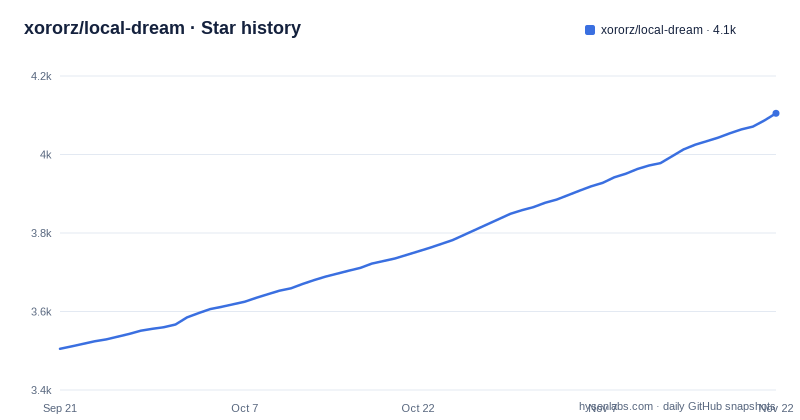
Star history
- xororz/local-dream4,105 ★ · +600
| Repository | 2026-09-21 | 2026-11-22 |
|---|---|---|
| xororz/local-dream | 3.5k | 4.1k |
600 Stars in the last 62 days, measured from the daily GitHub snapshot. Compare with other projects
Editorial analysis
The readme has an about section and then sends you elsewhere
Here is the entire user guide section of the file:
> For certain reasons, all guides and documentation have been moved to [Guide Site](https://ld-guide.chino.icu).
One sentence, a stated reason that is not explained, and a link to a site on a personal-looking domain. So the repository contains no installation step, no model download instructions, no settings reference and no troubleshooting, and the application itself is not distributed from here either: the repository's declared homepage is an app store listing, which means installation goes through a store rather than a package in the tree. What the file does contain is an about paragraph, a technical note about which models and which hardware, a long credits list, and a funding section. For a project that mixes two inference backends, that is thin, and the reason given is not a technical one.
One model was dropped and the reason is stated
The technical note opens with a scope decision and gives the reason, which is rarer than it should be:
> Currently focused on SD1.5 and SDXL models. SD2.1 is no longer maintained due to poor quality and limited popularity.
So the middle version of the model family was not quietly abandoned in a changelog nobody reads; it was named, with a reason, in the one place a new user will look. That is the kind of note that saves somebody an afternoon. It also tells you the shape of the project: two supported model generations, chosen on quality and on whether people use them, rather than every generation the engine could load.
The two execution paths state their requirements in different currencies
The note describes hardware support twice, and the two descriptions are not the same kind of statement. For the older model it names an architecture generation:
> SD1.5 models are supported on Snapdragon NPUs with Hexagon V68 architecture or newer.
For the newer one it names a device generation:
> SDXL models are supported on Snapdragon 8 Gen 3 and newer devices.
One is a statement about the processor's vector unit, the other about the chip. For someone checking whether their phone qualifies, the first is checkable if you know the generation and the second if you know the model, and neither is the other's equivalent. The processor and the SoC generation are not the same granularity, so a phone can satisfy one requirement and not the other, and the readme does not reconcile them. The fallback path is described in a third way again, in terms of the model package format rather than the hardware.
The memory warning is comparative and carries no number
There is one performance-shaped statement in the whole file:
> Large SDXL models require substantially more memory than SD1.5.
No figure, not in megabytes, not for a named model, not for a named device. For a project whose entire pitch is running large models on a phone, the memory ceiling is the constraint that decides which model a user can actually load, and it is the one number a reader would most want. So the honest position is: the newest models need considerably more memory than the older ones, and this repository will not tell you how much. Anyone with a specific device and a specific model in mind has to find the answer in the guide site or by trying it.
The credits list is the only technical documentation in the file
Nine C++ libraries, each with a one-line role, and they describe the application accurately enough to build a picture of it. A vendor's AI engine SDK for NPU execution. A tensor inference framework for CPU execution. A stable diffusion inference project credited with deep performance optimisation for on-device transformer inference. A tensor library for operations and scheduling. A tokeniser for text. A header-only HTTP server. A single-header image library. A compression library for model files. A JSON library. Below that, four Android libraries, an image loader, a cropping library, and the platform UI stack. So the app is a thin shell over two native inference stacks, and the credits are the only place that architecture is written down. The model credits add two upscalers and, notably, a content classification model for filtering.
A vendor SDK is credited and the licence file does not mention it
The project declares a licence file in its root and its metadata records no licence at all, so terms are established only by reading that file. The credits list names a vendor's neural processing SDK as the component that executes models on the NPU, alongside nine libraries that are all openly licensed. That combination is the kind of thing worth resolving before you build or redistribute: an application whose acceleration path depends on a vendor SDK is not covered by its own licence file, and the file says nothing about it. The same applies in a milder way to the model files themselves, which are the work of their creators and are credited as such, and to the two upscaling models and the filtering model. None of that is a criticism of the project, which credits everything carefully. It is the question to answer before you ship it.
Three releases, one version, all alphas
The three newest releases are the same major version at successive alphas, published inside five days: an alpha on 19 September 2026, the next on 21 September, and the third on 3 October, which is also the date the default branch was last pushed. So the project is mid-rewrite on a pre-release line and shipping fast, which is the right pace for something that early and the wrong thing to build an automated pipeline on. The about paragraph frames the moment, saying the project is now open sourced and completely free and asking for sponsorship, and the funding links point at three separate platforms across two payment ecosystems. The support channel is a chat group described as a place for discussion or help with testing, which is a candid description of where an alpha line's bug reports come from.
Editorial conclusion
Use it if you want image generation to run entirely on the handset, because that is the only thing it does and the two execution paths are the whole design. Three things to check before you commit a phone to it. The version line you would install is an alpha: three of the newest releases are the same major version at alphas two through four, published across five days, so expect the interface to move. The hardware floor is stated per model and expressed two different ways, so confirm your own chip against the requirement for the model you want rather than the model you have. And everything about actually using it is not in the repository, which points to a documentation site on someone else's domain for the reasons stated as certain reasons without elaboration.
Frequently asked questions
how to use local dream
The repository does not say. Its user guide section states that for certain reasons all guides and documentation have been moved to a separate guide site, and links there. What this repository does state is the model scope, the hardware each model needs, that installation is through the app store listing the repository points at, and a chat group for discussion or help with testing.
Which Stable Diffusion models does Local Dream run?
SD1.5 and SDXL. SD2.1 is no longer maintained, and the readme gives the reason as poor quality and limited popularity. On the processor path, SD1.5 needs a Snapdragon NPU of the V68 architecture or newer and SDXL needs a Snapdragon 8 Gen 3 or newer device, while the processor and graphics fallback supports SD1.5 and imported SDXL packages.
Does Local Dream run Stable Diffusion without an NPU?
Yes, with a caveat the readme states plainly. A processor and graphics path is supported for both SD1.5 and imported SDXL packages, and the note warns that large SDXL models require substantially more memory than SD1.5, without saying how much. The NPU path and the fallback path describe their requirements in different terms, so a model that loads on one is not guaranteed to load on the other.
What is Local Dream built on?
A Kotlin application over two native inference stacks, credited as a vendor AI engine SDK for NPU execution and a tensor inference framework for CPU execution, plus a stable diffusion inference project credited with on-device transformer optimisation. Supporting libraries cover tensor operations, tokenisation, HTTP serving, image processing, model compression and JSON, with four Android libraries and the platform UI stack above them.
Official sources
Add this badge to your README
If you maintain this project, the badge below links readers to this analysis and shows its maintenance status from the daily GitHub snapshot. Paste the markdown into your README; add ?metric=license or ?metric=stars to the image URL for a different field.

[](https://hysenlabs.com/projects/xororz-local-dream)Star history chart for your README
[](https://hysenlabs.com/projects/xororz-local-dream)Was this useful?