Chinese-Mixtral activates two of eight experts per token
Chinese Mixtral MoE LLMs
At a glance
- What is it?
- Chinese-Mixtral is a pair of Apache-2.0 checkpoints built on Mixtral-8x7B-v0.1: a base model continued on large-scale unlabeled Chinese data and an Instruct model tuned on labelled instructions, both with 8 experts and 2 active per token, a 32000 vocabulary, 32K native context, and three download sizes from 2.4 GB to 87 GB.
- Who is it for?
- Chinese-Mixtral fits a team that wants a sparse MoE model that handles Chinese natively, needs either text continuation or chat from the same family, and wants the training and fine-tuning scripts rather than weights alone. It does not fit anyone who needs a current toolchain, since the pinned stack is transformers 4.37.2 with peft 0.7.1 and bitsandbytes 0.42.0.
- Can I use it commercially?
- Yes. Apache-2.0 is a permissive licence: you can use, modify and sell software built on it, as long as you keep its copyright and licence notices.
- Is it still maintained?
- Activity is slowing. The repository last received commits 6 months ago.
- What is it written in?
- Mainly Python, according to GitHub's language statistics.
Answers come from the project's GitHub data, last synced on November 14, 2026, and from our analysis. They are not legal advice.
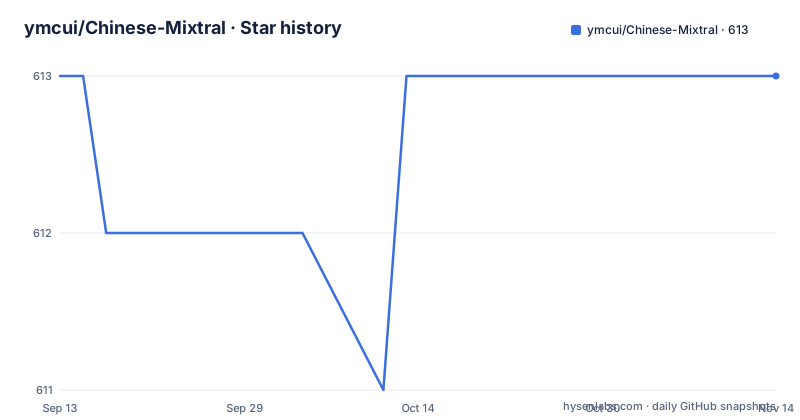
Star history
- ymcui/Chinese-Mixtral613 ★ · +0
| Repository | 2026-09-13 | 2026-11-14 |
|---|---|---|
| ymcui/Chinese-Mixtral | 613 | 613 |
0 Stars in the last 62 days, measured from the daily GitHub snapshot. Compare with other projects
Editorial analysis
Eight experts per layer, two chosen per token
The architecture is the reason a 46.7B parameter model behaves like a 13B one. Each feed-forward layer holds 8 different experts, which are fully connected layers, and gating values select the best 2 of them to activate.
The selection is per token, not per sequence. Every token in the input independently picks its experts, rather than the whole sequence sharing one set, which is the structural difference the project highlights against mainstream models in the LLaMA line.
Those two facts produce the headline numbers: about 46.7B parameters in total, of which about 13B are active during inference. The same shape appears in the model comparison table for both checkpoints, 8x7B with roughly 13B activated and 8 experts with 2 activated.
The Mixtral paper's structural diagram is reproduced in the documentation alongside this description, and the technical report for the Chinese adaptation is a separate paper by Cui and Yao, Rethinking LLM Language Adaptation: A Case Study on Chinese Mixtral.
Continued pretraining first, instruction tuning second
Two checkpoints come out of one base, and the difference between them is more than a name.
Chinese-Mixtral is the base model, trained by continued pretraining on large-scale unlabeled Chinese data starting from the original Mixtral-8x7B-v0.1. Its training type is causal language modelling, its corpus is unlabeled general text, and it needs no input template. Its use case is text continuation: given an opening, produce the rest.
Chinese-Mixtral-Instruct is built on top of that base model through instruction tuning on labelled instruction data. It expects the Mixtral-Instruct template to be applied to inputs, and its use case is instruction understanding, which the table lists as question answering, writing, chat and interaction. If you want a chat model, this is the one to take.
Both used QLoRA plus full embedding and lm-head training, both kept the original 32000 vocabulary, and both are described as gaining notable improvements in mathematical reasoning and code generation.
32K of native context, with 128K measured
Context handling is where this family differs from the author's earlier work. The documentation contrasts Chinese-Mixtral with Chinese-LLaMA-Alpaca and Chinese-LLaMA-Alpaca-2 on this point: those projects extended the context, whereas Mixtral supports 32K natively.
Beyond that, the project reports a measured figure of up to 128K. The distinction between the native and measured numbers is stated rather than blurred, and the practical argument given is that one model can cover tasks of different lengths instead of you keeping several checkpoints for different jobs.
Both checkpoints carry the same context row in the comparison table, 32K with up to 128K measured, so the choice between base and Instruct has no effect on how much text you can feed the model.
Three downloads, from 2.4 GB to 87 GB
The same weights are published in three forms, and the choice is about bandwidth rather than capability.
The full model is 87 GB, downloads ready to use, and needs no merge step. It is the option for anyone with the bandwidth. The LoRA version is 2.4 GB, cannot be used on its own, and has to be merged with the original Mixtral-8x7B-v0.1 to become the full model, with the merge procedure documented in the project wiki. That path is aimed at users with limited bandwidth who already hold the original Mixtral. The GGUF version is the quantized form for inference, compatible with llama.cpp and similar tools.
A news entry from March 27, 2024 records that 1-bit, 2-bit and 3-bit quantized GGUF builds were added on the Hugging Face hub, which is what makes the low end practical: the project states that quantized inference through llama.cpp needs as little as 16G of memory or video memory. Downloads are hosted on Baidu, Hugging Face and ModelScope.
Pinned to the 2024 stack, with serving paths listed
The training requirements are pinned tightly. requirements.txt lists peft 0.7.1, transformers 4.37.2, bitsandbytes 0.42.0 and sentencepiece 0.1.99, plus torch 2.0.1 or newer, with datasets and safetensors unpinned. That is a coherent set for the QLoRA work the project describes, and it is also a stack from early 2024.
Serving is a different matter, because the project names its supported ecosystem rather than pinning it: transformers, llama.cpp, text-generation-webui, LangChain, privateGPT and vLLM. A deployment mode imitating the OpenAI API was added on March 26, 2024 in the v1.2 release, so an existing client can point at it without speaking a private protocol.
The repository also open-sources the pretraining and instruction-tuning scripts themselves, with the stated purpose that users can train or fine-tune further. The examples directory holds evaluation write-ups, including a multi-turn conversation example and comparisons against Alpaca, one of them scored by GPT-4.
A 2024 release line with a 2026 commit
The version history is short and dated. v1.0 on January 29, 2024 released the base model and the Instruct model. v1.1 on March 5, 2024 open-sourced the training and fine-tuning code and published the technical report. v1.2 on March 26, 2024 added the OpenAI-style deployment mode. The quantized GGUF builds followed the next day.
After that the project moved sideways rather than forward. The most recent news entry is from April 30, 2024 and announces a different repository, Chinese-LLaMA-Alpaca-3, with Llama-3 based Chinese 8B models. The last push to the main branch of this repository is dated April 19, 2026.
Documentation is bilingual, with a Chinese README and an English one, and there is a wiki, an issue tracker, a discussions board and a leaderboard arena hosted on the author's own domain. The broader set of related projects by the same author and collaborators spans Chinese LLaMA and Alpaca generations, LERT, PERT, MacBERT, Chinese ELECTRA, Chinese XLNet and Chinese BERT, plus the TextBrewer distillation and TextPruner pruning tools.
Editorial conclusion
Chinese-Mixtral fits a team that wants a sparse MoE model that handles Chinese natively, needs either text continuation or chat from the same family, and wants the training and fine-tuning scripts rather than weights alone. It does not fit anyone who needs a current toolchain, since the pinned stack is transformers 4.37.2 with peft 0.7.1 and bitsandbytes 0.42.0. Before you commit disk and time, decide which of the three forms you actually need, because the 2.4 GB LoRA is unusable on its own without the original Mixtral, and check that your inference path, transformers, llama.cpp or vLLM, is one the project lists.
Frequently asked questions
What is Mixtral?
Mixtral is a sparse mixture of experts model. Each feed-forward layer holds 8 experts, gating values select the best 2 to activate, every token picks independently rather than a whole sequence sharing one set, and the model has about 46.7B parameters with roughly 13B active at inference.
Which Chinese-Mixtral model should I download?
The Instruct version for chat, question answering, writing or interaction, since it expects the Mixtral-Instruct template. The base version is for text continuation and needs no template. Both are 8x7B with about 13B active, 8 experts with 2 activated, and a 32000 vocabulary.
How large are the Chinese-Mixtral downloads?
Three forms: a full model at 87 GB that needs no merge step, a LoRA version at 2.4 GB that must be merged with the original Mixtral-8x7B-v0.1 before it can be used, and a GGUF quantized version for llama.cpp, including 1-bit, 2-bit and 3-bit builds added on March 27, 2024.
How much memory does running Chinese-Mixtral take?
The project states that quantized inference through llama.cpp needs as little as 16G of memory or video memory, which is what the low-bit GGUF builds are for.
Which Python packages are needed to train Chinese-Mixtral?
requirements.txt pins peft 0.7.1, transformers 4.37.2, bitsandbytes 0.42.0 and sentencepiece 0.1.99, and requires torch 2.0.1 or newer, together with datasets and safetensors.
Does Chinese-Mixtral offer an OpenAI-compatible API?
Yes. A deployment mode imitating the OpenAI API was added on March 26, 2024, in the v1.2 release, so clients can point at a local server instead of speaking a private protocol.
Official sources
Add this badge to your README
If you maintain this project, the badge below links readers to this analysis and shows its maintenance status from the daily GitHub snapshot. Paste the markdown into your README; add ?metric=license or ?metric=stars to the image URL for a different field.

[](https://hysenlabs.com/projects/ymcui-chinese-mixtral)Star history chart for your README
[](https://hysenlabs.com/projects/ymcui-chinese-mixtral)Was this useful?