Eighteen programmes for the USA, one for Canada, one status note
Research internships + summer programs for undergraduate students worldwide (NASA, CERN, Max Planck, +100 more)
At a glance
- What is it?
- This repository is a single markdown file: no code, no site generator, five top-level entries, and a list of undergraduate research programmes grouped by continent and then by country. What makes it useful is the annotations, since a handful of entries carry an eligibility note. What makes it fragile is everything else, because exactly one entry says whether it is open, and a Warwick programme is filed under Germany.
- Who is it for?
- The list is worth bookmarking if you are an undergraduate hunting for a research programme and you can tolerate verifying every link yourself, because the geographic coverage and the named institutions are the value. It is not a database and should not be scraped as one, since there is no licence, no status field, and no schema beyond a bullet.
- Can I use it commercially?
- Not without permission. GitHub finds no licence file in the repository, and without a licence all rights are reserved by default: you may read the code but not reuse it. Check the README, or ask the authors, before using it.
- Is it still maintained?
- Yes. The repository last received commits 15 days ago.
- What is it written in?
- GitHub does not report a main language for this repository.
Answers come from the project's GitHub data, last synced on October 22, 2026, and from our analysis. They are not legal advice.
Star history
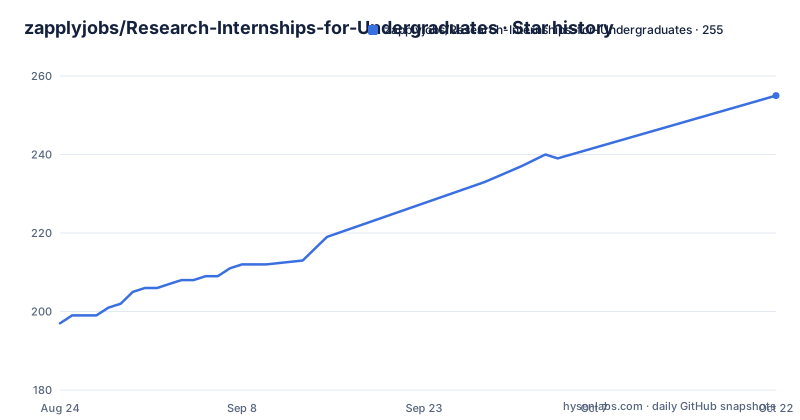
- zapplyjobs/Research-Internships-for-Undergraduates255 ★ · +58
| Repository | 2026-08-24 | 2026-10-22 |
|---|---|---|
| zapplyjobs/Research-Internships-for-Undergraduates | 197 | 255 |
58 Stars in the last 59 days, measured from the daily GitHub snapshot. Compare with other projects
Editorial analysis
Five top-level entries, and no code among them
The repository contains .github/, .vscode/, README.md, images/, and public/. There is no source directory, no build configuration, no licence file, and no detected primary language, and there are no GitHub releases. Two of those five entries are worth pausing on. images/ and public/ are the conventional directory names for a static site, so something was intended to publish this as a site, but no generator configuration sits in the tree, which means either the site lives elsewhere or the plan was never completed. A committed .vscode/ directory is the other oddity, since editor preferences in a list of links is a choice rather than a necessity. A short section further down, headed Explore Around, points at a Discord invite and a LinkedIn company page under a line about connecting with a network of fellow students and new grads, so even the community lives outside the repository. The result is that the entire project is one markdown document, and the last push to it is dated September 15, 2026, on a branch called main that is not archived.
The list calls itself non-exhaustive and India-weighted
The opening note makes two admissions in one sentence: the list is non-exhaustive, and many of the positions are only focused towards Indian students. The second admission is visible in the entries rather than hidden. A Max Planck software systems internship registers through an opencampus.net portal, and the Max Planck summer internship programme runs its application page on an imprs-ls opencampus subdomain. The Swissnex entry points at a swissnex.org path scoped to India. Turkey has two entries, one at Sabancı and one at Özyeğin, which is more attention than most European countries receive. None of this is criticism of the list, which flags the imbalance itself. It is a warning about coverage: the directories a student in a given country already knows about are the ones that will look thorough.
One section of the README is not a resource list
Between the disclaimer and the programme entries sits a section that reads like a product page. It points at an onboarding URL and then lists four things: a Chrome extension that autofills job applications in seconds, a dedicated job board with openings across various roles, user accounts with multiple profiles for different resume types and roles, and job application tracking with streaks and commitment awards. A separate line says the repository is maintained in collaboration with Zapply, and every link into that section carries a referral query parameter. So the repository is doing two jobs at once, and one of them is a funnel. That is worth naming when you use the list, because it means the resource half and the commercial half are maintained by the same party and you should not read the endorsement as editorial independence over the entries. The section closes with a line inviting readers to experience an advanced career journey, which is the one sentence in the whole document with nothing behind it.
Eligibility is annotated in three different ways
There is no eligibility field, so each entry that needs one says it in whatever form the author chose. The LPI summer internship in planetary science is annotated as being for both national and international students. A Max Planck gravitational physics internship is described as for all students. The QRLSSP summer programme at Arizona State carries the bluntest note of all, only for US citizens and permanent residents. The Berkeley Amgen Scholars link is filed under the University of Tokyo and annotated as only for biotech and biochemistry programmes, and the Berkeley SUPERB entry is scoped to information technology students. A fifth pattern is quieter: the Princeton entry is a URL with the eligibility fields already filtered to non-Princeton juniors in engineering. So a reader has to check the prose, the link, and the link's query string, in that order of reliability.
Exactly one entry says whether it is open
Status tracking is the clearest gap. Scanning the visible entries, one carries a status annotation: the ETH Zurich research fellowship is marked application closed. Every other programme, from the NASA and Caltech fellowships through CERN, EPFL, and the Max Planck institutes, is listed with no deadline, no open or closed marker, and no year. So a reader has to supply the year themselves, which is exactly the work the list appears to promise it has done. The maintenance model is stated and is entirely crowd-sourced: the README invites an issue or a pull request when a programme is missing or a link is broken, and says contributions are reviewed and merged regularly. Link rot is therefore the acknowledged failure mode, and no date field exists to help you judge how stale an entry is.
Eighteen United States entries against one for Canada
The North America section is dominated by a single country. The United States carries eighteen programmes and Canada carries one, the University of Alberta research experience. Within the US list, two entries are both called SURF and both point at Caltech: one filed as the NASA and Caltech Summer Undergraduate Research Fellowship with a link into the JPL site, and a second filed as the Caltech SURF Program with a link into a different Caltech host. They may be two routes into the same programme or two distinct programmes sharing a name, and the list does not say. The rest of the US entries span astronomy, robotics, complexity science, engineering, and information technology, with a mix of eligibility gates from open to all students to US citizens only.
A Warwick programme is filed under Germany
The Europe section is organised by country, and one entry is in the wrong bucket. Under Germany, between a Max Planck institute and the HZDR Dresden programme, sits the Warwick Statistics Internship Scheme with the University of Warwick named in the entry itself. Warwick is in the United Kingdom, and the United Kingdom section has its own Warwick entry, the DSSGx UK summer fellowship, also from the same institution. So the list contains a university twice, once correctly and once filed under a different country, and nothing in the structure prevents that from happening again. The rest of the European coverage includes three Max Planck programmes, CERN's summer student and OpenLab programmes, two EPFL entries, Oxford's Visual Geometry Group, and single entries for France, Spain, Finland, Austria, and Russia.
One institution, several headings
The country-first organisation has a predictable side effect: an institution that runs several programmes gets one entry per programme, spread across whichever headings suit each. Max Planck appears three times under Germany, once for gravitational physics, once for software systems, and once as the summer internship programme, and it is also named in the repository description. EPFL appears twice under Switzerland, once as the E3 programme and once as Summer at EPFL. CERN appears twice as well, the summer student programme and the OpenLab programme for computer science undergraduates. Oxford appears once, as the Visual Geometry Group, which is a research group rather than a programme and sits in the list on the same footing as a fellowship. None of this is an error, but it does mean the list measures programmes rather than institutions, so counting entries tells you about the curation rather than about the available places. The Asia section that follows the European one shows the same pattern with narrower annotation: Japan carries an Amgen Scholarship entry restricted to biotech and biochemistry programmes and a research internship programme at the Okinawa Institute of Science and Technology, and nothing in the visible entries records a deadline.
Editorial conclusion
The list is worth bookmarking if you are an undergraduate hunting for a research programme and you can tolerate verifying every link yourself, because the geographic coverage and the named institutions are the value. It is not a database and should not be scraped as one, since there is no licence, no status field, and no schema beyond a bullet. Before relying on any entry, check the deadline on the programme's own page and read the eligibility note where one appears, because the United States section is far longer than any other region shown.
Frequently asked questions
How can I find research internships?
This repository groups undergraduate research internships and summer programmes by continent and then country, covering the United States, Canada, and European destinations including CERN, Max Planck, ETH Zurich, EPFL, Oxford, and Warwick, with further sections after Asia. It describes itself as a non-exhaustive list.
How to get research experience as an undergrad?
The repository is a catalogue of programmes rather than advice. It includes the LPI summer internship in planetary science, annotated as open to both national and international students, and several Max Planck internships, one of which is described as open to all students.
Which research internships in the list are restricted to US citizens?
The QRLSSP summer programme at Arizona State University, annotated as only for US citizens and permanent residents. Most other entries carry no such restriction, and the LPI programme is explicitly noted as open to both national and international students.
Does the list say which programmes are still open?
Only one entry carries a status: the ETH Zurich research fellowship is marked application closed. Every other programme is listed without a deadline or an open and closed marker, and the README asks readers to submit an issue or pull request when a link is broken.
Is the Research-Internships-for-Undergraduates list limited to the United States?
No, but it is heavily weighted that way. The United States section alone carries eighteen programmes against one for Canada, and the README says many of the positions are focused towards Indian students, which several entries reflect through their application portals.
What is Zapply and why does it appear in a list of internships?
The README says the repository is maintained in collaboration with Zapply, and a section points at its Chrome extension for autofilling job applications, its job board, accounts with multiple profiles for different resume types, and application tracking with streaks. The section ends with a call to action rather than a resource.
Official sources
Add this badge to your README
If you maintain this project, the badge below links readers to this analysis and shows its maintenance status from the daily GitHub snapshot. Paste the markdown into your README; add ?metric=license or ?metric=stars to the image URL for a different field.

[](https://hysenlabs.com/projects/zapplyjobs-research-internships-for-undergraduates)Star history chart for your README
[](https://hysenlabs.com/projects/zapplyjobs-research-internships-for-undergraduates)