Zellij vs Tmux: What Its Own README Actually Claims
A terminal workspace with batteries included
At a glance
- What is it?
- Zellij calls itself a terminal workspace rather than a multiplexer, built around WebAssembly plugins, layouts and a built-in web client. Its README never claims it beats tmux, it just describes a different feature set.
- Who is it for?
- A developer who wants layouts, a WebAssembly plugin system and a built-in web client, not just split panes, is who this README is written for. Someone who needs Windows-native usage instructions should look elsewhere first, since the README documents installation routes but no Windows-specific usage walkthrough.
- Can I use it commercially?
- Yes. MIT is a permissive licence: you can use, modify and sell software built on it, as long as you keep its copyright and licence notices.
- Is it still maintained?
- Yes. The repository last received commits 2 days ago.
- What is it written in?
- Mainly Rust, according to GitHub's language statistics.
Answers come from the project's GitHub data, last synced on November 15, 2026, and from our analysis. They are not legal advice.
Star history
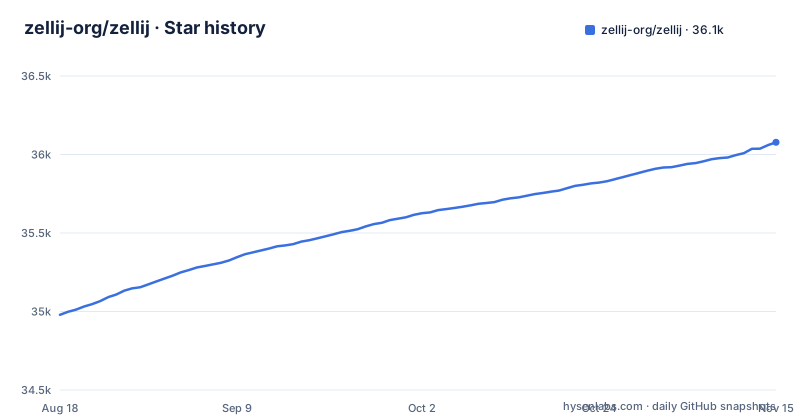
- zellij-org/zellij36,078 ★ · +1,099
| Repository | 2026-08-18 | 2026-11-15 |
|---|---|---|
| zellij-org/zellij | 35k | 36.1k |
1,099 Stars in the last 89 days, measured from the daily GitHub snapshot. Compare with other projects
Editorial analysis
A Terminal Workspace, Not Just Another Multiplexer
The README introduces Zellij as "a workspace aimed at developers, ops-oriented people and anyone who loves the terminal," and adds, almost in passing, that "similar programs are sometimes called 'Terminal Multiplexers'," a label it does not claim for itself. Its stated philosophy is that "one must not sacrifice simplicity for power," aimed at both beginners and power users through "deep customizability, personal automation through layouts, true multiplayer collaboration, unique UX features such as floating and stacked panes."
Two features stand out as specific rather than generic. The plugin system lets anyone "create plugins in any language that compiles to WebAssembly," not a fixed scripting language. A built-in web client, linked from the README, makes a local terminal emulator optional entirely, since a browser can reach a Zellij session directly.
Nine Default Plugins, Already in the Workspace
Layouts and the plugin system are not just a promise in prose. Cargo.toml's workspace lists default-plugins/bars, default-plugins/strider, default-plugins/session-manager, default-plugins/configuration, default-plugins/plugin-manager, default-plugins/about and default-plugins/share as separate crates built alongside the main zellij binary. That is a concrete answer to what "batteries included," the project's own tagline in Cargo.toml's description field, means in practice: a session manager, a configuration plugin and a plugin manager ship as part of the same workspace rather than as something a user has to find and compile separately.
The core binary itself depends on zellij-client and zellij-server as separate workspace crates, both pinned to version 0.46.0 inside Cargo.toml, which splits the thing a user types commands into from the background process actually managing panes, tabs and sessions underneath it.
Four Install Routes, and One You're Told Not to Use
The README's own first recommendation is a package for the reader's OS, documented separately in docs/THIRD_PARTY_INSTALL.md. Failing that, it offers a prebuilt binary from the latest GitHub release to place in $PATH, or compiling directly with cargo:
cargo install --locked zellijFor trying it without any install step, the README gives two shell-specific one-liners, one for bash and zsh:
bash <(curl -L https://zellij.dev/launch)and a wrapped version for fish and xonsh:
bash -c 'bash <(curl -L https://zellij.dev/launch)'The README is explicit about a fifth path it does not want readers to default to: installing straight from the main branch. Its own words call that branch "pre-release code, is constantly being worked on and may contain broken or unusable features," and warn that using it "may corrupt the cache for future versions, forcing users to clear it before they can use the officially released version." Nothing stops a reader from doing it anyway, bug reports included, but the README asks for the latest release first.
Building It Yourself with cargo xtask
For anyone working on Zellij rather than just running it, the README reduces the development loop to two commands run from a clone of the project: cargo xtask run for a debug build, and cargo xtask test to run the full test suite, with CONTRIBUTING.md named as the place for more build commands beyond those two.
The repository's docker-compose.yml shows one piece of that test infrastructure directly: a service named zellij-e2e, built from the ghcr.io/linuxserver/openssh-server image, exposing an SSH server on 127.0.0.1:2222 with a fixed test user and password. That container exists to give end-to-end tests something to connect to over SSH, bind-mounting the build's target directory and a fixtures folder into the container rather than requiring a real remote host for the tests that need one.
Cargo.toml's dev-dependencies name ssh2 directly, alongside insta for snapshot testing. The main dependency list separately names clap for command-line argument parsing, dialoguer for interactive prompts, and interprocess for the inter-process communication a split client and server architecture needs to talk to each other at all.
An Open Issue Here Is Not a Confirmed Bug
The README sets expectations about its own issue tracker directly, a genuine limitation on what a reader should assume: "Issues in this repository, whether open or closed, do not necessarily indicate a problem or a bug in the software. They only indicate that the reporter wanted to communicate their experiences or thoughts to the maintainers." It goes further, saying the maintainers "cannot promise these will always be dealt with or even read."
That is a specific, stated constraint on using the issue tracker as a signal: counting open issues, or reading a closed one, tells a prospective user less than it would for a project that treats every issue as a bug report pending triage. Anyone evaluating Zellij by its issue list alone is evaluating something the maintainers themselves say is not a reliable proxy for software quality.
The README Never Actually Compares Itself to Tmux
Zellij's own README never names tmux, and never makes a claim about being faster, lighter or better than any specific multiplexer. The closest it comes is the single line distancing itself from the "Terminal Multiplexers" label while still acknowledging that is what similar programs get called.
What the README does offer, in place of a head-to-head comparison, is its own list of differentiators: a plugin system built on WebAssembly rather than a fixed scripting language, true multiplayer collaboration in a single session, floating and stacked panes as named UX features, and a web client that removes the terminal emulator requirement altogether. A reader comparing it to a multiplexer they already use has to weigh those specific features against whatever that other tool offers, since this repository gives no side-by-side numbers to lean on instead.
Where the Name Comes From, by the README's Own Citation
The README dedicates an entire section, sourced explicitly to Wikipedia, to the project's name. Zellij, it explains, is "a style of mosaic tilework made from individually hand-chiseled tile pieces," fitted together into "elaborate Islamic geometric motifs such as radiating star patterns composed of various polygons," and names it as one of the main characteristics of architecture across the western Islamic world, specifically Morocco, Algeria, early Islamic sites in Tunisia, and the historic monuments of al-Andalus.
The choice reads as a metaphor the project leans on rather than explains further: individual tiles, in this case panes, plugins and layouts, fitted together into one larger, deliberately patterned workspace. The README does not spell out that connection itself.
MIT License, a Named Author, Sponsors Listed by Name
Zellij's license is MIT, stated plainly in the README's own License section and set in Cargo.toml through license.workspace = true, pointing at a single value shared across every crate in the workspace. Cargo.toml also names a primary author directly, Aram Drevekenin, with a contact email, rather than leaving authorship to a generic organization name.
Activity has stayed close to the surface: the last recorded push to the repository was on 2026-11-02, and the three most recent releases were v0.45.1 on 2026-08-28, v0.45.0 on 2026-08-20, and v0.44.3 on 2026-05-13, so the two newest tags landed about a week apart after a longer gap of roughly three months before them. The README names two sponsors directly, TerminalTrove and a GitHub user, redcathode.
Editorial conclusion
A developer who wants layouts, a WebAssembly plugin system and a built-in web client, not just split panes, is who this README is written for. Someone who needs Windows-native usage instructions should look elsewhere first, since the README documents installation routes but no Windows-specific usage walkthrough. Before building on the main branch, read the README's own warning: it calls that branch pre-release, capable of corrupting the cache for future versions, and recommends the latest tagged release instead.
Frequently asked questions
What does the name Zellij mean?
According to the README's own citation to Wikipedia, Zellij is a style of mosaic tilework made from individually hand-chiseled tile pieces, forming geometric patterns common in the architecture of Morocco, Algeria, Tunisia and al-Andalus.
Is Zellij better than Tmux?
The README does not make that comparison; it never names tmux directly and only notes that similar programs are sometimes called terminal multiplexers, describing its own feature set, layouts, WebAssembly plugins, multiplayer collaboration and a web client, instead of claiming superiority.
What is Zellij?
Zellij is described in its own README as a terminal workspace aimed at developers, ops-oriented people and terminal users generally, built around layouts, a WebAssembly plugin system, multiplayer collaboration and an optional built-in web client.
How do you install Zellij?
The README recommends a package for your OS first, documented in docs/THIRD_PARTY_INSTALL.md, followed by a prebuilt binary from the latest GitHub release placed in $PATH, or compiling it with cargo install --locked zellij.
How do you use Zellij on Windows?
The README does not give Windows-specific usage steps; it offers the same OS-general installation routes, a package, a prebuilt binary, or cargo, plus a built-in web client that works through a browser instead of a terminal emulator.
Official sources
Add this badge to your README
If you maintain this project, the badge below links readers to this analysis and shows its maintenance status from the daily GitHub snapshot. Paste the markdown into your README; add ?metric=license or ?metric=stars to the image URL for a different field.

[](https://hysenlabs.com/projects/zellij-org-zellij)Star history chart for your README
[](https://hysenlabs.com/projects/zellij-org-zellij)Was this useful?