Maths, CS & AI Compendium: An Intuition-First Textbook That Ships With an MCP Server
Become a cracked AI/ML researcher/engineer with this unconventional textbook covering maths, computing, and ML with intuition.
At a glance
- What is it?
- A TypeScript-hosted, Apache-2.0 compendium whose README outline lists eighteen chapters spanning vectors to ML systems design, plus an MCP server that exposes the text to Claude Code, Cursor or VS Code. The prose is opinionated and the outline is unusually broad, but the repository is a reading project, not a library you import.
- Who is it for?
- Adopt it if you want a single Markdown tree that runs from vector spaces through transformers to GPU programming and ML systems design, and you are willing to read rather than import. Skip it if you need versioned releases, a Python package, or a citable edition, because the repository publishes none of those.
- Can I use it commercially?
- Yes. Apache-2.0 is a permissive licence: you can use, modify and sell software built on it, as long as you keep its copyright and licence notices.
- Is it still maintained?
- Yes. The repository last received commits 119 days ago.
- What is it written in?
- Mainly TypeScript, according to GitHub's language statistics.
Answers come from the project's GitHub data, last synced on November 14, 2026, and from our analysis. They are not legal advice.
Star history
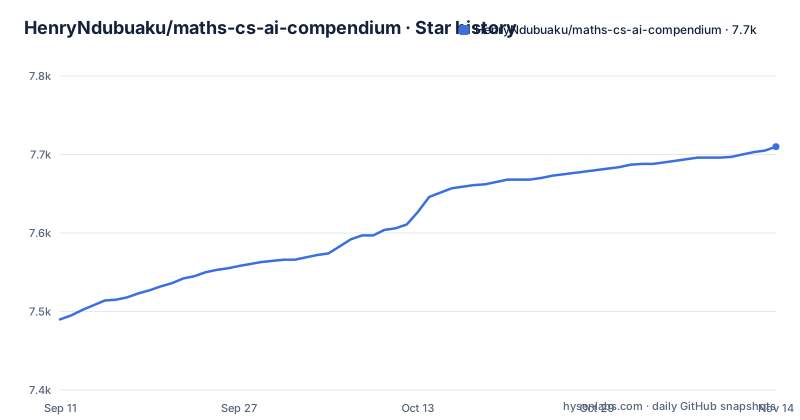
- HenryNdubuaku/maths-cs-ai-compendium7,710 ★ · +220
| Repository | 2026-09-11 | 2026-11-14 |
|---|---|---|
| HenryNdubuaku/maths-cs-ai-compendium | 7.5k | 7.7k |
220 Stars in the last 64 days, measured from the daily GitHub snapshot. Compare with other projects
Editorial analysis
The gap this compendium is trying to close
The README states the problem directly: most textbooks bury ideas under dense notation, skip intuition, assume prior knowledge, and age badly in fast-moving fields. The stated audience is curious practitioners who want to understand the material rather than pass an exam or an interview. Eighteen chapters are listed, from vectors and matrices through calculus, statistics and probability, then machine learning, computational linguistics, computer vision, audio and speech, multimodal learning, autonomous systems, graph neural networks, computing and OS, data structures and algorithms, production software engineering, SIMD and GPU programming, AI inference, and ML systems design. Every row in the outline table is marked Available. That breadth is the pitch: one repository instead of a shelf. The background section explains the origin, describing notebooks filled with intuition-first notes that friends used for interview preparation, and notes that the author got into Y Combinator. Those are the author's claims about his own notes, not verifiable outcomes for you as a reader, and they should be read as framing rather than evidence.
What the MCP server actually changes about reading it
The repository ships an MCP server, described as letting any AI assistant (Claude Code, Cursor, VS Code and similar) use the compendium as a knowledge base. Two constraints are stated plainly. It requires a local clone of the repo, so there is no hosted endpoint to point an assistant at. And it comes with tools for educational purposes plus example implementations. That second phrase is worth pausing on: the README's MCP section does not enumerate the tool names, their input schemas, or what the example implementations compute. If you are evaluating this for a team, the MCP surface is the least documented part of an otherwise well-outlined project. My read is that the server is a retrieval layer over the same Markdown you would read yourself, useful when you want an assistant to answer from the compendium instead of from its training data. It is not a tutoring system with graded exercises.
The TypeScript label and what it does not imply
The primary language is listed as TypeScript, which is easy to misread. The learning content is Markdown: the outline links to files such as chapter 01 - vectors/01. vector spaces.md and chapter 16 - SIMD and GPU programming/00. why C++ and how ML frameworks work.md. Chapter 16 covers C++ for ML, CUDA, Triton, TPUs, RISC-V, Vulkan and WebGPU. So TypeScript most plausibly describes the tooling around the content, the reader site and the MCP server, not the subject matter. If you arrived hoping for a pip-installable package that implements the algorithms, the repository layout does not offer one. The homepage field is empty, but the README gives a read-online link at henryndubuaku.github.io/maths-cs-ai-compendium, which is the practical entry point if you want to skim before cloning. Chapter folders are numbered with a space and a hyphen, and the outline links percent-encode the spaces and the plus signs in C++, which matters if you script anything against these paths.
Getting it running locally
The README gives one concrete instruction for the MCP server: it requires a local clone of the repo. The standard form of that is git clone https://github.com/HenryNdubuaku/maths-cs-ai-compendium, after which you register the server with your assistant of choice. Treat the exact registration snippet, the command to start the server, and the config keys for Claude Code, Cursor or VS Code as the first things to check in the repository once cloned rather than something you can copy from this article. The repository has no published GitHub releases. Pin a Git commit for a reproducible checkout and review the changes before updating, which is a real cost if you have quoted the text or built notes on top of chapter numbering. The Apache-2.0 licence is permissive and includes an explicit patent grant, which is the usual reason projects pick it over MIT. That is a factual difference in the licence text, not legal advice, and if you plan to redistribute the content inside a commercial product you should read the licence and the NOTICE requirements yourself.
Where eighteen chapters becomes the weakness
Scope is the selling point and also the main risk. A single author covering discrete maths, operating systems, concurrency, CUDA, quantisation, feature stores and A/B testing will inevitably be stronger in some chapters than others, and the README offers no per-chapter depth signals beyond a one-line summary and an Available marker. The outline gives no page counts, no prerequisites per chapter, and no indication of how the chapters relate to each other. Chapter 06 moves from classical ML to gradient methods to deep learning to reinforcement learning to distributed training in one file group, which is a lot of ground for a single chapter. If your goal is to learn CUDA properly, a chapter inside a general compendium is a starting orientation, not a substitute for the vendor documentation and the profiler. The honest use case is a map: read the chapter to learn the vocabulary and the shape of the field, then go to specialised sources for depth. Anyone treating this as a complete curriculum for GPU programming or systems design is likely to be disappointed by the density.
How it compares with a maintained book or a course
The obvious alternative is a published textbook plus a structured course, for example a standard linear algebra text paired with a university lecture series. The difference in approach is maintenance and review. A published book goes through editing and technical review, has a fixed edition you can cite, and does not change under you mid-semester. This compendium is a living repository: the last push was on 2026-07-18, chapters can be edited at any time, and there is no edition number. The compensating advantage is that it can cover fast-moving material such as text diffusion, mixture-of-experts, state space models and speculative decoding without waiting for a print cycle, and it can link the maths chapter directly to the systems chapter. A second alternative is a curated course with graded assignments and a cohort. That gives you feedback and deadlines, which a Markdown tree does not. The compendium gives you breadth and a single consistent voice across maths, systems and applications, which is genuinely hard to find in one place. Pick based on whether you need accountability or coverage.
Maintenance, versioning and what to verify first
The repository has no published GitHub releases, so versioning is effectively commit-based. For an individual reader that is fine. For a team building internal onboarding material on top of specific chapters, it means your references can drift without notice, and the fix is to record the commit hash you read rather than the branch name. The Apache-2.0 licence permits reuse and modification with attribution and notice retention, so quoting chapters in internal docs is straightforward; confirm the licence terms if you intend to republish large sections. Before adopting, verify three things: that the chapter files exist at the paths in the outline table, that the MCP server starts and exposes the tools you expect, and that the chapters you care about are at the depth you need rather than an orientation. The first two are checkable in an afternoon. The third requires reading the chapter, and no summary in the README substitutes for that.
Editorial conclusion
Adopt it if you want a single Markdown tree that runs from vector spaces through transformers to GPU programming and ML systems design, and you are willing to read rather than import. Skip it if you need versioned releases, a Python package, or a citable edition, because the repository publishes none of those. Before committing, open the chapter folders you actually care about and confirm the files listed in the outline exist at the paths given, then clone locally if you want the MCP server, since it requires a local checkout.
Frequently asked questions
What type of math is used in AI?
The compendium's first five chapters are the mathematical ones: vector spaces with norms and metrics, matrix properties with linear transformations and decompositions, calculus including multivariate calculus and gradient descent, statistics including sampling and hypothesis testing, and probability including distributions, Bayesian methods and information theory. Later chapters then build on them, with a separate chapter on discrete mathematics inside the computing and operating systems chapter.
What is the Maths, CS & AI Compendium?
It is a free, open textbook covering mathematics, computing and artificial intelligence from the ground up, written as markdown chapters in the repository and published as a static site. It is aimed at practitioners who want to understand the material rather than pass an examination, and it carries an Apache 2.0 licence.
How do I read the compendium online?
A built site is published on the author's GitHub Pages address, linked from the top of the readme. The repository itself is the source, and each chapter lives in its own directory with a numbered markdown file, so you can also read it locally or clone it.
Can I use the compendium as an AI assistant knowledge base?
Yes, through the model context protocol server included in the repository, which works with assistants such as Claude Code, Cursor and Visual Studio Code. It requires a local clone rather than a hosted service, and it ships with tools for educational purposes and example implementations.
Official sources
Add this badge to your README
If you maintain this project, the badge below links readers to this analysis and shows its maintenance status from the daily GitHub snapshot. Paste the markdown into your README; add ?metric=license or ?metric=stars to the image URL for a different field.

[](https://hysenlabs.com/projects/henryndubuaku-maths-cs-ai-compendium)Star history chart for your README
[](https://hysenlabs.com/projects/henryndubuaku-maths-cs-ai-compendium)Was this useful?