A Korean Translation Workflow for the Modern JavaScript Tutorial
모던 JavaScript 튜토리얼(The Modern JavaScript Tutorial in Korean )
At a glance
- What is it?
- javascript-tutorial/ko.javascript.info is the Korean translation of the Modern JavaScript Tutorial, with structured source material, translation policies, linting guidance, and contribution rules. It suits Korean-speaking developers and contributors, but it is not a standalone JavaScript package.
- Who is it for?
- Adopt this repository when you want a Korean-maintained version of the Modern JavaScript Tutorial or want to contribute under its translation rules. Do not treat it as a JavaScript runtime, library, or packaged course without checking its hosting and source structure.
- Can I use it commercially?
- Check first. The repository uses a licence we do not classify automatically, so read its LICENSE file before any commercial use.
- Is it still maintained?
- Yes. The repository last received commits 6 days ago.
- What is it written in?
- Mainly HTML, according to GitHub's language statistics.
Answers come from the project's GitHub data, last synced on November 7, 2026, and from our analysis. They are not legal advice.
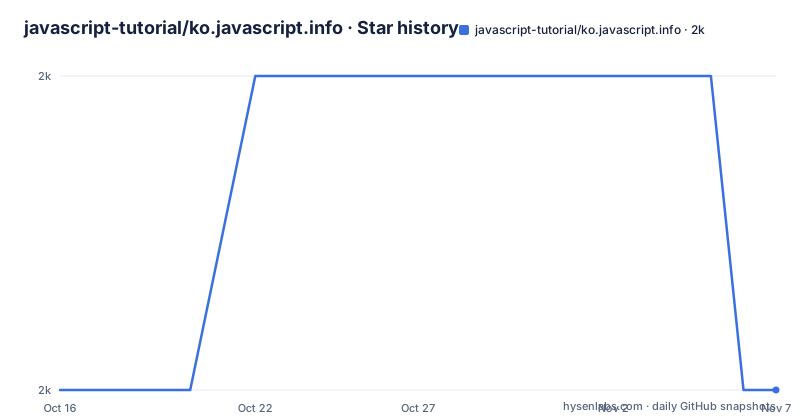
Star history
- javascript-tutorial/ko.javascript.info1,980 ★ · +0
| Repository | 2026-10-16 | 2026-11-07 |
|---|---|---|
| javascript-tutorial/ko.javascript.info | 2k | 2k |
0 Stars in the last 22 days, measured from the daily GitHub snapshot. Compare with other projects
Editorial analysis
What ko.javascript.info Contains and Who It Serves
This repository is a Korean translation project for the Modern JavaScript Tutorial at <https://javascript.info/>. Its stated goal is to give Korean-speaking developers access to high-quality web-development learning material in their native language. The project serves two related groups. Readers can use the Korean site as a structured JavaScript tutorial. Contributors can work on translating, correcting, and synchronizing the educational content with its English source.
The repository is organized as documentation rather than as a distributable software package. Its top-level entries include numbered directories such as `1-js/`, `2-ui/`, `3-frames-and-windows/`, `4-binary/`, `5-network/`, `6-data-storage/`, `7-animation/`, `8-web-components/`, and `9-regular-expressions/`. Other entries such as `images.yml`, `script/`, `changes.sketch`, and `figures.sketch` support the content and its assets. Based on the repository layout, this is a source repository containing tutorial chapters and supporting material, not a library with an importable API.
The README also points to the Korean website for reading, a translation-progress page at <https://javascript.info/translate>, and Discord channels for questions. It identifies the English tutorial project owner as Ilya Kantor and the Korean project owner as 이보라. There are no GitHub releases listed for this repository, so adoption decisions should focus on the website, repository contents, contribution documentation, and stated policies rather than release artifacts.
How the Translation Repository Preserves Source Alignment
The central design constraint is synchronization with the original tutorial. The contribution policy requires translated files to retain the original line breaks and paragraph structure. The README specifically says that a pull request will not be accepted when the number of lines differs from the original. This is unusual for prose documentation because line count normally has little value, but here it reduces merge conflicts when English source corrections are brought into the Korean version.
The policy also separates translatable natural language from formatting and code. Contributors must not change spaces, quotation marks, hyphens, backticks, or other special characters. In source code, the guidance is to avoid changing spaces and other formatting where possible, and to translate only natural-language comments. The repository treats code structure as shared material that must remain compatible with upstream updates.
Terminology is handled through a shared glossary. The README links to a terminology spreadsheet and says that new, unregistered terms should be added before translation. The newer `tech-translation-ko` skill packages translation examples, terminology rules, formatting rules, spelling conventions, and review checks into a reusable workflow. Its documented sequence is translation, structural and terminology linting with `check_translation.py`, self-review, and spelling checking. The repository states that line-count, special-character, and glossary violations can be checked automatically by the skill's linter.
This approach favors reproducibility over free-form rewriting. It also creates a meaningful contributor constraint: a technically acceptable translation can still be rejected if formatting, terminology, or spelling does not match the project rules.
Reading, Contributing, and the First Local Preview
The README contains no installation commands and does not describe the project as an npm package, CLI, or containerized application. Readers are directed to the hosted Korean tutorial at <https://ko.javascript.info/>. Contributors are directed to `CONTRIBUTING.md`, while the README links to a wiki page named `로컬 서버 세팅 방법` for setting up a local server.
The first practical step for a reader is therefore to open the hosted site and navigate the numbered content directories through the tutorial interface. The repository entries indicate that the site is organized by JavaScript and web-development topics. The translation-progress page is the place to check which language versions and translation percentages are reported, although the README does not state a completion threshold that readers should expect.
For a contributor, the documented first step is to read `CONTRIBUTING.md` and the project policy in the README. The policy asks contributors to use formal Korean, run the specified Korean spelling checker before opening a pull request, preserve source line structure, avoid changing special characters, and register new terms in the glossary. It also asks contributors to preview the local result using the linked wiki instructions before submitting a pull request. The README says the spelling checker should be run manually once per document and should not be placed in an automated pipeline.
No command or configuration snippet is provided for the local server. The wiki page is the source for that setup. The absence of a documented one-command installation is relevant for contributors who expect a conventional developer tool.
Maintenance Signals, Licensing, and Contribution Cost
The repository is not archived, and the recorded last push was on 2026-10-12. That is recent relative to the repository state, but it does not by itself guarantee that every translation section is current. The README states that English source corrections must be merged carefully because source alignment is part of the review policy. Contributors who work on chapters affected by upstream changes should therefore check both the Korean file and its English counterpart.
The repository uses `LICENSE.md` and is classified as having a custom license that GitHub cannot classify. The README does not state the exact permissions, redistribution conditions, or attribution requirements, so those terms cannot be summarized as permission to copy, modify, or redistribute the material. Anyone using the repository in a publication, commercial course, derivative edition, or mirrored service should read `LICENSE.md` directly. This is a licensing boundary, not legal advice.
The contribution process has a measurable editorial cost. Translation requires more than replacing English words with Korean equivalents. A contributor must preserve line counts, respect formatting characters, follow formal-language rules, check terminology, run spelling validation, preview the result, and respond to review. The recommended skill can automate selected structural checks and provide reference guidance, but the README still requires manual spelling checks. This makes the project suitable for contributors who can maintain both technical accuracy and source synchronization.
The Discord channels offer a route for questions, but the repository does not promise response times or formal support. The absence of GitHub releases means there is no documented release-based migration path. Upgrades are handled as source synchronization and contribution work rather than as versioned package upgrades.
Limitations and a Different Learning-Project Approach
The main limitation is that this repository is not an independent JavaScript curriculum. It is a translated representation of the content at javascript.info, and its contribution rules prioritize fidelity to that source. A learner who needs exercises, runnable projects, assessment, or a local development environment should not assume those features are present because the repository has numbered chapter directories and source-code examples.
A second limitation is that the README does not document a complete local development command, test suite, deployment procedure, or rollback process. It does link to a local-server wiki page, but the README does not reveal the server technology or its commands. The repository also has no listed GitHub releases. These omissions make it less suitable for teams that require a packaged artifact, a documented release channel, or a self-contained command-line workflow.
A real alternative is to use the original Modern JavaScript Tutorial directly at <https://javascript.info/> and use ko.javascript.info specifically as the Korean translation layer. The original site can provide the upstream reading path when a Korean translation is missing or needs comparison. Another practical alternative is a conventional JavaScript course or tutorial repository that treats each lesson as an independent exercise, rather than translating a synchronized upstream publication. The difference is editorial: ko.javascript.info prioritizes language parity and source-format preservation, while an exercise-driven course prioritizes self-contained learning activities.
Editorial conclusion
Adopt this repository when you want a Korean-maintained version of the Modern JavaScript Tutorial or want to contribute under its translation rules. Do not treat it as a JavaScript runtime, library, or packaged course without checking its hosting and source structure. Verify the current contribution workflow, custom LICENSE.md terms, local preview procedure, and the completeness of the relevant translated material before making changes.
Frequently asked questions
What is javascript-tutorial/ko.javascript.info?
It is the Korean translation repository for the Modern JavaScript Tutorial at javascript.info. The project provides Korean web-development learning material and a contribution workflow for translators.
How do I contribute a translation to ko.javascript.info?
The README directs contributors to `CONTRIBUTING.md` and requires compliance with project rules for formal Korean, spelling checks, line breaks, special characters, source code formatting, and glossary registration. It also recommends using the `tech-translation-ko` skill.
Does ko.javascript.info provide an npm package or CLI?
The README does not describe an npm package, CLI, installation command, or runnable JavaScript library. It presents the project as a tutorial translation repository with a hosted Korean site.
Official sources
Add this badge to your README
If you maintain this project, the badge below links readers to this analysis and shows its maintenance status from the daily GitHub snapshot. Paste the markdown into your README; add ?metric=license or ?metric=stars to the image URL for a different field.

[](https://hysenlabs.com/projects/javascript-tutorial-ko-javascript-info)Star history chart for your README
[](https://hysenlabs.com/projects/javascript-tutorial-ko-javascript-info)Was this useful?