KaWaIDeSuNe/xingjiabijichang: VPN Provider List and Client Guide
2026性价比机场推荐VPN、翻墙🚀推荐稳定性高,适合各类人需求的机场
At a glance
- What is it?
- This repository is a Chinese-language directory of commercial VPN subscription providers, with package comparisons, client compatibility notes, and links to separate network tests. It offers useful buying criteria, but it does not provide the proxy software, a subscription generator, or independently verified performance data.
- Who is it for?
- Readers who already understand VPN subscriptions and need a shortlist of Chinese-language provider listings may find the directory useful, while users who need auditable server details, transparent ownership, or software they can inspect should not treat it as sufficient evidence for adoption.
- Can I use it commercially?
- Not without permission. GitHub finds no licence file in the repository, and without a licence all rights are reserved by default: you may read the code but not reuse it. Check the README, or ask the authors, before using it.
- Is it still maintained?
- Yes. The repository received new commits within the last day.
- What is it written in?
- GitHub does not report a main language for this repository.
Answers come from the project's GitHub data, last synced on October 23, 2026, and from our analysis. They are not legal advice.
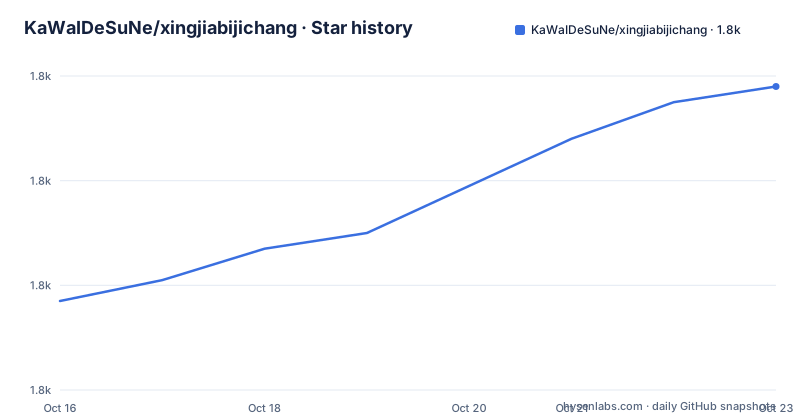
Star history
- KaWaIDeSuNe/xingjiabijichang1,838 ★ · +41
| Repository | 2026-10-16 | 2026-10-23 |
|---|---|---|
| KaWaIDeSuNe/xingjiabijichang | 1.8k | 1.8k |
41 Stars in the last 7 days, measured from the daily GitHub snapshot. Compare with other projects
Editorial analysis
What the xingjiabijichang Repository Actually Contains
KaWaIDeSuNe/xingjiabijichang is not a VPN client or a proxy server implementation. It is a recommendation list aimed at Chinese-speaking readers looking for subscription-based proxy providers. Its repository layout consists of `README.md`, `README_EN.md`, and a `测评` directory containing separate evaluation pages. The main README groups providers by advertised monthly price, included traffic, connection type, client compatibility, and intended users.
The distinction matters. A Clash, sing-box, or similar application can consume a subscription supplied by a provider, but this repository does not supply that application, generate a subscription, or operate the listed networks. The README says that the third-party clients are used with subscription links and directs macOS, Linux, and Windows users to `clash-verge-rev`, Android and HarmonyOS users to `ClashMetaForAndroid`, and iOS users to search for `clashmi`, `sing-box`, or `Shadowrocket`.
Several entries are presented with personal judgments. For example, the README describes 飛兔云 as a transit provider with more than 80 nodes, recommends it for China Unicom and China Mobile users, and does not recommend it for China Telecom users. It describes KTM Cloud as inexpensive for high-volume use but slower than the other transit providers. Those are the maintainer's assessments, not a substitute for testing on the buyer's own connection.
Provider Categories, Plans, and Selection Trade-offs
The most useful part of the README is its classification system. It separates dedicated routes from transit routes and combinations of both. The summary names 青云梯 and 龙猫云 as dedicated-line providers, EF Network and 飛兔云 as transit providers, and 极速云, 山水云, KTM Cloud, and WY Cloud as combinations of dedicated and transit connections. This classification is more meaningful than price alone because route design affects which access network and region may work for a particular subscriber.
The buying guide also separates monthly allowances into ordinary traffic, more than 1,000 GB per month, and less than 50 GB per month. KTM Cloud receives several high-volume entries, including 14 yuan per month for 2,048 GB, while a smaller 45 GB monthly plan is also listed. 飛兔云 and EF Network appear in several price bands. These figures describe what the README lists, not a guaranteed current offer, because service operators can change pricing, traffic rules, node inventories, or registration domains.
Client support creates another constraint. 飛兔云, 紅葉, and WY Cloud are marked as supporting both official and third-party clients. 青云梯, 龙猫云, and TNTCloud are marked as supporting official clients but not third-party clients. EF Network has the reverse classification. This matters because the repository's broader client guidance centers on third-party clients such as Clash, so those compatibility labels can determine whether its purchasing advice is applicable to the reader's intended setup.
The README also recommends keeping backups and buying monthly plans because it warns that any provider may cease operating. That warning undercuts any attempt to treat the list as permanent.
Client Setup and a First Subscription Check
There is no installation command for this repository because it is a recommendation directory, not distributable software. The README points Windows, macOS, and Linux readers to the `clash-verge-rev` release page. It points Android and HarmonyOS readers to the `ClashMetaForAndroid` release page. For iOS, it says to search the App Store for `clashmi`, `sing-box`, or `Shadowrocket`, while noting that `clashmi` and `sing-box` are preferred and that `Shadowrocket` has weaker support for newer protocols.
A cautious first use starts with one monthly plan from one provider. Select the provider's registration link from the README, confirm the displayed package, price, allowance, expiry, and renewal terms on the provider's own site, and obtain the subscription method offered after purchase. Then open the matching client and use its subscription interface. The README establishes that the listed clients work with subscription links, but it does not document the exact import menus, account steps, or configuration fields, so this article does not invent them.
After importing, the user still needs to select a node and confirm connection on the local network. The repository provides a status page that says it probes nodes every ten minutes, plus provider-specific analysis files under `测评`. Those resources are useful for orientation, but the README does not explain the probe geography, test method, client version, or whether results represent sustained throughput. The first practical check therefore has to happen from the user's own connection and region.
Monitoring Pages and Separate Test Files
The repository links to a hosted node-status page at `https://proxy.20261917.xyz/probe/` and describes it as an automatic check performed every ten minutes. Individual provider sections link to fragments for some services, including 飛兔云 and WY Cloud. The separate `测评` directory contains files named for several services, such as `飞兔云.md`, `红叶.md`, `青云梯.md`, `龙猫云.md`, `KTMCloud.md`, `WY Cloud.md`, and `TNTCloud.md`.
Based on the repository layout, this project combines editorial recommendations with a second tier of provider-specific analysis rather than producing a machine-readable package index or a unified client configuration. The README does not document an API for the probe results, retention periods, historical uptime calculations, or the infrastructure used to run probes. It also does not state whether status results include subscription-specific authentication or whether a healthy node necessarily performs well for a particular ISP.
That makes the monitoring links decision aids rather than proof of service quality. A status page can flag a broad outage and may present basic measurements, but its results should be considered alongside testing on the user's chosen entry route. The README's separate files may add context, yet the main document does not explain a repeatable methodology that readers could apply consistently to every provider.
Claims That Need Independent Verification
The README includes strong promotional claims, including BGP lines, IPLC private connections, streaming-service unlocking, native IP support, AI-service access, and strong evening performance. It also says that 紅葉 supports media unlocking, GPT, and 8K startup, while WY Cloud lists Netflix, Disney+, Hulu, HBO Max, and BBC iPlayer access. These statements describe what the directory reports, but no underlying test procedure or recurring independent verification policy is documented in the main README.
Some caveats appear directly in the text. The 紅葉 entry notes that the provider recently changed ownership. The 龙猫云 entry says customer-support responses are slow and reports that Jiangsu Mobile users may be unable to use it. The TNTCloud entry does not fill in its recommended-user category. Such omissions make the list useful for initial screening but uneven as a decision record.
The README also warns users about provider disappearance without identifying ownership, jurisdiction, logging policy, breach history, payment handling, or the relationship between the recommender and each registration link. Registration codes and affiliate-style query parameters appear throughout, but the README does not state whether commissions are received. That is not proof of improper conduct, yet it is relevant context when assessing editorial independence. Readers should treat prices and service claims as provider-controlled claims until checked on the provider's site.
Maintenance, Releases, and License Boundaries
The repository is not archived, and the last push was on 2026-10-16. However, the repository has no GitHub releases, so there is no versioned release history or documented compatibility policy for the listed clients and provider pages. The README describes the status checking as automatic, but that describes the hosted monitoring service rather than a guarantee of GitHub maintenance.
The repository metadata does not identify a license. Without a license, the default copyright rules generally restrict copying, modification, and redistribution of the repository's content. This is a licensing boundary rather than legal advice. In particular, the README images, written evaluations, and provider listings should not be assumed to be reusable merely because they are visible in a public GitHub repository.
For users, the practical upgrade cost falls into two parts. The client may require separate updates through its own project or app store, while provider subscriptions can change independently without any repository release. The README links to release pages for `clash-verge-rev` and `ClashMetaForAndroid`, but it does not specify supported versions, subscription format changes, or a rollback process. Neither the README nor the repository entry list documents rollback.
Where xingjiabijichang Differs from a VPN Client
A real alternative approach is to select and configure a client such as `clash-verge-rev` or `sing-box` directly, then use a subscription source chosen by the user. The difference is architectural. `KaWaIDeSuNe/xingjiabijichang` is editorial data: it groups external providers, displays stated package prices, and links to tests. A client is executable software that reads configuration and routes application traffic according to its rules.
Another alternative is a self-hosted proxy service, where an operator controls the server and client configuration rather than buying a short-term commercial subscription. The README does not document such a service, so this comparison is about adoption criteria, not a claim that the repository provides self-hosting. A self-hosted choice requires server administration and operational work that a hosted subscription avoids, while a hosted subscription introduces provider dependence that a self-operated server can reduce.
For a reader who wants immediate access to a curated Chinese-language list, the directory fills a practical information gap. For a reader who needs reproducible server details, auditable configuration, transparent provider ownership, or source code for the network implementation, the repository falls short because it contains none of those items.
Editorial conclusion
Readers who already understand VPN subscriptions and need a shortlist of Chinese-language provider listings may find the directory useful, while users who need auditable server details, transparent ownership, or software they can inspect should not treat it as sufficient evidence for adoption. Before paying, verify the provider's current package terms, subscription compatibility, privacy policy, client requirement, and the linked status page, then start with a monthly plan because the README itself warns that any provider can disappear.
Frequently asked questions
What is KaWaIDeSuNe/xingjiabijichang used for?
It is a Chinese-language directory of commercial VPN subscription providers. It compares listed plans, routes, node types, client support, and prices, then links to provider pages and separate test files.
Does KaWaIDeSuNe/xingjiabijichang include a VPN client?
No. The repository points users to separate clients such as `clash-verge-rev`, `ClashMetaForAndroid`, `clashmi`, `sing-box`, and `Shadowrocket`; it does not bundle the client software itself.
Which client does the xingjiabijichang README recommend for desktop systems?
The README links macOS, Linux, and Windows users to the `clash-verge-rev` releases page. It does not document the exact subscription-import procedure.
Official sources
Add this badge to your README
If you maintain this project, the badge below links readers to this analysis and shows its maintenance status from the daily GitHub snapshot. Paste the markdown into your README; add ?metric=license or ?metric=stars to the image URL for a different field.

[](https://hysenlabs.com/projects/kawaidesune-xingjiabijichang)Star history chart for your README
[](https://hysenlabs.com/projects/kawaidesune-xingjiabijichang)Was this useful?