BCEmbedding for bilingual and crosslingual RAG retrieval
Netease Youdao's open-source embedding and reranker models for RAG products.
At a glance
- What is it?
- BCEmbedding provides separate embedding and reranking models for RAG retrieval, with emphasis on Chinese and English crosslingual search. Its two-stage design suits teams that need more than a single embedding pass, although the documented commands are not included in the README excerpt.
- Who is it for?
- BCEmbedding is a reasonable candidate for developers building bilingual or crosslingual RAG systems, especially where a second-stage reranker and documented LangChain or LlamaIndex integrations matter. It is less suitable for users needing a fully reproduced first deployment from the README excerpt, because the install and quick-start commands are not shown there.
- Can I use it commercially?
- Yes. Apache-2.0 is a permissive licence: you can use, modify and sell software built on it, as long as you keep its copyright and licence notices.
- Is it still maintained?
- Yes. The repository last received commits 66 days ago.
- What is it written in?
- Mainly Python, according to GitHub's language statistics.
Answers come from the project's GitHub data, last synced on November 7, 2026, and from our analysis. They are not legal advice.
Star history
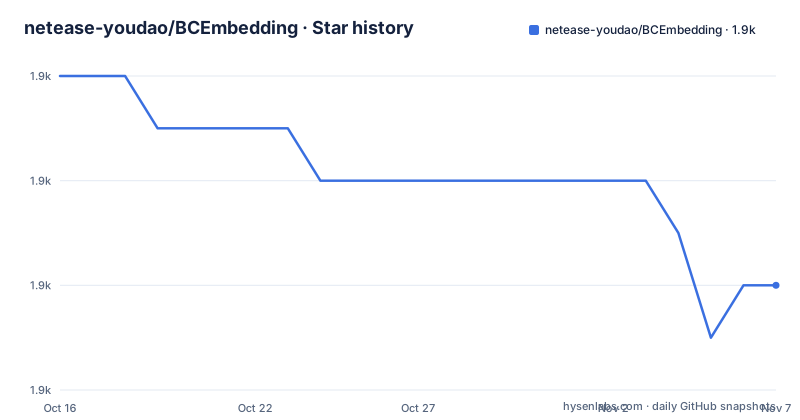
- netease-youdao/BCEmbedding1,878 ★ · -4
| Repository | 2026-10-16 | 2026-11-07 |
|---|---|---|
| netease-youdao/BCEmbedding | 1.9k | 1.9k |
-4 Stars in the last 22 days, measured from the daily GitHub snapshot. Compare with other projects
Editorial analysis
What BCEmbedding Adds to a RAG Retrieval Pipeline
BCEmbedding addresses the retrieval stage of retrieval augmented generation, where a system converts a user query into candidate documents before sending relevant material to a language model. The repository divides that work between two model types. `EmbeddingModel` produces semantic vectors for dense retrieval, while `RerankerModel` evaluates and reorders passages returned by the first stage. This split gives an application a way to retrieve broadly and then apply a more detailed relevance pass to the candidates.
The primary target is retrieval across Chinese and English. The README states that the embedding model supports Chinese and English, including bilingual and crosslingual retrieval, while the reranker supports Chinese, English, Japanese, and Korean. The project is aimed at developers working on RAG products and applications such as translation, summarization, question answering, education, medical information, law, finance, literature, FAQ systems, textbooks, Wikipedia content, and general conversation. These are application domains listed by the project, not guarantees that every model performs equally well in every domain.
Dual-Encoder Retrieval and Cross-Encoder Reranking
The documented architecture follows a common two-stage retrieval pattern. During the first stage, `EmbeddingModel` acts as a dual encoder and converts queries and documents into semantic vectors. A vector search can then locate candidates that are semantically related to the query, including matches across Chinese and English. The README specifically describes the embedding model as instruction-free, meaning callers do not need to provide a task-specific query instruction for each retrieval use.
The second stage uses `RerankerModel` as a cross encoder. Instead of relying only on the original query-document vector comparison, the reranker receives query and passage information for a more detailed relevance assessment. The project says that it produces a meaningful relevance score, which can help remove low-quality passages. That score is useful when an application needs to filter candidates before sending them to an LLM.
The trade-off is architectural. A dual encoder is intended to support efficient candidate retrieval, while a cross encoder adds computation in exchange for deeper ranking. The README does not document latency, throughput, batch limits, quantization, or exact hardware requirements, so those costs cannot be inferred from the repository description.
Model Language Coverage and RAG Boundaries
The language coverage differs by component, which matters when selecting a model for a multilingual application. `EmbeddingModel` is documented as supporting Chinese and English. `RerankerModel` covers Chinese, English, Japanese, and Korean. The README presents the bilingual and crosslingual behavior as a result of Youdao's translation engine work, but it does not publish model dimensions, maximum embedding lengths, training-data details, or per-language accuracy figures in the available text.
The project is therefore not a general multilingual embedding collection as presented here. A team building a Japanese or Korean retrieval system may find the reranker suitable while still needing to confirm whether the embedding model or the surrounding retrieval pipeline supports the same languages. The document also states that the reranker handles passages longer than 512 tokens and shorter than 32k tokens. That is a documented boundary, not a promise about every input configuration.
The repository lists QAnything, ragflow, HuixiangDou, ChatPDF, ChatLLM.cpp, Xinference, and MindNLP's BCEmbedding inference implementation as third-party examples or integrations. These references indicate intended usage contexts, but the README does not provide their configuration details or establish that all listed projects use the same models or versions.
BCEmbedding Installation and First-Use Constraints
The README table of contents includes sections named `Installation`, `Quick Start (transformers, sentence-transformers)`, and `Embedding and Reranker Integrations for RAG Frameworks (langchain, llama_index)`. However, the README excerpt stops before the commands and examples in those sections. It would be misleading to reconstruct a `pip install` command, model identifier, or Python invocation from the package metadata alone.
The repository's `setup.py` does confirm that the Python package is named `BCEmbedding`, uses version `0.1.5`, and declares dependencies on `torch>=1.6.0`, `transformers>=4.35.0,<4.37.0`, `datasets`, and `sentence-transformers`. That declaration is useful for dependency planning, but it is not itself a complete deployment guide. It does not state the model repository names, required checkpoint files, tokenizer behavior, Python version, or hardware configuration.
A first real use therefore needs to begin with the README's installation section. The README states that `transformers` and `sentence-transformers` are supported for the quick start, and that LangChain and LlamaIndex integrations are provided through BCEmbedding APIs. Those documented boundaries should be checked before choosing a checkpoint or writing application code, particularly the differing language support and the reranker's token range.
Why the Reranker Is a Separate Retrieval Stage
An embedding-only pipeline can already perform semantic retrieval, so the separate reranker is not automatically necessary for every application. The case for including it is that first-stage vector retrieval prioritizes candidate discovery, while reranking can apply a closer comparison between the query and each candidate. BCEmbedding's documentation positions the reranker as a precision-oriented second stage and specifically highlights its relevance score.
This design is useful when the initial search returns too many loosely related passages, or when an application wants to remove low-quality material before an LLM sees it. It also creates an operational decision point. Teams must decide how many candidates to retrieve, what score threshold to use, how long each passage can be, and whether reranking latency is acceptable for interactive requests. The README does not prescribe those values.
The project also describes a hosted `Youdao's BCEmbedding API` in its table of contents. That is an alternative deployment route to self-managing the open-source models, but the README does not document its endpoints, pricing, authentication, or whether its behavior is identical to a local checkpoint. Those details require separate verification.
Single-Stage Embedding Search as the Main Alternative
The closest architectural alternative is a conventional single-stage embedding retriever that embeds the query, searches a vector index, and sends the ranked results onward without a cross-encoder pass. This approach has a simpler pipeline and fewer model-dependent decisions. It avoids the second-stage scoring step, which may matter when request latency, infrastructure cost, or model hosting complexity is the main concern.
BCEmbedding's two-stage approach is different because it uses a reranker to inspect the query and candidate passages more closely after vector retrieval. That extra stage is intended to improve result quality, especially where semantic relevance is subtle or candidates have similar embeddings. The project also documents relevance scores as a filtering signal. A single-stage system can provide ranked results too, but it does not have BCEmbedding's documented reranker or its stated support for long-passage reranking.
The choice depends on the retrieval problem. For broad semantic search where approximate ranking is acceptable, the simpler route may be easier to operate. For a RAG application in which low-quality passages have a direct effect on generated answers, BCEmbedding makes reranking an explicit, inspectable component.
Maintenance, Licensing, and Upgrade Boundaries
The repository is not archived. Its last push was on 2026-09-03, but it has no GitHub releases, so there is no release history to use as an upgrade guide. The package metadata currently declares version `0.1.5` and pins `transformers` to a narrow range, `>=4.35.0,<4.37.0`. That constraint may make installation more reproducible, but it also means dependency upgrades require checking compatibility rather than simply allowing a newer Transformers release.
The repository identifies Apache-2.0 as its license in both the repository badge and `setup.py`. That states the licensing basis shown for the source, but users still need to review model weights, datasets, and any third-party components separately when they apply Apache-2.0 to a deployment. No legal interpretation is required to note that the repository metadata and model distribution terms are different review points.
The lack of releases also affects operational planning. There is no documented release cadence, compatibility matrix, migration guide, or rollback procedure in the README. A production adopter should record the package version, Transformers range, model checkpoint, and framework adapter version used in its deployment.
Editorial conclusion
BCEmbedding is a reasonable candidate for developers building bilingual or crosslingual RAG systems, especially where a second-stage reranker and documented LangChain or LlamaIndex integrations matter. It is less suitable for users needing a fully reproduced first deployment from the README excerpt, because the install and quick-start commands are not shown there. Before adoption, verify the exact model files, dependency compatibility, hardware requirements, and whether the reranker's supported token range fits the application's documents.
Frequently asked questions
What is BCEmbedding used for?
BCEmbedding provides embedding and reranking models for retrieval in RAG applications. The README positions it for semantic search, question answering, translation, summarization, and crosslingual retrieval.
Which languages does BCEmbedding support?
The README states that `EmbeddingModel` supports Chinese and English. It states that `RerankerModel` supports Chinese, English, Japanese, and Korean.
How do I install and use BCEmbedding?
The README links to installation and quick-start sections for `transformers`, `sentence-transformers`, LangChain, and LlamaIndex, but the excerpt does not include their commands or examples. `setup.py` declares version `0.1.5` and dependencies on `torch>=1.6.0`, `transformers>=4.35.0,<4.37.0`, `datasets`, and `sentence-transformers`.
Official sources
Add this badge to your README
If you maintain this project, the badge below links readers to this analysis and shows its maintenance status from the daily GitHub snapshot. Paste the markdown into your README; add ?metric=license or ?metric=stars to the image URL for a different field.

[](https://hysenlabs.com/projects/netease-youdao-bcembedding)Star history chart for your README
[](https://hysenlabs.com/projects/netease-youdao-bcembedding)Was this useful?