OpenGithubs/github-monthly-rank: A Monthly Record of GitHub Growth
Github开源项目:每月📈飙升榜 top30,每月1号早上8点更新
At a glance
- What is it?
- OpenGithubs/github-monthly-rank publishes a top 30 ranking of GitHub projects by monthly star growth. It helps developers find projects that attracted attention during a defined month, but it does not assess code quality or production suitability.
- Who is it for?
- Use this repository when you want a dated monthly signal for finding GitHub projects that attracted attention. Do not use it as proof that a project is mature, secure, maintained, or suitable for adoption.
- Can I use it commercially?
- Not without permission. GitHub finds no licence file in the repository, and without a licence all rights are reserved by default: you may read the code but not reuse it. Check the README, or ask the authors, before using it.
- Is it still maintained?
- Yes. The repository last received commits 7 days ago.
- What is it written in?
- GitHub does not report a main language for this repository.
Answers come from the project's GitHub data, last synced on November 7, 2026, and from our analysis. They are not legal advice.
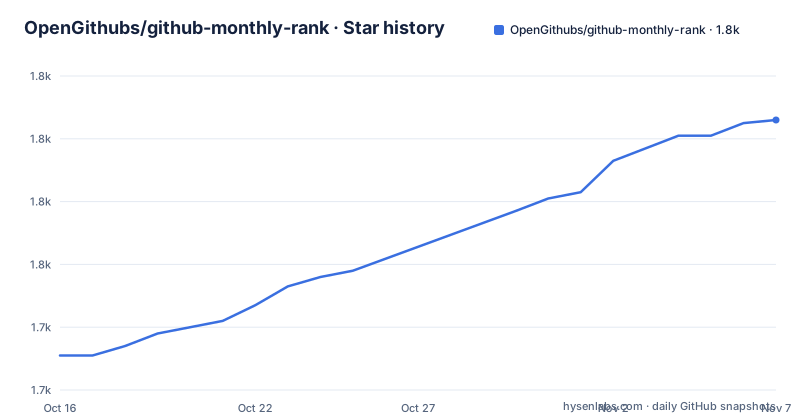
Star history
- OpenGithubs/github-monthly-rank1,806 ★ · +75
| Repository | 2026-10-16 | 2026-11-07 |
|---|---|---|
| OpenGithubs/github-monthly-rank | 1.7k | 1.8k |
75 Stars in the last 22 days, measured from the daily GitHub snapshot. Compare with other projects
Editorial analysis
What github-monthly-rank Tracks
OpenGithubs/github-monthly-rank solves a discovery problem rather than a software engineering problem. GitHub contains many repositories, while this project narrows attention to a defined monthly set and orders it by reported star growth. The repository description identifies it as a monthly rising-project list, with a top 30 and an update time of 8 a.m. on the first day of each month. The README presents the ranking as the "本月最佳开源项目", or best open source projects of the month, while the table gives the more concrete measure: total stars and growth during the stated period.
The likely users are developers, maintainers, engineering managers, and open source readers who want a compact way to find newly noticed repositories. In the September 2026 snapshot, the listed period was 2026.09.01-2026.09.30 and the first entry was tt-a1i/archify, followed by projects related to coding agents, decision systems, code review, security audits, desktop agents, and developer utilities. Each entry includes a project link, an opening date, total stars, a monthly growth figure, and a short description.
This is useful as an attention feed, but the distinction matters. Star growth measures visible repository interest, not code quality, production suitability, security, licensing compatibility, or whether the project solves a real problem. A repository can receive many stars quickly, while a technically important project with a narrower audience may appear much lower in the ranking.
The Monthly Ranking Mechanism
The repository layout is primarily archival. Its top-level entries include directories for 2024, 2025, and 2026, alongside README.md. That structure indicates that monthly results are organized by year rather than exposed as an application with a visible runtime or API. The repository description states that the ranking is updated monthly, and the displayed page carries a date range for each ranking period.
The visible data flow is simple. The maintainers collect GitHub projects, associate each with an opening date and description, record total stars and monthly star growth, then publish the results in a table. The table ranks entries numerically from 1 to 30. For example, the September 2026 table lists archify with 74.1k total stars and 40043 monthly growth. It lists cloudflare/security-audit-skill with 23.1k total stars and 16211 monthly growth.
Those figures are presented as ranking data, but the README does not document the collection script, GitHub API calls, calculation rules, handling of deleted repositories, or validation method for descriptions. The result is a readable report with a historical record, not a documented analytics engine. Because the calculation process is not explained, comparisons between months should be treated as editorial comparisons unless the repository later adds methodology.
Where to Start With the Rankings
There are no installation instructions in the README for this repository. It is a list, so there is no documented package to install and no command for generating a new ranking. The repository points readers to GitHub and presents monthly results through README.md and the year-based entries.
For a first use, browse the 2026 directory and read the current monthly table in README.md. The listed links open the underlying GitHub projects. Start with the project name, opening date, description, total stars, and monthly growth figure. Then inspect the candidate repository itself for installation instructions, supported platforms, dependency requirements, and documentation. The rank page should be treated as a discovery pointer, not as a substitute for those checks.
The README also links to DiscoverHub, the OpenGithub community, Github周刊, Github月刊, and daily, weekly, and monthly subscription lists. Those links provide related channels maintained by the same publisher. They are not installation instructions and should not be interpreted as evidence that the ranking repository exposes a separate service.
Reading Growth Without Mistaking It for Quality
The monthly growth column is the ranking's central signal, but its interpretation needs restraint. A high growth figure can indicate discovery through social posts, an active launch, an attractive description, or interest in a particular subject. It does not tell the reader whether the project has tests, release discipline, issue responses, a clear license, or a safe default configuration.
The September 2026 results illustrate the range of descriptions included in the list. archify is described as an agent skill for architecture and workflow diagrams, while ayghri/i-have-adhd is described as a skill for more concise coding-agent output. The list also includes alibaba/open-code-review, described as a hybrid deterministic-pipeline and LLM-Agent code review tool, and cloudflare/security-audit-skill, described as a coding-agent skill for multi-phase security audits. These descriptions identify subject categories, but they do not replace the underlying project's documentation or source inspection.
The ranking is also sensitive to timing. A project opened shortly before the end of the month can appear with a large monthly increase, as shown by NandhaKishorM/laya, whose listed opening date is 2026-09-21 and whose reported monthly growth is 24592. That does not establish a monthly performance rate against older projects. Readers should compare opening dates and period lengths before drawing conclusions about sustained growth.
Limits of the Discovery Signal
The largest limitation is missing methodology. The README does not explain how star totals are obtained, when the monthly snapshot is taken, whether numbers are rounded in the table, or what happens when a repository is renamed, transferred, deleted, or changes ownership. The displayed table mixes values such as 74.1k with exact growth figures such as 40043. That is convenient for presentation, but it does not show the precision of every field or whether the totals and growth values came from the same observation time.
The repository is not a tool for evaluating source code. A security-audit project appearing in the ranking does not mean the security audit performed by that project is valid, and a code-review project appearing in the ranking does not mean its checks are complete. Those conclusions require reviewing the candidate's implementation and documentation.
The list is limited to GitHub projects. It does not represent package registries, commercial products, private repositories, or projects hosted elsewhere. It also focuses on star growth, which can underrepresent projects whose value is internal, specialized, multilingual, or newly published. For these reasons, the ranking works best as a first-pass filter, not as the final decision.
Alternative Discovery Methods for GitHub Projects
A real alternative is to use GitHub's own repository discovery and project pages, then inspect each candidate directly. That approach does not produce the same monthly growth table, but it keeps the evaluation closer to a repository's current description, topics, documentation, and activity. It is useful when the reader wants current project information rather than a publisher's dated ranking.
Another alternative is to use the README's related Github周刊 and Github月刊 subscriptions. They are editorial discovery channels associated with the OpenGithub organization, but the README does not state whether they use the same ranking data or methodology. They should be treated as separate editorial sources rather than assumed to be identical rankings.
The practical difference is scope. github-monthly-rank provides a constrained monthly comparison based on star growth, with a fixed top 30 and historical year directories. Direct GitHub inspection provides more current project context but requires the reader to define filters and perform comparisons manually. Neither method establishes technical quality on its own.
Maintenance, License, and Upgrade Boundaries
The repository is not archived. The repository is updated with dated rankings; check its activity page for the latest update. However, the repository has no GitHub releases, and the README does not document a versioning policy, compatibility promise, or release process. Monthly ranking maintenance should be understood as repository content maintenance, not as a released software package with upgrade paths.
The license is not identified in the repository information presented by the README. The page contains links to many underlying open source projects, but it does not state the license of the ranking repository itself or grant permissions for redistribution of the data. Readers who need to reuse the list should check the repository's license files and each linked project's separate license before copying descriptions or other content.
The default branch is main, and the repository uses year-based top-level entries. The README does not document a command for rebuilding the list, so there is no documented upgrade command to run. For a current assessment, the ranking page should be compared with the linked repository's own README and repository state.
Editorial conclusion
Use this repository when you want a dated monthly signal for finding GitHub projects that attracted attention. Do not use it as proof that a project is mature, secure, maintained, or suitable for adoption. Check the selected project's repository, license, release history, documentation, and current maintenance state first.
Frequently asked questions
What is OpenGithubs/github-monthly-rank?
It is a GitHub discovery repository that publishes a monthly top 30 ranking of open source projects by reported star growth. The repository also organizes results by year.
How often is the github-monthly-rank list updated?
The repository description says the list is updated on the first day of each month at 8 a.m. Its README changes as new rankings are published; check the date range on the current list or browse the year directories for past months.
Does github-monthly-rank explain how monthly star growth is calculated?
No. The README displays total stars and monthly growth figures, but it does not document the collection script, snapshot process, API usage, or calculation rules.
Does the repository provide installation commands for github-monthly-rank?
No. The README contains no installation or package setup commands. It presents monthly results and links to the underlying GitHub projects for further inspection.
Can I use the ranking to decide whether a GitHub project is production-ready?
The ranking does not support that conclusion. It reports star growth and does not evaluate tests, security, licensing, documentation, releases, or production suitability.
Official sources
Add this badge to your README
If you maintain this project, the badge below links readers to this analysis and shows its maintenance status from the daily GitHub snapshot. Paste the markdown into your README; add ?metric=license or ?metric=stars to the image URL for a different field.

[](https://hysenlabs.com/projects/opengithubs-github-monthly-rank)Star history chart for your README
[](https://hysenlabs.com/projects/opengithubs-github-monthly-rank)Was this useful?