HunyuanVideo: the December 2024 text-to-video release, not the 1.5 model
HunyuanVideo: A Systematic Framework For Large Video Generation Model
At a glance
- What is it?
- Tencent's HunyuanVideo repository holds PyTorch model definitions, pre-trained weights and sampling code for one text-to-video model, with exact dependency pins and separate sibling repositories for every capability released since. Reading it as the current HunyuanVideo is the main mistake.
- Who is it for?
- Adopt it if you specifically need the original text-to-video weights and are willing to match an exact dependency set and a script driven checkout rather than an installed package. Do not adopt it expecting image to video, avatar animation, or the HunyuanVideo-1.5 behavior, since each of those lives in its own repository.
- Can I use it commercially?
- Check first. The repository uses a licence we do not classify automatically, so read its LICENSE file before any commercial use.
- Is it still maintained?
- Yes. The repository last received commits 38 days ago.
- What is it written in?
- Mainly Python, according to GitHub's language statistics.
Answers come from the project's GitHub data, last synced on November 15, 2026, and from our analysis. They are not legal advice.
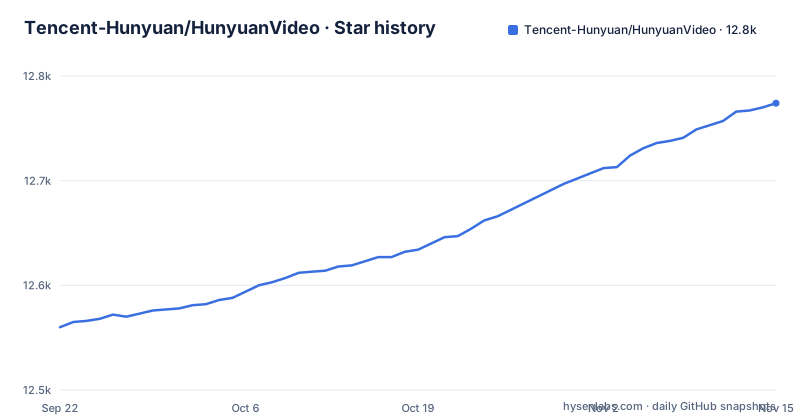
Star history
- Tencent-Hunyuan/HunyuanVideo12,774 ★ · +214
| Repository | 2026-09-22 | 2026-11-15 |
|---|---|---|
| Tencent-Hunyuan/HunyuanVideo | 12.6k | 12.8k |
214 Stars in the last 54 days, measured from the daily GitHub snapshot. Compare with other projects
Editorial analysis
Every capability newer than December 2024 lives in a different repository
This tree is the text-to-video release and the news list makes the rest of the family explicit. The December 3, 2024 entry is the one that ships inference code and model weights here. Everything after it points elsewhere: Mar 06, 2025 sends image-to-video to HunyuanVideo-I2V, May 09, 2025 sends multimodal-driven customized generation to HunyuanCustom, May 28, 2025 sends audio-driven human animation to HunyuanVideo-Avatar, and Nov 21, 2025 announces HunyuanVideo-1.5 as a separate foundation model with its own repository. The last push to this branch is dated 2026-10-08, so the files are still being touched. The consequence for a reader is that a request for image conditioning, an avatar, or 1.5 behavior does not resolve here, and moving to it means a second codebase with its own pins and its own checkpoint set.
requirements.txt uses exact equality pins, so there is no compatible range to fall back on
The dependency set is a decision, not a suggestion. requirements.txt pins fifteen packages with equality signs, which means a mismatched environment is not resolved by the installer choosing a newer compatible build: torch==2.7.1 and diffusers==0.31.0 sit beside transformers==4.46.3, tokenizers==0.20.3, accelerate==1.1.1 and numpy==1.24.4. The video path is visible in the same file through opencv-python==4.9.0.80, imageio==2.34.0, imageio-ffmpeg==0.5.1 and safetensors==0.4.3 for weight loading, with einops==0.7.0 for shape work, pandas==2.0.3, tqdm==4.66.2 and loguru==0.7.2. gradio==5.0.0 confirms the web demo is expected to run in this environment. The consequence is that on a machine already holding a different torch build, this file has to be edited before anything imports, and those edits become your divergence from what the maintainers tested.
No GPU requirement is stated anywhere, so hardware limits get answered by forks
The README's table of contents includes a Requirements section, which is the place to check for card and memory figures; the news entries also touch the problem. The Dec 18, 2024 entry releases FP8 model weights explicitly to save GPU memory, and the Dec 7, 2024 entry ships parallel inference code powered by xDiT for faster inference on more GPUs. Past that boundary every efficiency measure belongs to someone else. The community section points to HunyuanVideoGP labelled GPU Poor version, HunyuanVideo-gguf for a GGUF version and quantization, TeaCache and NaviCache for cache-based acceleration, Jenga for training-free efficiency, and FramePack, which packs input frame context into next-frame prediction models. The consequence is that a reader with one consumer card ends up selecting among forks, each with its own compatibility surface.
Cost, quota and content policy belong to hosted pages this repository cannot speak for
Three hosted surfaces are linked from the header and none of them is described here: the project page at aivideo.hunyuan.tencent.com, the generation site at video.hunyuan.tencent.com, and a Replicate endpoint. Weights sit on Hugging Face at tencent/HunyuanVideo, the prompt rewrite model sits separately at tencent/HunyuanVideo-PromptRewrite, and the Diffusers pipeline documentation is linked as an integration route. What the repository itself carries is no price, no quota, no free tier statement, no watermark policy and no content restriction for the hosted generator. The consequence is direct: questions about what the service costs and about what it will refuse to generate cannot be answered from this code, because both are properties of a hosted site whose terms you have to read where they are actually published.
The root is a script tree you run from a checkout, not an installable package
Top level holds hyvideo/ for model definitions, scripts/ for entry points, utils/ for helpers, sample_video.py as a single worked example, gradio_server.py for the demo, tests/, assets/, ckpts/ for weight placement, requirements.txt, and two readmes, README.md plus README_zh.md. That listing contains no packaging entry, so the intended consumption is running code from a clone with the exact pins satisfied, not pip installing a distribution and importing it. Two supported routes sit outside that tree: the Diffusers pipeline, integrated on Dec 17, 2024, and native ComfyUI support, listed in the plan alongside inference, checkpoints, multi-gpu sequence parallel inference, the Gradio web demo, FP8 quantified weight and the benchmark. The consequence for you is that upgrades mean editing pins and file layout by hand.
License detection resolves nothing, so the terms live in two files at the root
No recognized license identifier is attached to this repository, which means the terms are not summarized anywhere a reader would look first. They are in LICENSE.txt and in a separate Notice file, both at the root. That sits awkwardly next to the news section, where every line is a dated link a reader can follow in one click. The consequence is that the single question you cannot answer by skimming is the one that decides whether you may ship generated output, fine-tune on the weights, or redistribute them, so those two files need opening before any of that work starts. A second gap sits beside it: the repository has no GitHub releases, so a weight download carries no version tag identifying which model generation it came from, and the download instructions are on a separate ckpts page linked from the December 3, 2024 entry.
Eight ticked boxes for one model, and a benchmark CSV as the only comparison artifact
The open-source plan tracks eight deliverables for the text-to-video model, all ticked: inference, checkpoints, multi-gpus sequence parallel inference described as faster inference speed on more gpus, a Gradio web demo, Diffusers, FP8 quantified weight, the Penguin Video Benchmark, and ComfyUI. The image-to-video entry immediately below it has exactly two items, inference and checkpoints, which is an honest signal of how much of that sibling model this tree covers. Beyond the README's Comparisons section, the Penguin Video Benchmark is a CSV released on Jan 13, 2025 in the assets folder. The consequence for a reader is that the checklist proves a piece exists without saying which model generation it belongs to, so with five model families now spread across five repositories, identifying what a given checkpoint actually is remains manual work.
Editorial conclusion
Adopt it if you specifically need the original text-to-video weights and are willing to match an exact dependency set and a script driven checkout rather than an installed package. Do not adopt it expecting image to video, avatar animation, or the HunyuanVideo-1.5 behavior, since each of those lives in its own repository. Before you build anything on it, read LICENSE.txt and the Notice at the root for the terms, confirm your GPU fits the pinned torch 2.7.1 stack, and check the ckpts page for which model generation a download corresponds to.
Frequently asked questions
What is HunyuanVideo?
It is described as a systematic framework for a large video generation model, and this repository holds the PyTorch model definitions, pre-trained weights and inference and sampling code. The architecture breaks down into a unified image and video generative architecture, an MLLM text encoder, a 3D VAE and a prompt rewrite step.
How do I install HunyuanVideo?
The repository ships requirements.txt with fifteen exact pins, including torch==2.7.1, diffusers==0.31.0, transformers==4.46.3 and numpy==1.24.4, rather than a range you can relax. Weights are handled separately, with download instructions on the ckpts page linked from the December 3, 2024 release entry.
How do I use HunyuanVideo locally?
The root holds sample_video.py, gradio_server.py, scripts/ and utils/ so you drive the model from a checkout with the pinned environment satisfied. The open-source plan also records a Gradio web demo and native ComfyUI support as shipped, and the README's table of contents lists a Requirements section to check before planning hardware.
Is Hunyuan video free?
The repository does not say. No recognized license identifier is attached to it, so the terms are in LICENSE.txt and a Notice file at the root, and the hosted sites it links, such as aivideo.hunyuan.tencent.com, are not described by this code.
Is HunyuanVideo censored?
The repository documents no content policy of any kind for the hosted services it links. Any filtering or restriction would be a property of the running site rather than of this code, so it has to be checked where the service is published.
Official sources
Where this project is recommended
Add this badge to your README
If you maintain this project, the badge below links readers to this analysis and shows its maintenance status from the daily GitHub snapshot. Paste the markdown into your README; add ?metric=license or ?metric=stars to the image URL for a different field.

[](https://hysenlabs.com/projects/tencent-hunyuan-hunyuanvideo)Star history chart for your README
[](https://hysenlabs.com/projects/tencent-hunyuan-hunyuanvideo)Was this useful?