useful-java-links: a Java libraries list that ranks nothing
A list of useful Java frameworks, libraries, software and hello worlds examples
At a glance
- What is it?
- Useful Java links is a fork of awesome-java that files Java projects under eight numbered areas and annotates every entry with a licence link and a star figure. It is a hand edited map of the ecosystem, and the repository was last pushed on 2026-05-08.
- Who is it for?
- Useful Java links earns a bookmark as a map, not as a shortlist. Read it to see which Java projects its author thought worth keeping, then confirm version numbers, licence terms and build status on each project's own repository before adopting one.
- Can I use it commercially?
- Check first. The repository uses a licence we do not classify automatically, so read its LICENSE file before any commercial use.
- Is it still maintained?
- Activity is slowing. The repository last received commits 6 months ago.
- What is it written in?
- Mainly Java, according to GitHub's language statistics.
Answers come from the project's GitHub data, last synced on November 15, 2026, and from our analysis. They are not legal advice.
Star history
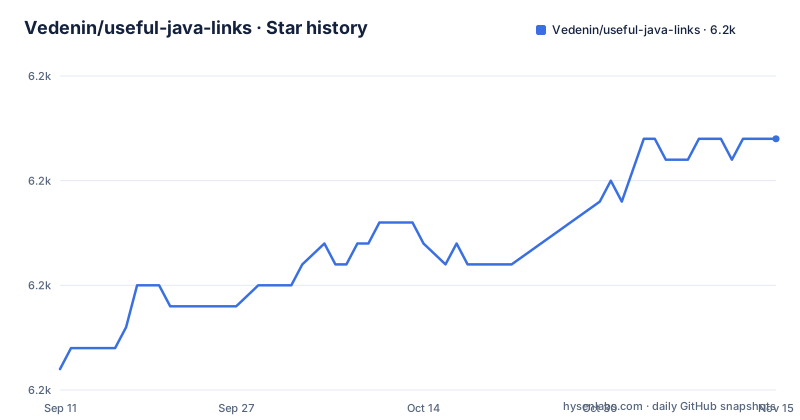
- Vedenin/useful-java-links6,212 ★ · +11
| Repository | 2026-09-11 | 2026-11-15 |
|---|---|---|
| Vedenin/useful-java-links | 6.2k | 6.2k |
11 Stars in the last 65 days, measured from the daily GitHub snapshot. Compare with other projects
Editorial analysis
Eight numbered areas in one markdown file, with no build step
Useful Java links is a single markdown document, not a program. There is nothing to compile, no dependency file, and no release to download: the repository publishes no GitHub releases, its default branch is master, and what a reader gets is the text of readme.md plus a handful of sibling directories.
The document organises its entries under eight roman numbered headings. I. Development holds common frameworks and libraries, web development, GUI, business, game development, useful libraries, imagery and video, code generation, distributed applications, science and OSGI. II moves to databases, search engines, big data and machine learning. III is network and integration, IV testing, V tools for developing, VI languages and applications written with Java, VII other, VIII resources.
That taxonomy is the entire mechanism. There is no index, no filter and no query layer, so finding a library means scrolling a table of contents of roughly eighty anchors or reading the file in an editor that can jump between headings.
The 390 star cutoff is the admission rule
The fork's admission rule is numeric. New links were added for all non-mobile GitHub projects with 390 or more stars, and every entry records GitHub's star figure beside the link.
Entries are annotated rather than bare. Each one carries a description, a link to the project's repository and a Licence field pointing at a licence text, for example License: Apache 2 on both the Spring framework row and the Google Guava row. Some rows carry more: the Spring entry cites a Stack Overflow tag with more than 100 000 questions. Apache Commons is described as an Apache project focused on all aspects of reusable Java components.
The readme states that this is a fork of akullpp/awesome-java with a new structure, added licence information and the star data, and that a Russian version lives in the link-rus/ directory.
Cloning the fork and opening readme.md by hand
There is no installation step because there is nothing to install. The project points at its own repository on GitHub, on the master branch, and a clone is the whole setup:
git clone https://github.com/Vedenin/useful-java-links.git
cd useful-java-links
What lands in the working directory is this layout, and it is short enough to read in one pass:
.gitignore
article.md
contributing.md
hello world
helloooo world
helloworlds/
img/
license.md
link-rus/
readme.md
A first real pass is to open readme.md, jump to the heading that matches your problem, then follow that row's link to the project itself. Three entries sit at the top of I. Development under 1. Common frameworks and libraries: Spring framework, Google Guava and Apache Commons. The Guava row records what it covers (collections, caching, primitives support, concurrency libraries, common annotations, string processing, I/O) and its floor of JDK 1.6 or higher as of 12.0, the kind of detail that saves a lookup.
Perfomance tools and Geospatial Service Interation leave anchors that miss
The table of contents is hand written and hand maintained, and it has drifted. V. Tools for developing carries 3. Perfomance tools with a vowel missing. III carries 17. Geospatial Service Interation and 10. Integratin with API, both missing a letter, and 1. Servers (Web Server and Application Server)) closes with two parentheses. The JSON entry is written as [8. Json](#8--json), an anchor holding a stray double hyphen.
Each anchor repeats the misspelling of its link text, so these are typos in the contents rather than evidence of broken links.
No file in the top level layout looks like a script that would catch this.
A licence link on every entry, and NOASSERTION on the repository
Licence information is one of the fork's stated additions, and it shows up per entry. The Spring framework row and the Google Guava row both carry License: Apache 2 with a link to the licence text, while the Apache Commons row links to commons.apache.org rather than to a GitHub repository.
The repository tells a different story. A license.md file sits at the top level, yet the repository's own licence is reported as NOASSERTION. A reader who wants to know what they may do with the collected list has no machine readable answer and has to open that file by hand.
This is not legal advice, and the per entry links describe the listed projects, not the list. The distinction matters when you copy a row into your own notes: the Apache 2 tag beside Guava is Guava's licence, and it says nothing about the rights in the page you copied it from.
The push on 2026-05-08 froze the star column
The repository's last push was 2026-05-08, and it is not archived.
That is the limit that reading harder will not fix. There is no test, no CI configuration and no release history in the repository: a correction lands when an editor makes it by hand.
A contributing.md file exists at the top level; read it before proposing an entry.
Three paths to a hello world, and no source in the list
Hello world examples sit outside the catalogue. The top level holds a directory named hello world, another named helloooo world, and a helloworlds/ directory, which the readme names as the project's Hello Worlds examples.
Three names for one idea is duplication; the readme's opening links only to helloworlds/. A newcomer cannot tell from the documentation whether hello world and helloooo world are samples, older copies or scratch space.
The same gap runs through the catalogue. Nothing here can tell you whether a listed library still compiles, still builds on your JDK, or still deserves the count printed beside it. For a list whose entries all live elsewhere, that is the boundary worth knowing before you bookmark it.
Editorial conclusion
Useful Java links earns a bookmark as a map, not as a shortlist. Read it to see which Java projects its author thought worth keeping, then confirm version numbers, licence terms and build status on each project's own repository before adopting one. Anyone who needs current version data or a filtered catalogue should open the linked projects directly and leave this fork out of their tooling.
Frequently asked questions
What are the top 10 Java libraries in Vedenin's useful-java-links?
The list does not rank anything. Its first category, Common frameworks and libraries, opens with Spring framework, Google Guava and Apache Commons, and every other entry is filed under eight numbered areas rather than ordered by importance.
How do you say "hi" in Java, and where do those examples live in useful-java-links?
The hello world samples sit outside the catalogue, in top level entries named hello world, helloooo world and helloworlds/, and the readme points readers at helloworlds/ as the Hello Worlds examples project.
Does useful-java-links still reflect the Java ecosystem?
Not continuously. The last push was 2026-05-08, the repository is not archived, and it has no GitHub releases, so the list has not been edited since that date.
Official sources
Add this badge to your README
If you maintain this project, the badge below links readers to this analysis and shows its maintenance status from the daily GitHub snapshot. Paste the markdown into your README; add ?metric=license or ?metric=stars to the image URL for a different field.

[](https://hysenlabs.com/projects/vedenin-useful-java-links)Star history chart for your README
[](https://hysenlabs.com/projects/vedenin-useful-java-links)Was this useful?