The FDE Book Is Thirteen Markdown Files, and the PDF Is Only a Snapshot
A zero-to-hero guide to Forward Deployed Engineering (FDE), based on the framework of Fan Bing's book Growth Hacker.
At a glance
- What is it?
- A free Chinese-language book on the forward deployed engineer role, written as a research synthesis with its own source appendix, published under a licence that permits reading and requires the author's written permission for commercial reuse.
- Who is it for?
- This book is worth your time if you are an engineer considering a delivery-embedded role, a founder selling into enterprises, or a Chinese-speaking reader who wants a single account of what the role is and who is doing it, since the six-stage delivery journey and the case index give you a map rather than a slogan.
- Can I use it commercially?
- Not without permission. GitHub finds no licence file in the repository, and without a licence all rights are reserved by default: you may read the code but not reuse it. Check the README, or ask the authors, before using it.
- Is it still maintained?
- Yes. The repository last received commits 13 days ago.
- What is it written in?
- GitHub does not report a main language for this repository.
Answers come from the project's GitHub data, last synced on November 15, 2026, and from our analysis. They are not legal advice.
Star history
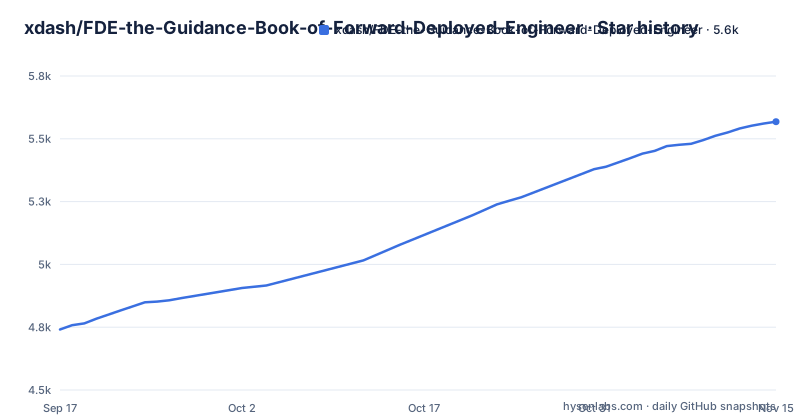
- xdash/FDE-the-Guidance-Book-of-Forward-Deployed-Engineer5,568 ★ · +827
| Repository | 2026-09-17 | 2026-11-15 |
|---|---|---|
| xdash/FDE-the-Guidance-Book-of-Forward-Deployed-Engineer | 4.7k | 5.6k |
827 Stars in the last 59 days, measured from the daily GitHub snapshot. Compare with other projects
Editorial analysis
Thirteen chapter files, and the PDF loses to the Markdown
The repository is the book in Markdown, one file per chapter, with a merged PDF beside it for convenience:
00-自序.md
08-第8章-完整案例集.md
12-附录C-全书案例索引与资料出处.md
前线部署工程师(FDE)v1.0.26.pdf
VERSION
The full set runs from a preface through eight chapters, a postscript on professional ethics, and three appendices covering the metrics an FDE should watch, a list of FDE people and teams, and an index of every case in the book with its source. That structure is the whole navigation system, since there is no build step and no site generator in the repository. One instruction in the README settles which copy wins: the PDF is the merged version at the root, and where they disagree the chapter Markdown is authoritative. The practical consequence is that a reader who downloads the PDF on one day and the repository on the next may be reading different drafts, and the version is recorded separately in a VERSION file, so that is the file to check when you want to know which text you are looking at.
Two numbers carry the argument, and one of them comes from a report
The book opens on a single figure that the author says flooded their feed in the summer of 2025: ninety-five percent. The source is named as a 2025 report from the NANDA laboratory at the Massachusetts Institute of Technology called The GenAI Divide, which the README summarises as saying that global enterprises spent tens of billions of dollars on generative AI over three years and that ninety-five percent of projects produced no value that could be written into a financial statement. Set against that, the README describes job postings for the forward deployed engineer role on Silicon Valley recruiting sites rising more than sevenfold in a year, with OpenAI, Anthropic and more than a hundred Y Combinator companies hiring. The conclusion the author draws from putting the two side by side is that models are no longer scarce and the people who can put a model into a customer's real business are. Both figures are reported rather than measured here, and Appendix C is where the sourcing lives, which is the right place to look before repeating either number as settled.
The method is documentary research, and the author says so
The book's provenance is explained rather than implied. The author previously wrote a book on growth hacking and describes doing the same thing again: taking something happening in Silicon Valley that has no name in China, researching it systematically, and explaining it honestly. The source list is specific. Early Palantir executives' podcast retrospectives, former employees' memoirs, venture capital industry analysis, the original text of the MIT report, dozens of job postings from different companies, compensation reports, practitioners' complaints on forums, and experience talks from the first people doing this in China. Read that list as a strength and a limit at once. It is a wide documentary base. It also means the content is second-hand, and the author's own framing is that the book was first written as study notes, with the test being whether the subject could be explained well enough that someone else could read it.
The delivery journey is six stages, and renewal is one of them
The middle section is organised as one continuous journey rather than as a list of skills. The stages named in the README are, in order: finding the right problem, winning the customer, activating the deployment, holding the renewal, expanding revenue, and scaling replication. Each of those has a chapter file, so the ordering is also the reading order. Two features of that sequence are worth noticing. The stage about renewal sits in the middle rather than at the end, which puts the retention of an existing account at the same weight as winning the first one. That framing is the part most likely to differ from what a sales engineer or a consultant expects, since the README itself notes that much of the domestic discussion is still stuck on whether this role is a renamed presales job.
165 named cases, indexed in the appendix where sources are recorded
The third thing the book sets out to do is show who is doing the work, and it claims one hundred and sixty-five real, checkable cases spanning Palantir, OpenAI and Anthropic through Harvey and Sierra, plus the first practitioners in China. Chapter eight is the complete case collection, and Appendix C is the index of cases together with their sources. The author states that every figure and case in the book has its source marked there, and invites corrections through an issue if something is wrong. That is an unusually strong claim for a free book and it is also the most testable part of it, because an appendix of sources can be checked against the claims it supports. The honest reading is that this is where the book's value concentrates if you care about facts rather than narrative: the argument in chapter one is arguable, but the list of who does this work, and where each claim came from, is something you can audit.
The licence opens reading and closes commerce
The copyright statement at the end of the README is specific and worth reading before you plan anything around the text. Copyright belongs to the author, and the repository content is published with the author's authorisation for free reading and non-commercial sharing, with the requirement that reposts note the source and the author. Then the restriction: any commercial use, listed as including publishing, training, and adapting the content into something you charge for, requires obtaining the author's written permission in advance. Read as a practitioner, the practical effect is narrow and clear. You can read it, link to it, share chapters with attribution, and quote it. You cannot turn it into a course, an internal training programme, or a derivative book without asking, and training is named in the list. For a book whose stated purpose includes helping engineers see the role clearly, that boundary sits on exactly the use most companies would want, so plan around email rather than assuming.
The website is the primary edition and holds more than the repository
Reading is offered three ways, and they are not equivalent. The official site at fde4.ai is described as synchronised with the repository in real time, better on a phone, and faster to reach inside mainland China. Reading online through GitHub means clicking the table of contents and reading a chapter file at a time. Downloading gets you the merged PDF, which is the one the README already flagged as secondary. The site is also where content lives that the repository does not: alongside the book it maintains a case library, an ecosystem map and a directory that are updated continuously outside the book. That is the structural difference between the two editions. The repository is versioned prose with a source appendix and a version file, so you can cite it and see its history. The site is a moving collection that includes pages with no commit behind them. If you are going to quote this work in something that needs to be checkable later, take the chapter files and the appendix, and treat the site as the place to check for updates.
Editorial conclusion
This book is worth your time if you are an engineer considering a delivery-embedded role, a founder selling into enterprises, or a Chinese-speaking reader who wants a single account of what the role is and who is doing it, since the six-stage delivery journey and the case index give you a map rather than a slogan. It is not a substitute for first-hand experience, because the author's stated method is documentary research rather than practice, and it is not usable as a training course without asking. Before you rely on it, check three things: whether the two headline figures it opens with hold up in Appendix C, which the README says is where every case and source is recorded, whether the cases named are relevant to the market you work in, since they span Palantir, OpenAI, Anthropic, Harvey and Sierra alongside the first practitioners in China, and what you intend to do with it, since free reading and non-commercial sharing are permitted and anything commercial needs the author's written permission.
Frequently asked questions
What is the definition of a forward deployed engineer (FDE)?
This repository is a book about the role rather than software for it. It describes FDE as a role that grew out of Palantir's intelligence projects, explains how it is defined and why it expanded in the AI era, and organises the work as a delivery journey: find the right problem, win the customer, activate the deployment, hold the renewal, expand revenue, and scale replication.
What does FDE stand for and what does it mean?
Forward Deployed Engineer, written 前线部署工程师. The book's framing is that models are no longer scarce while the people who can put a model into a customer's real business are scarce, and that this is the scarcity behind the role's rise. The repository holds the free full text of the book, chapter by chapter, under an agreement allowing free reading and non-commercial sharing.
How to prepare for a FDE interview?
The README's outline of the book does not mention interview preparation. It covers the role's definition and origin, the six-stage delivery journey, one hundred and sixty-five checkable cases from companies including Palantir, OpenAI, Anthropic, Harvey and Sierra plus early practitioners in China, an appendix of metrics an FDE should track, and an appendix listing FDE people and teams.
How much do FDEs get paid?
No pay figure appears in the repository's front matter. The author lists compensation reports among the source documents used while researching the book, and states that every case and data point in the book has its source recorded in Appendix C, the index of cases and sources, so compensation detail would be documented there rather than in the README.
Official sources
Add this badge to your README
If you maintain this project, the badge below links readers to this analysis and shows its maintenance status from the daily GitHub snapshot. Paste the markdown into your README; add ?metric=license or ?metric=stars to the image URL for a different field.

[](https://hysenlabs.com/projects/xdash-fde-the-guidance-book-of-forward-deployed-engineer)Star history chart for your README
[](https://hysenlabs.com/projects/xdash-fde-the-guidance-book-of-forward-deployed-engineer)Was this useful?