yao-open-prompts: 118 prompt files, three maintenance scripts, and a release scheme never used
Practical bilingual AI prompt library for prompt engineering, work, learning, content, marketing, and everyday use.
At a glance
- What is it?
- A bilingual Chinese and English prompt library where the substance is Markdown files with a fixed frontmatter contract, organised by scenario and mirrored path for path into an English copy. Its category counts add up exactly to the file count it claims, its licence field says nothing while the README names two licences, and the date-based release scheme it proposes has never produced a release.
- Who is it for?
- Treat this as a reference collection rather than a package, and read a prompt file before copying from it, since the quality of an individual prompt is not something the repository structure can promise you. Two things to check.
- Can I use it commercially?
- Check first. The repository uses a licence we do not classify automatically, so read its LICENSE file before any commercial use.
- Is it still maintained?
- Yes. The repository last received commits 38 days ago.
- What is it written in?
- Mainly Python, according to GitHub's language statistics.
Answers come from the project's GitHub data, last synced on November 15, 2026, and from our analysis. They are not legal advice.
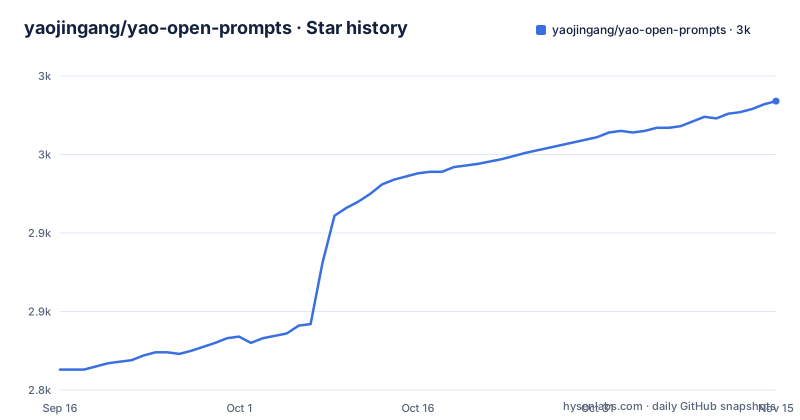
Star history
- yaojingang/yao-open-prompts2,984 ★ · +171
| Repository | 2026-09-16 | 2026-11-15 |
|---|---|---|
| yaojingang/yao-open-prompts | 2.8k | 3k |
171 Stars in the last 60 days, measured from the daily GitHub snapshot. Compare with other projects
Editorial analysis
The category counts add up to exactly the number of files claimed
The README says the repository holds 118 Chinese prompt files, and the category table beneath it lists nine categories with a count against each: eight for AI methods, ten for work, eleven for learning, two for daily life, four for education, fifty for content, one for programming, twenty nine for marketing and three for thinking. Those nine numbers add up to 118 exactly. That is worth stating plainly because a table like this usually drifts from the thing it counts, and here it does not. The distribution is also lopsided in a way that describes the collection's centre of gravity: half the library is content work, a further twenty nine entries are marketing, and the programming category holds a single entry. The English side claims the same total, mirrored path for path.
The release scheme is documented and has never been used
The maintenance section specifies a release process in detail. It suggests date-based versions with a year, month and sequence number, gives a concrete example format, and says every release should go through a checklist kept in the maintenance directory. It also names a changelog file as the place to record changes when a prompt is revised. The repository has no releases at all. So the versioning scheme, the checklist and the changelog convention all describe a process that has never produced a tag, and the only way to tell what changed between two points is to read the changelog or diff the files. That is a defensible choice for a collection with no consumers to break, and it means nobody should script against a version here.
The licence field says nothing while the README describes two licences
The repository's licence metadata is empty, meaning nothing could be determined automatically. The README takes a different route and describes a split: one licence for the prompt content, and a second, more permissive one reserved for scripts or tooling code if any is added later. A licence file does exist at the root of the tree. So there are three statements in play and they do not line up: no recorded value, a prose description of a split arrangement with the second half phrased conditionally, and a file whose relationship to that split is not stated anywhere. Given that the tree already contains a scripts directory, the conditional half of that description has already been overtaken by the layout.
Three Python scripts are the only executable part of the repository
Almost everything here is Markdown. The runnable surface is three commands, all invoked the same way, and each maps to one stage of the publishing pipeline:
python3 scripts/check_repo.py
python3 scripts/generate_catalog.py
python3 scripts/generate_webpage.py
The first is the quality check, run against the repository. The second regenerates the catalogue, which is the full index of prompts that readers navigate by. The third rebuilds the web pages, which is what feeds the project site published from a pages address. The dependency rule around them is consistent: add a prompt to the right category directory, revise a prompt by raising its version field in place and recording the change, and if you move something between categories then update its classification fields and regenerate the catalogue afterwards. The scripts are described in the structure section as directory generation and repository quality check scripts.
Every prompt file carries the same nine-field frontmatter contract
There is a fixed metadata block at the top of each prompt file, and it is spelled out in full:
title: 提示词标题
category: 一级分类
subcategory: 子类
source_section: 原合集章节号
author: 作者或来源
version: 提示词版本
created: 创建日期
status: active | draft | third-party-review
tags: 标签列表
Two fields carry more weight than the rest. The status field is a three-value enum, and one of those values exists specifically for material the project has not cleared: prompts held for review are marked as third party rather than published. The source section field records which section of the original compiled document a prompt came from, which means the collection is traceable back to a source rather than being free-standing. The author field accepts an author or a source, which is a looser contract than the field name suggests. A template file exists so new prompts start with the same block.
A prompt file body is allowed three sections and nothing else
The rule for the body of a file is stated as a restriction rather than a suggestion. It keeps only three parts: a title, a short introduction, and the prompt itself. Anything that needs a worked example, an evaluation screenshot, a tutorial link or a long explanation is supposed to go into the references directory or a later case directory instead, specifically so that it does not get mixed into text a reader is going to copy. The stated reason is that the prompt text has to stay copyable, which is a good discipline and also explains why the repository looks the way it does: a large references directory for recommended resources, third party content and an index of external projects, sitting beside the prompt bodies rather than inside them.
Third-party material is quarantined out of the main prompt library
The sourcing policy is the part of the README with the most legal weight, and it is explicit. Content that is obviously third party or republished is not merged directly into the main prompt library. It goes into the references directory first, or it is marked with the third party review status, and it is published only after authorisation has been confirmed. That gives the collection two tiers with different provenance, and the status enum is the machine-readable half of that rule. It also explains the shape of the references directory, which is described as holding recommended resources, third party content and an index of external projects. The stated approach to keeping the library navigable is also visible in practice: series material is preferentially merged into themed collections rather than left as many short individual prompts.
Editorial conclusion
Treat this as a reference collection rather than a package, and read a prompt file before copying from it, since the quality of an individual prompt is not something the repository structure can promise you. Two things to check. The licence is not settled by the metadata, which records nothing, while the README describes one licence for prompt content and another, conditionally, for scripts, and there is a licence file in the tree whose relationship to that split is not explained. And the versioning scheme described in the maintenance section has never been used, so there is no tagged version to pin to and updates are tracked in a changelog file instead.
Frequently asked questions
What is yaojingang/yao-open-prompts?
It is a bilingual Chinese and English AI prompt library covering prompt engineering, work, learning, content, marketing and daily life scenarios. The Chinese side holds 118 prompt files arranged by scenario, and the English prompts mirror the same paths in a parallel directory.
How many prompts are in yao-open-prompts?
118 Chinese prompt files. The category table lists nine categories whose counts sum to exactly 118, and the English side claims the same number with the prompts mirrored at identical paths.
How do I use a prompt from yao-open-prompts?
Find it in the catalogue by scenario, open the Markdown file, copy the prompt region, replace the double-brace variables, the bracketed placeholders or any example content with your own task information, then test the output in your target model and record the iteration.
What licence is yao-open-prompts under?
The repository's licence metadata records nothing. The README describes one licence for the prompt content and a second, more permissive one for scripts or tooling code if such code is added later, and a licence file exists at the root of the tree. The three are not reconciled in the documentation.
Does yao-open-prompts have any released versions?
No. The repository has no releases. The maintenance section proposes a date-based version format and a release checklist, but no tag has ever been published, so changes are tracked through the changelog file instead.
Official sources
Add this badge to your README
If you maintain this project, the badge below links readers to this analysis and shows its maintenance status from the daily GitHub snapshot. Paste the markdown into your README; add ?metric=license or ?metric=stars to the image URL for a different field.

[](https://hysenlabs.com/projects/yaojingang-yao-open-prompts)Star history chart for your README
[](https://hysenlabs.com/projects/yaojingang-yao-open-prompts)Was this useful?