Markdown-Resume-Template: a plain Markdown resume skeleton
大厂程序员自己的简历模板免费分享出来了 。技术简历追求简单明了,避免没有必要的花哨修饰,大家可以fork到自己仓库中,基于这个模板进行修改。
At a glance
- What is it?
- The Markdown-Resume-Template repository is a single README file holding a Chinese-language technical resume skeleton, with sections for personal details, employment and education, skills, projects, awards, personal accounts and a closing note, meant to be forked and edited. It suits a Chinese-speaking software engineer who wants a plain-text resume they can version in Git, and it deliberately carries no styling.
- Who is it for?
- Adopt Markdown-Resume-Template if you want a Markdown resume you can keep in a Git repository, and you read Chinese, since the section headings and the example content are in that language. Skip it if you need a styled PDF or a document format, because the repository contains only a README and an image, so you supply the rendering.
- Can I use it commercially?
- Not without permission. GitHub finds no licence file in the repository, and without a licence all rights are reserved by default: you may read the code but not reuse it. Check the README, or ask the authors, before using it.
- Is it still maintained?
- Yes. The repository last received commits 61 days ago.
- What is it written in?
- GitHub does not report a main language for this repository.
Answers come from the project's GitHub data, last synced on November 7, 2026, and from our analysis. They are not legal advice.
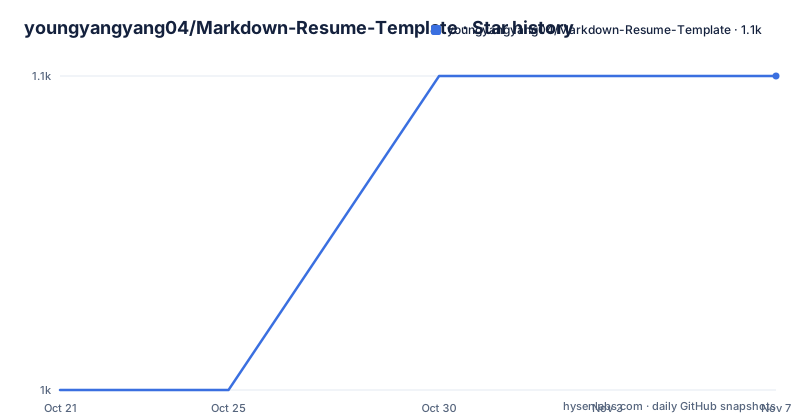
Star history
- youngyangyang04/Markdown-Resume-Template1,050 ★ · +1
| Repository | 2026-10-21 | 2026-11-07 |
|---|---|---|
| youngyangyang04/Markdown-Resume-Template | 1k | 1.1k |
1 Stars in the last 17 days, measured from the daily GitHub snapshot. Compare with other projects
Editorial analysis
A README that is the product
The repository contains two files and nothing else, a README.md and an image. There is no template engine, no build step, no stylesheet and no theme. The README is the resume, and that is a deliberate design rather than an unfinished project. The description says the template is shared for free by a developer from a large company, and that a technical resume should pursue simplicity and clarity and avoid unnecessary decoration. The intended use is stated as forking it into your own repository and editing it. The primary language is recorded as unknown, the license is unknown, the last push was on 2026-09-08, and the repository has no GitHub releases, so the artifact you get is the current state of that one file. For anyone who has seen the many LaTeX and Typst resume repositories, the appeal here is that it is the opposite of those.
The section order, and why it is that order
The document opens with a centred title, then moves through a fixed sequence. The personal information section carries gender, age, mobile number, email, major and target position. Then work and education history, listing a previous employer with dates and a business group and department, followed by universities with degree and level. Then professional skills, then project experience, then awards, then personal accounts, then other information, and it closes with a summary and a section of AI resources. The order is a reading order a technical interviewer will follow, and the detail in the work history entry is the template, a business group name and a department name, which tells the reader that a resume should show organizational context rather than just a job title. Every line in the template is an example to replace, and the placeholders are deliberately shaped like real content so you can see the expected density.
What the project and awards sections ask you to show
The project experience section is the part that carries the most guidance. Each entry is numbered and follows a fixed four-part pattern, the organization and school, the project, the role, and the date range, for example a company or school, a web server project, independently developed, from 201508 to 201512. Under each one there are four bullet points, what the specific functionality was, which technologies were used and where the technical difficulty lay, and what the result was, with a demo address and a GitHub address. That is a compact answer to the three questions an interviewer asks about a project, and the template asks you to answer all three every time. The awards section is shorter, with placeholders for outstanding new employee, student society cadre and a competition prize, and the personal accounts section asks for a blog address with the technical articles written, and a GitHub address with the standout projects.
The skills section, and its deliberate brevity
The professional skills section is three bullets, and they show the intended register. The first is a sentence about languages, stating fluency in C++ and Go and familiarity with Java, Python and PHP. The second is a line about knowing the basic principles of data structures and algorithms. The third is a placeholder, and so on. The example sets the level of specificity, which is low, and that is the point of the surrounding advice about avoiding unnecessary decoration. A skills list that enumerates every technology you have touched is noise, and the template's restraint is itself a piece of advice. The other two sections follow the same pattern, with other information asking for things like a liking for digging into technology and an outgoing personality, and the closing summary carrying the argument that a good resume is a door-opener but should not consume too much of your energy, since a good resume and interview technique are the finishing touches and the offer really depends on real ability.
The online builder, and the free export
The document includes a section on making a resume online, pointing at a Chinese-language web tool for building resumes, with a screenshot of it in the repository and a note that you can export once for free with no watermark. So the template and the tool are two routes to the same result, one being a plain Markdown file you edit by hand and the other being a form-driven builder. The presence of the tool is what makes the template feel less austere, since the obstacle to a Markdown resume is usually not the writing but the rendering, and a builder that outputs a document is the missing half. The repository also carries a final section pointing at another of the author's repositories for ChatGPT and Claude subscription top-up guides, which tells you this account publishes practical material for working developers rather than a curated collection.
What the format costs and what it buys
The trade of a Markdown-only resume is worth naming. You get a file you can diff, review and track across job applications, which is worth a great deal to someone who sends twenty versions of the same document, and you get plain text that any tool can read, from a Markdown renderer to a PDF converter to a web page. You give up the typographic control that a LaTeX template offers, and you take on the job of rendering it yourself, which is a small chore with Pandoc and a large one if you want a designed PDF. The repository gives you no guidance on rendering because that is deliberately outside its scope, and the linked builder is the hint for people who want the output without the tooling. Given that the README itself argues for simplicity over decoration, a resume that is a Markdown file is the consistent choice rather than a limited one.
Editorial conclusion
Adopt Markdown-Resume-Template if you want a Markdown resume you can keep in a Git repository, and you read Chinese, since the section headings and the example content are in that language. Skip it if you need a styled PDF or a document format, because the repository contains only a README and an image, so you supply the rendering. Before you fork it, note that the license is not stated in the repository metadata, so check with the author rather than assuming, and note the repository's own advice at the end, that a good resume is a door-opener but the interview skill and the real ability are what get the offer.
Frequently asked questions
What is the Markdown-Resume-Template repository?
A single README file holding a Chinese-language technical resume skeleton, with sections for personal information, work and education history, professional skills, project experience, awards, personal accounts, other information, a summary and AI resources. It is meant to be forked and edited.
What should each project entry in the Markdown-Resume-Template contain?
The organization or school, the project, your role and the date range, followed by three bullets covering the specific functionality, which technologies were used and where the technical difficulty lay, and the result, with a demo address and a GitHub address.
Can I use the Markdown-Resume-Template in English?
The section headings and the example content are in Chinese, so you would translate them as part of editing your fork. The structure and the guidance carry over, since they are about what to include rather than the wording.
Is there a tool for making a resume with the Markdown-Resume-Template?
The README points at a Chinese-language online resume builder, and notes you can export once for free without a watermark. The repository includes a screenshot of the tool alongside the template.
Official sources
Add this badge to your README
If you maintain this project, the badge below links readers to this analysis and shows its maintenance status from the daily GitHub snapshot. Paste the markdown into your README; add ?metric=license or ?metric=stars to the image URL for a different field.

[](https://hysenlabs.com/projects/youngyangyang04-markdown-resume-template)Star history chart for your README
[](https://hysenlabs.com/projects/youngyangyang04-markdown-resume-template)Was this useful?