Eighteen chapter PDFs, one of them linked twice
Foundations of Medical Large Language Model Learning
At a glance
- What is it?
- An open Chinese textbook on medical large language models, published as eighteen PDFs in five parts rather than as Markdown. The contents table has a link that points at the wrong file, five part headings that all point at a different repository, four different filename conventions across the chapter set, and a stray macOS metadata file committed at the root.
- Who is it for?
- This book suits a reader who wants medical large language models covered in one Chinese volume, from the history of the field through to hallucinations and bias, and who is comfortable with PDFs rather than a searchable web text. Three things to know before you plan to read it end to end.
- Can I use it commercially?
- Check first. The repository uses a licence we do not classify automatically, so read its LICENSE file before any commercial use.
- Is it still maintained?
- Activity is slowing. The repository last received commits 6 months ago.
- What is it written in?
- GitHub does not report a main language for this repository.
Answers come from the project's GitHub data, last synced on November 24, 2026, and from our analysis. They are not legal advice.
Star history
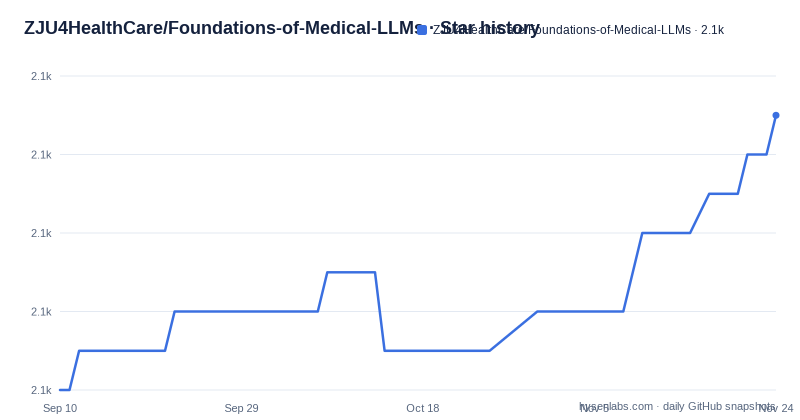
- ZJU4HealthCare/Foundations-of-Medical-LLMs2,135 ★ · +7
| Repository | 2026-09-10 | 2026-11-24 |
|---|---|---|
| ZJU4HealthCare/Foundations-of-Medical-LLMs | 2.1k | 2.1k |
7 Stars in the last 75 days, measured from the daily GitHub snapshot. Compare with other projects
Editorial analysis
Two chapters point at the same PDF
The contents table is the whole index, and it has one clear defect. Chapter thirteen is titled as the reshaping of the patient experience through a lifecycle of intelligent assistance, and chapter fourteen is titled as the life science frontier with large models accelerating drug discovery. Both of those rows link to the same file. The chapter thirteen row points at one document and the chapter fourteen row points at it as well, with the same name, including the space in the middle of it. So a reader who clicks through to the chapter on drug discovery gets the previous chapter's document. Nothing else in the table repeats a target. It is the sort of error that survives because the table was assembled row by row and the second row was copied from the first, and it is worth knowing about before planning to read the book in order.
Four naming conventions across eighteen files
The chapter files are named in four different styles, and the style changes as the numbering goes on. The first six use no separator at all, then the next four switch to a hyphen, then four files switch to a space, and the last four return to a hyphen. The consequence that matters is the two files with a space in the name: a space in a URL has to be encoded, so those links only resolve because the renderer handles it, and any tool that copies them literally, a script, a downloader, an offline mirror, will produce a broken path. The hyphenated ranges are fine. So an offline copy of the book is not one command today, because the naming is not uniform, and the fix is renaming eight files and updating eighteen links. The numbers do add up correctly, which is the one thing that is easy to verify and is right: eighteen rows of chapters across the five parts.
All five part headings link to a different repository
Every part title in the contents table is itself a link, and every one of those five links points somewhere other than where you are. The repository you are reading belongs to one organisation, while all five part titles are linked to an identically named repository under a shorter organisation name, with the same path after it. That is consistent across all five, so it is not a single stale link but a set that was written once and never revisited. What a reader gets, if anything, is the same book from a second place, or a redirect, or a different state of the same files. The practical advice is narrow: use the chapter links, which point into this repository's content directory, and treat the part headings as plain text. It is also a small warning about the provenance of the book as a whole, since the two copies can drift independently and nothing on the page says which is authoritative.
Monthly updates and a paper list per chapter are promised, and the index shows neither
The opening paragraph makes two commitments. The first is cadence: monthly updates, with the authors saying they will take suggestions from the open source community and from experts. The second is a per chapter paper list intended to track the latest progress in the field, which is the more interesting promise because it turns a book into a living index. What the contents table provides is eighteen chapter links and nothing else. There is no paper list column, no linked list, and no separate directory for one in the top level listing, which holds the chapters, a figures directory, the readme in two formats and a licence file. So on the evidence of the page, the tracking mechanism that would justify the monthly cadence is not yet visible, and the page itself has not moved since the last recorded commit on 2026-05-27. Neither promise is broken so much as unfinished, and the readme does invite issues, which is presumably how corrections arrive.
Five parts that run from history to medical general intelligence
The structure is the argument, and it is conventional in a way that makes the book easy to place. Part one covers the history of medical artificial intelligence, a first look at large language models, and the moment the two meet. Part two is the technical foundation: the transformer architecture, then pretraining and fine tuning, then prompt engineering and what the text calls an external brain. Part three turns vertical, covering medical data and how it is prepared, training strategies for a domain-specific model, frontier techniques, and evaluation with benchmarks. Part four is applied clinical and research work, running from clinical decision support through documentation automation and ambient clinical intelligence, to the patient lifecycle, to large models accelerating drug discovery. Part five is the risk chapter and the horizon: hallucinations, data privacy and compliance, ethics and algorithmic bias, and a closing look at multimodal systems and medical general intelligence. Two of the chapter titles use an alchemy metaphor for model training, one for the training process itself and one for data preparation.
A readme in two formats and a macOS metadata file at the root
The top level listing is six entries and two of them are worth a comment. There is a readme in Markdown and a readme in HTML, both committed, which means two rendered versions of the same page have to be kept in step by hand and only one of them is what the hosting service renders. There is also a macOS directory metadata file committed at the root, which is an artefact of browsing the folder in a file manager rather than something anyone intended to publish. The remaining entries are the licence file, the content directory holding the chapter PDFs, and a figures directory. There is no code, no build configuration, no notebook and no issue template, which is what you would expect from a book repository rather than a software one, and it means the PDF files are the product: if a reader wants them in a searchable or accessible format, nothing in this repository provides it.
The licence is a file in the tree and an empty field in the metadata
The hosting service records no licence it could classify for this repository, and the tree contains a licence file. Those two facts sit side by side without any comment explaining the relationship, so a reader has to open the file to know the terms, and a reader who trusts the service's badge instead gets nothing. That is a normal consequence of a hand written licence file whose name the service does not recognise as one of its conventional spellings, rather than a sign of anything deliberate. The readme itself says nothing about licensing beyond the closing section, which is an acknowledgements note thanking readers for suggestions and inviting issues. Contact is a single email address at the university domain, with no other channel offered. For a textbook that asks its readers to file issues and corrections, the licensing question is the one thing a reader should settle before redistributing any of it.
Editorial conclusion
This book suits a reader who wants medical large language models covered in one Chinese volume, from the history of the field through to hallucinations and bias, and who is comfortable with PDFs rather than a searchable web text. Three things to know before you plan to read it end to end. The index links one chapter to the wrong file, and the chapter filenames use four conventions with four of them containing spaces, so download them individually rather than scripting it. The per chapter paper list that the readme promises as the mechanism for tracking new work is not visible in the index, and the page has not been touched since May 2026, so treat the contents as a fixed snapshot rather than a living reference. And read the licence file in the root before redistributing anything, because the hosting metadata records nothing it could classify.
Frequently asked questions
How many chapters does the Foundations of Medical LLMs book have?
Eighteen, grouped into five parts, and each chapter is a separate PDF in the content directory. Three chapters in the first two parts and four in each of the remaining three.
Which chapters cover evaluation, benchmarks and risk?
Evaluation and benchmarks are in the third part, alongside medical data preparation, vertical training strategies and frontier techniques. Risk is the whole of the fifth part: hallucinations, data privacy, security and compliance, medical ethics and algorithmic bias, then a closing look at multimodal systems and medical general intelligence.
How is the Foundations of Medical LLMs book updated?
The readme states monthly updates and a per chapter paper list to track the latest progress in each area. The contents table lists the chapters without any paper list, and the last recorded commit on the main branch is dated 2026-05-27.
Can I download all the chapters as one file?
There is no combined file and no build step; the chapters are eighteen separate PDFs. The filenames use four different conventions, including four files with a space in the name, so a scripted or offline mirror needs to handle the encoding rather than concatenating the links.
What licence applies to the Foundations of Medical LLMs material?
The repository contains a licence file at its root while the hosting metadata records no licence it could classify. The readme does not state terms, so the file itself is the only place the answer appears, and it is worth reading before redistributing the chapters.
Official sources
Add this badge to your README
If you maintain this project, the badge below links readers to this analysis and shows its maintenance status from the daily GitHub snapshot. Paste the markdown into your README; add ?metric=license or ?metric=stars to the image URL for a different field.

[](https://hysenlabs.com/projects/zju4healthcare-foundations-of-medical-llms)Star history chart for your README
[](https://hysenlabs.com/projects/zju4healthcare-foundations-of-medical-llms)Was this useful?